Will AI make your posts sound like everyone else's? What the research on AI sameness actually shows
The worry is that everyone writing with the same AI ends up sounding the same. I read a 2026 meta-analysis and ten of the studies behind the debate. The effect is real but small, it's strongest when you hand the AI the ideas rather than the sentences, and the studies point to a few habits that reduce it.

By Kyle Kirkby
Published | Updated
There's a worry I hear from almost every founder who writes with Claude or ChatGPT. If everyone uses the same few models, won't every post start to sound the same? You can feel it on LinkedIn already: the same three-beat hooks, the same tidy lists, the same confident wrap-up.
Most of what's been written about this repeats the worry and quotes one or two studies as proof. I wanted to know what the evidence actually says, so I read a systematic review and meta-analysis of the question published in August 2026, and ten of the studies behind the debate. That includes the one field study of small-business marketing, which used Italy's 2023 ChatGPT ban as a natural experiment.
The short version: the sameness effect is real, but it's smaller and patchier than the "AI is making everyone identical" posts suggest. It's strongest when you let the AI choose the idea, not when it helps with the sentences. Where it comes from is fairly well understood. And several experiments have tested ways to reduce it, with mixed but useful results.
This is a research summary, not a product pitch. I've kept the Deynix bit short and near the end.
Executive summary
- The effect is real but small on average. Across 19 studies and 61 effect sizes, using generative AI made people's work more alike, with a pooled effect of d = 0.33. That's small by the usual standard, and it held after removing the most influential study (d = 0.25) [1] [2].
- It depends on the job you give the AI. The effect was largest when people used AI to generate ideas for a defined problem (d = 0.70). For writing tasks it was smaller (d = 0.27) and not statistically significant [2]. The risk is in borrowed angles more than borrowed sentences.
- Better individually, more alike collectively. Writers given AI story ideas were rated more creative, especially weaker writers, but their stories ended up more similar to each other [4]. Other studies find the same narrowing of the pool [5] [6].
- The sameness comes from the AI's text, not yours. In a co-writing experiment, the homogenising effect came from the text the model contributed. The points the writers added themselves were no less diverse than without AI [9].
- The one marketing field study points the same way. When ChatGPT was blocked in Italy, Milan restaurants' Instagram posts became less alike, and likes went up. It's an unpublished working paper, so treat it as a signal, not a verdict [7] [8].
- It can be reduced. A step-by-step prompt brought the diversity of GPT-4's ideas close to that of a group of people (similarity 0.255 against 0.243 for people and 0.377 for a basic prompt) [12]. In a small study, feeding writers ideas from ten different AI personas kept their stories as varied as the no-AI group [13]. But in one essay study, prompt and settings tweaks didn't close the gap [6].
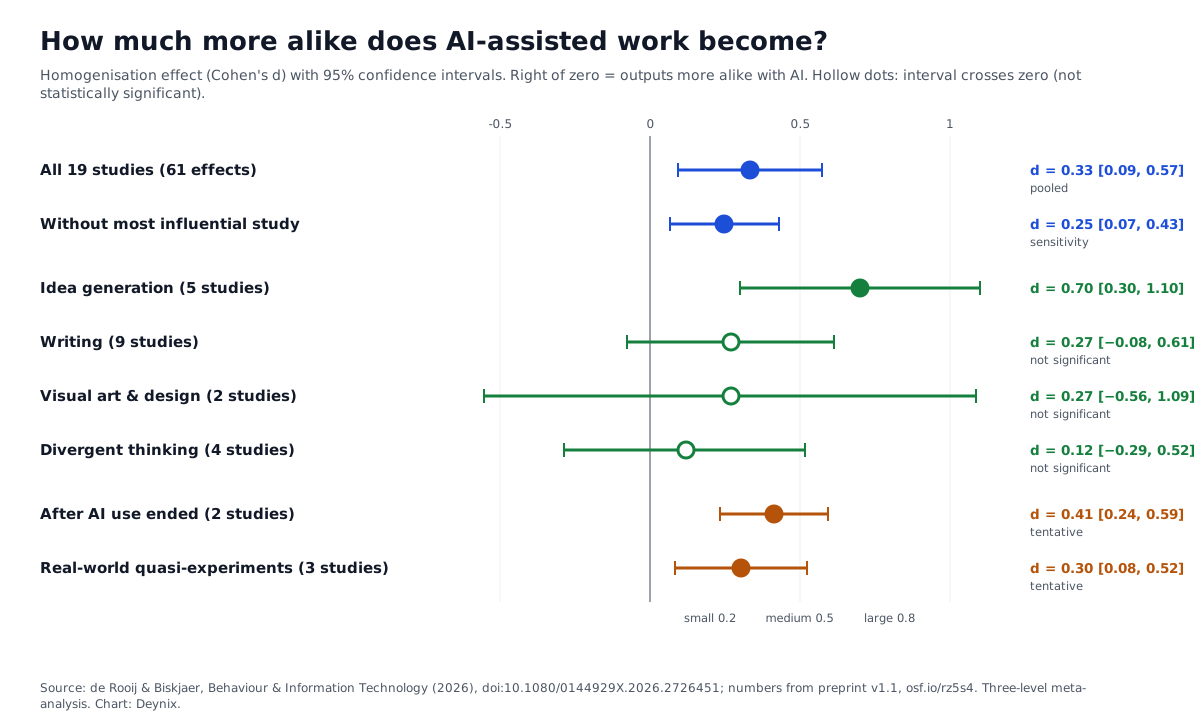
Figure 1. How much more alike AI-assisted work becomes, by type of task. Source: de Rooij and Biskjaer meta-analysis [1], figures from the preprint [2].
Why this question matters for founders now
AI-assisted writing is no longer niche in business communication. A Stanford-led team estimated how much text in several large datasets showed signs of being written with an LLM. By late 2024, they put it at roughly 24% of corporate press releases and 18% of US financial consumer complaints. In job postings, it was just under 10% at small firms, and 10–15% in some roles at small firms founded after 2015 [3]. Those are estimates for the whole population of texts, not a tool that flags individual documents, and the authors suggest reading them as a lower bound, because heavily edited AI text is hard to detect.
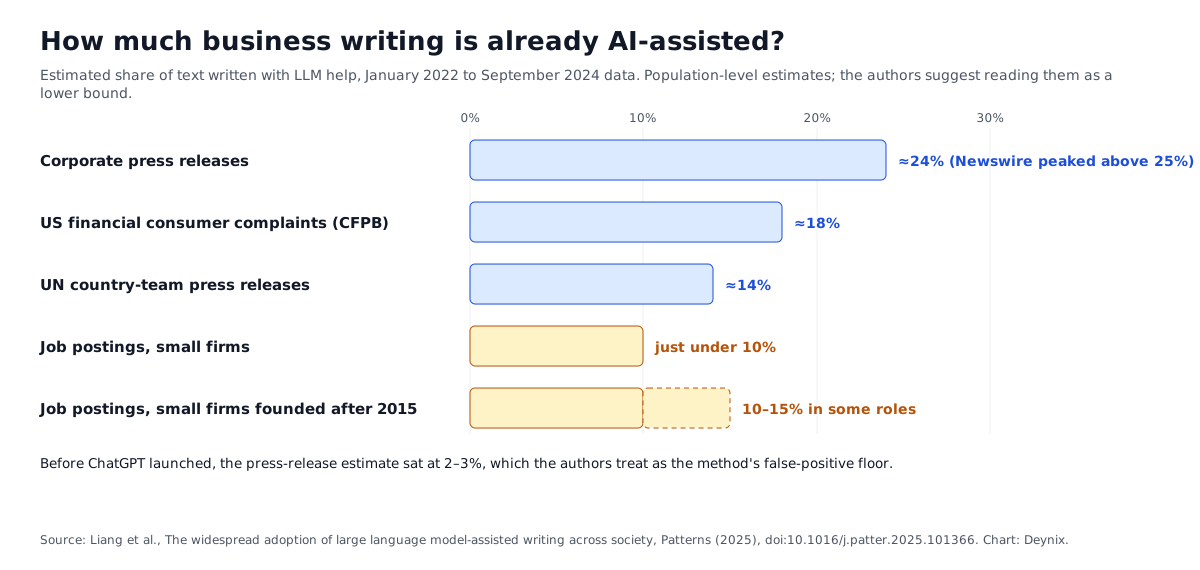
Figure 2. Estimated share of text written with LLM help, late 2024. Population-level estimates, not individual detection. Source: Liang et al. [3].
That last detail matters. Younger, smaller firms adopted fastest [3]. That's the Deynix audience: founders and small teams who use an assistant because they don't have a marketing team. If sameness is a problem, it lands hardest on the people with the least time to fight it.
The other reason it matters is that being different is the whole point of a founder's feed. A post that sounds like any other company's doesn't make anyone remember yours.
Finding 1: the effect is real, but it's small and depends on the task
The best single source is a systematic review and three-level meta-analysis by Alwin de Rooij (Tilburg University) and Michael Mose Biskjaer (Aarhus University), published in Behaviour & Information Technology in August 2026 [1]. They pulled together 19 experiments and quasi-experiments that compared work made with generative AI against work made without it (or before and after AI arrived), and measured how similar the outputs were across people. That gave them 61 effect sizes.
The pooled result was a homogenisation effect of d = 0.334 (95% CI 0.094 to 0.574) [2]. By the usual rule of thumb, that's small. One study had an outsized influence; without it the effect was d = 0.247, still significant. They found no sign that the result was inflated by publication bias. There was a lot of variation between studies, which tells you the effect depends heavily on the setup.
The split by task is the most useful part for founders:
- Idea generation (for example, proposing solutions to a defined problem): d = 0.70, a medium-to-large effect.
- Writing (essays, stories): d = 0.27, positive but not statistically significant (CI −0.078 to 0.613).
- Visual art and design: d = 0.27, not significant, from only two studies.
- Divergent thinking (open tasks like "list unusual uses for a paperclip"): d = 0.12, not significant.
The authors' explanation is that homogenisation is strongest where the problem is tightly framed and the AI's first suggestions anchor everyone in the same place [2]. That's a close match to "write me a LinkedIn post about our launch". The frame is fixed, and everyone asks for roughly the same thing.
Two further results are tentative because they rest on very few studies. The effect showed up after people had stopped using AI (d = 0.41, from two studies), and in real-world before-and-after comparisons, not just labs (d = 0.30, from three studies) [2]. The authors call both provisional, and so should we.
What this means: "AI makes everything identical" overstates it. "Letting AI pick your angles makes you more like everyone else who did the same" is closer to the evidence.
Finding 2: individual work gets better while the pool gets narrower
The study most people cite is by Anil Doshi (UCL) and Oliver Hauser (Exeter), published in Science Advances in 2024 [4]. 293 people each wrote a short eight-sentence story. Some wrote alone, some could get one story idea from GPT-4, and some could get up to five. Then 600 separate evaluators rated the stories without knowing who had AI help.
Stories written with AI ideas were rated more creative, better written and more enjoyable. The gains were biggest for the least creative writers. For them, access to five AI ideas improved rated novelty by 10.7% and usefulness by 11.5%. But the AI-assisted stories were also more similar to each other. They were about 5% more similar to the AI ideas themselves than the no-AI stories were (5.2% for one idea, 5.0% for five), which the authors read as anchoring [4].
Doshi and Hauser describe this as a social dilemma. Each writer is better off using the AI, but together they produce a narrower range of work. For a founder the dilemma is concrete: the AI draft may well be better than what you'd write in ten tired minutes, and also more like what your competitors are posting.
Other teams found the same pattern with different tasks:
- Lennart Meincke, Gideon Nave and Christian Terwiesch (Wharton) re-analysed data from a Nature Human Behaviour study of ChatGPT in brainstorming. ChatGPT made individual ideas more creative and made the pool of ideas less diverse [5].
- Kibum Moon, Adam Green and Kostadin Kushlev compared 2,200 college admissions essays. Each additional human essay added more new ideas to the pool than each additional GPT-4 essay. The gap widened as more essays were added, and adjusting the prompt or the model's settings didn't close it [6].
- In a 36-person study by Barrett Anderson, Jash Hemant Shah and Max Kreminski, people brainstorming with ChatGPT produced more, and more detailed, ideas. Those ideas were less distinct from one person to the next than ideas produced with another creativity tool, and the ChatGPT users felt less responsible for what they came up with [10].
That last detail is easy to skip, but it matters for anyone publishing under their own name. If an idea doesn't feel like yours, you're less likely to push it somewhere unexpected before you post it.
Finding 3: the one marketing field study found the same thing, with a twist
Lab stories and essays are a long way from a café's Instagram. So the most directly relevant study is a working paper by Chaoran Liu, Tong Wang and S. Alex Yang, posted to SSRN in July 2025 [7].
They used Italy's temporary ban on ChatGPT in April 2023 as a natural experiment and looked at the Instagram posts of restaurant businesses in Milan. During the ban, the posts became less similar to each other. According to the paper's abstract, the Milan restaurants saw "relative decreases of 15%, 12%, 2%, and 3% in lexical, syntactic, semantic, and language style similarity" compared with a comparison group. The ban also had a positive effect on engagement, "an approximate 3.5% increase in average like counts", even though restaurants posted less often and wrote shorter posts. The lead author's London Business School doctoral thesis, deposited in August 2026, describes the same result. It reports "a significant decline in lexical, syntactic, semantic, and stylistic similarity during the ban period", and says this "correlates with increased consumer engagement" [8].
Read this with care. It's a working paper, not peer reviewed. SSRN blocked my access to the full text, so the numbers above come from the abstract as quoted word for word in an independent write-up, and match a second summary. I haven't checked them against the paper's tables. The engagement result comes from one short, unusual period in one city. Still, the shape of the result matters. The biggest shift was in wording and sentence structure. The meaning of the posts changed much less (2%). That fits the meta-analysis: in everyday business writing, AI seems to standardise how things are said more than what is said.
The cultural version of this effect is worth knowing too. In a CHI 2025 experiment, 118 people from India and the US wrote about their own culture, with and without AI autocomplete [11]. With AI suggestions, the Indian participants' writing drifted towards American styles. They also accepted more suggestions (25% against 19% for the Americans) and had to modify them more. If your brand's voice is regional, or simply unusual, expect the AI to pull it towards the middle.
Finding 4: the sameness comes from the model's words, not yours
The most practical result comes from Vishakh Padmakumar and He He at NYU, presented at ICLR 2024 [9]. They had people write argumentative essays three ways: alone, with a base language model (GPT-3), or with a model tuned on human feedback (InstructGPT, the kind of tuning behind today's chat assistants).
Writing with InstructGPT made essays from different people significantly more alike and reduced lexical and content diversity. Writing with the base GPT-3 did not. When they traced where the sameness came from, it was the text InstructGPT contributed. The key points the writers added themselves were just as diverse as in essays written without AI.
Two things follow from this. First, the polish that makes a chat assistant pleasant to use seems to cost some variety. The authors suggest that tuning models on human feedback "might come at the cost of more homogeneous and less diverse content" [9]. Second, your own contributions keep their own shape. The more of the substance in a post that comes from you, the less of the shared default it carries.
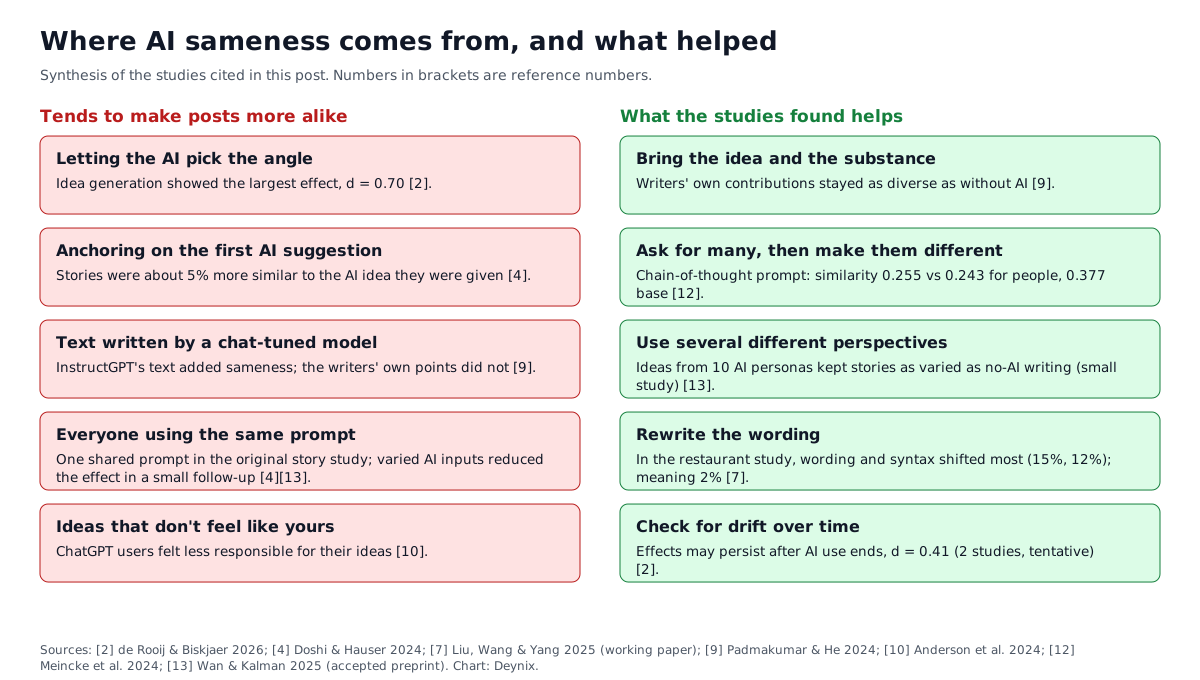
Figure 3. Where AI sameness comes from, and what the studies found helps. Sources: [2], [4], [7], [9], [10], [12], [13].
Finding 5: you can reduce it, but prompt tricks aren't a cure
If sameness comes from the model's defaults, can you prompt around them? Three studies tested versions of this.
Step-by-step prompting helped a lot, for ideas. Lennart Meincke, Ethan Mollick and Christian Terwiesch asked GPT-4 for product ideas for college students under $50, using 35 different prompts, and measured how alike the ideas were [12]. Lower similarity means a more varied set. Ideas from groups of students scored 0.243. A basic prompt scored 0.377. Asking it to think like Steve Jobs barely helped (0.368), and giving it creativity techniques from a Harvard Business Review article made things slightly worse (0.387). The winner was a chain-of-thought prompt: list 100 short ideas first, then make them bolder and more different from each other, then write them up. It scored 0.255, close to the students, and raised the estimated number of unique ideas from about 3,700 to 4,700.
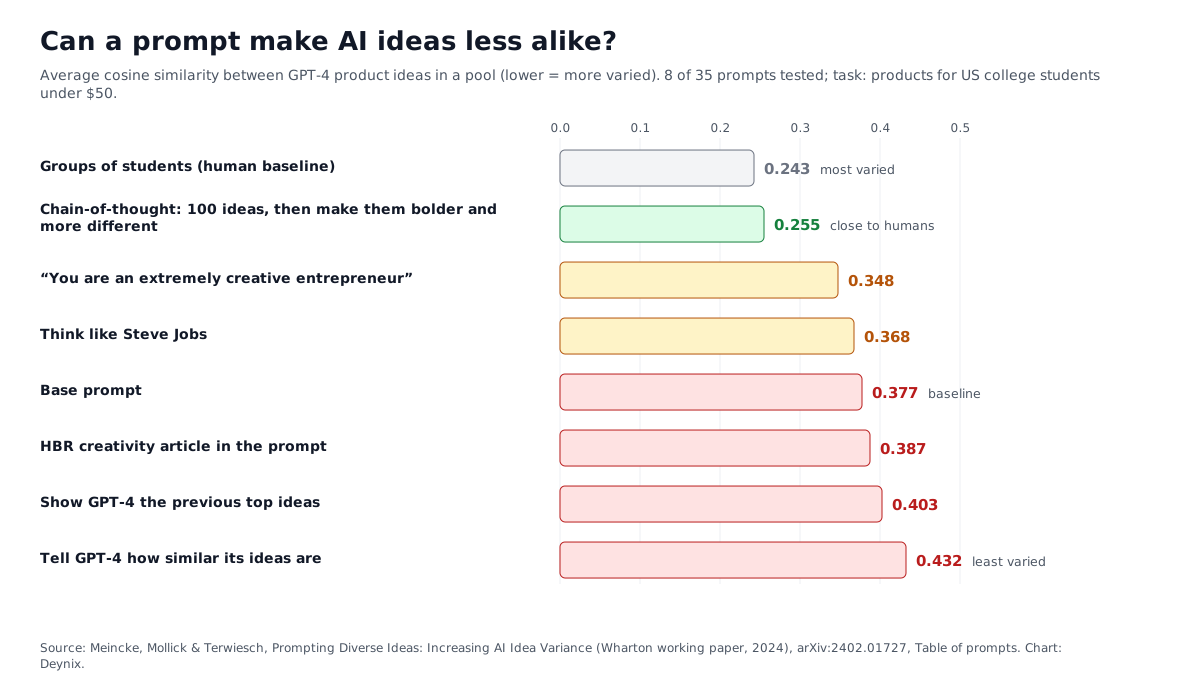
Figure 4. How alike GPT-4's product ideas were under different prompts (lower is more varied). Selected prompts from 35 tested. Source: Meincke, Mollick and Terwiesch [12].
Several different perspectives helped too, in a small study. Yun Wan and Yoram Kalman re-ran the Doshi and Hauser story experiment with one change [13]. Instead of every writer getting ideas from the same prompt, the ideas came from a pool of 300 plots generated by ten deliberately different AI personas. With 97 UK participants, stories written with these ideas were no more alike than stories written without AI, with some evidence that the one-idea group was more varied. The authors say the study is underpowered (they estimate about 165 participants would be needed for a firm answer). I read the preprint, which the authors say has been accepted by a journal. Their conclusion is worth repeating: the trade-off "may emerge from uniform deployment practices rather than from an inherent limitation of GenAI".
But tweaks don't always work. In the 2,200-essay study, adjusting the prompt and the model's settings didn't close the diversity gap between GPT-4 and human essays [6]. That study compared essays written entirely by AI with essays written by people, which isn't how most founders work. It's a fair warning, though, that you can't prompt your way out of the problem entirely when the AI writes the whole thing.
My reading of these three together: prompting changes the range of options the model gives you. It doesn't supply the thing that makes a post yours, which is something only you know.
Methodology
Question. Does writing with AI assistants make people's output more alike, how large is the effect, and what reduces it? I focused on evidence relevant to short marketing and social content by founders and small teams.
Search. On 23 October 2026, I searched the web, OpenAlex and Crossref for homogenisation, content diversity and generative AI. I started with the de Rooij and Biskjaer meta-analysis [1] and followed its included studies, and the citations of the most-cited ones, for marketing-specific work.
What I read. Full text for the meta-analysis (the open preprint, version 1.1 [2], whose headline numbers match the published abstract and article summary), and for Doshi and Hauser, Liang et al., Padmakumar and He, Anderson et al., Agarwal et al., Meincke et al. (2024) and Wan and Kalman. Abstract and publisher pages only for Moon et al. and Meincke et al. (2025). For Liu, Wang and Yang, I read the SSRN record, the abstract as quoted in two independent write-ups and the lead author's thesis abstract, but not the full paper.
Checks. Every number in this post was re-checked against the source text in a separate pass, and each key claim was cross-checked against at least one other source: the published abstract, an independent summary, or another paper that cites the same result. Where a number comes from a single source, the text says so.
Charts. All four charts were drawn in code from numbers in the cited papers. Nothing was estimated from images. I haven't re-analysed any raw data for this post.
Limits. Most studies use stories, essays and brainstorming with US or UK participants, often students or online panels, and mostly GPT-3 to GPT-4-era models. Only one study looks at real small-business marketing posts, and it's unpublished. No study I found measures sameness in founders' LinkedIn or X posts, or tests whether giving an assistant a brand's own material changes the effect.
What this means in practice
None of this says "stop using AI". The individual gains are real, especially on days when you'd otherwise post nothing. It says to be deliberate about which part of the job you hand over.
1. Bring the idea yourself. The biggest effect in the meta-analysis was in idea generation [2]. "What should I post this week?" is the riskiest question to hand over completely. Start from something only you have: a customer call, a number from your dashboard, a mistake you made last month. Then ask the AI to help shape it.
2. If you do ask for ideas, ask for many and different. Ask for a long list first, then ask the assistant to make the ideas more different from each other, then pick one [12]. Don't take the first suggestion. That's where anchoring happens [4].
3. Keep the substance in your own words. The sameness came from the model's text, not the writer's [9]. Write the claim, the example and the opinion yourself, even roughly, and let the AI tidy around them.
4. Edit the wording, not just the facts. In the restaurant study, the biggest shifts were in vocabulary and sentence structure [7]. When you review a draft, look for the phrases you'd never say out loud, and rewrite them.
5. Vary the input, not just the prompt. One shared prompt was the problem in Doshi and Hauser's setup. Varied perspectives reduced it in Wan and Kalman's [13]. Different source material, such as your notes, your old posts or your customers' words, gives the model something other than the average to work from.
6. Watch the drift over time. The evidence that sameness persists after you stop using AI is thin (two studies) but consistent [2]. Every few months, put five recent posts next to five you wrote before you used an assistant. If you can't tell which are which, or the new ones sound like your competitors, that's worth fixing.
7. Protect what's unusual about you. If your voice is regional, technical, blunt or odd, expect the AI to sand it down [11]. Write that part yourself.
Where Deynix fits. Deynix drafts from brand knowledge built from your site, your Notion and the thoughts you save, and you can read and correct what it believes about your brand. Every draft lands in Review, where you keep, edit or reject it before anything is posted [14]. We built it that way because we think the brand material and the review step are where a founder's voice gets in. To be clear, though, no study I found has tested whether giving an assistant a brand's own material reduces sameness. The habits above matter whichever tool you use.
What we don't know yet
- Whether any of this holds for short social posts. The lab evidence is mostly stories and essays. The field evidence is one working paper on restaurants in one city.
- Whether newer models are better or worse. Most studies used GPT-3.5 or GPT-4-era models. The meta-analysis authors list "model diversity" and "prompting conventions" among the factors that aren't yet understood [2].
- Whether audiences notice. The restaurant study links less sameness with more likes [7], but no study I found shows that readers penalise a specific post for sounding generic.
- Whether brand context helps. That's the obvious next experiment, and nobody has published it.
If you know of a study that tests any of these, I'd like to read it.
References
- de Rooij, A. and Biskjaer, M. M. (2026). Does generative AI make us think alike? A systematic review and meta-analysis of homogenisation effects in human–AI co-creation. Behaviour & Information Technology. https://doi.org/10.1080/0144929X.2026.2726451
- de Rooij, A. and Biskjaer, M. M. (2026). Preprint of reference 1, version 1.1, PsyArXiv/OSF. https://osf.io/rz5s4
- Liang, W., Zhang, Y., Codreanu, M. A., Wang, J., Cao, H. and Zou, J. (2025). The widespread adoption of large language model-assisted writing across society. Patterns. https://doi.org/10.1016/j.patter.2025.101366
- Doshi, A. R. and Hauser, O. P. (2024). Generative AI enhances individual creativity but reduces the collective diversity of novel content. Science Advances, 10(28), eadn5290. https://doi.org/10.1126/sciadv.adn5290
- Meincke, L., Nave, G. and Terwiesch, C. (2025). ChatGPT decreases idea diversity in brainstorming. Nature Human Behaviour, 9, 1107–1109. https://doi.org/10.1038/s41562-025-02173-x
- Moon, K., Green, A. E. and Kushlev, K. (2025). Homogenizing effect of large language models (LLMs) on creative diversity: An empirical comparison of human and ChatGPT writing. Computers in Human Behavior: Artificial Humans. https://doi.org/10.1016/j.chbah.2025.100207
- Liu, C., Wang, T. and Yang, S. A. (2025). Generative AI and content homogenization: The case of digital marketing. SSRN working paper. https://doi.org/10.2139/ssrn.5367123
- Liu, C. (2025). The impacts of blockchain and Gen AI on marketing dynamics. Doctoral thesis, London Business School. https://lbsresearch.london.edu/id/eprint/4504/
- Padmakumar, V. and He, H. (2024). Does writing with language models reduce content diversity? ICLR 2024. https://arxiv.org/abs/2309.05196
- Anderson, B. R., Shah, J. H. and Kreminski, M. (2024). Homogenization effects of large language models on human creative ideation. Creativity and Cognition 2024. https://doi.org/10.1145/3635636.3656204
- Agarwal, D., Naaman, M. and Vashistha, A. (2025). AI suggestions homogenize writing toward Western styles and diminish cultural nuances. CHI 2025. https://doi.org/10.1145/3706598.3713564
- Meincke, L., Mollick, E. and Terwiesch, C. (2024). Prompting diverse ideas: Increasing AI idea variance. Wharton working paper. https://arxiv.org/abs/2402.01727
- Wan, Y. and Kalman, Y. M. (2025). Diverse AI personas can mitigate the homogenization effect in human-AI collaborative ideation. arXiv preprint, accepted in Computers in Human Behavior: Artificial Humans. https://arxiv.org/abs/2504.13868
- Deynix. Homepage, accessed 23 October 2026. https://www.deynix.com
Browse all updates in News.