Your AI drafts, you approve: do your social posts need an AI label in the EU?
The EU's AI labelling rules have applied since 2 August 2026. I read the Commission's final guidance against the posts founders actually publish. Most marketing posts need no label, but news takes, health claims and realistic AI images can, and clicking approve doesn't count as review.

By Kyle Kirkby
Published | Updated
I build a tool that drafts social posts with AI and holds every one for approval, so I keep getting asked one question: now that the EU's AI labelling rules apply, do founders have to put an "AI" label on posts their assistant wrote?
The rules have applied since 2 August 2026. The European Commission published its guidance on them on 20 July 2026, and that guidance includes worked examples [1]. What I'd read so far was either a list of platform toggles or a legal memo for newsrooms, so I read the guidance, the Act and the five platforms' help pages and mapped them onto what founders actually post. Everything below links to where it came from, and where I'm interpreting rather than quoting, I say so.
This isn't legal advice. It's a careful read of public documents.
Executive summary
- Most AI-assisted marketing text doesn't need a label under EU law. The labelling duty for text only covers posts that inform the public on matters of public interest. The Commission gives "a company's advertisement or product descriptions" as an example of text outside that duty [1].
- Two common kinds of founder post can fall inside it. One is a take on policy, economic or scientific news. The other is any promotional post with a health, consumer safety or sustainability claim, which the Commission expressly carves back in [1].
- Approving a draft isn't automatically "human review". To skip the label, someone with relevant knowledge has to check the substance, fact-checking it at a minimum. A "cursory editorial approval without substantive engagement" doesn't count, and any AI edits after sign-off cancel the exemption [1].
- For images, the test is realism, not whether AI was involved. A text card or an obviously impossible scene isn't a deep fake. A realistic AI avatar of your CEO is, and so is an AI product shot that makes the product look better than it is [1].
- When a label is required, people have to be able to see it. Hidden metadata doesn't count, and neither does a label "hidden under layers of menu options" [1]. On very large platforms you can use the platform's own labelling tool if it shows a clear label, but X and Bluesky document no such tool.
- The UK and US have no general AI-label law for this. The tests there are about not misleading people [19], plus a US ban on fake reviews and testimonials, including AI-generated ones [20].
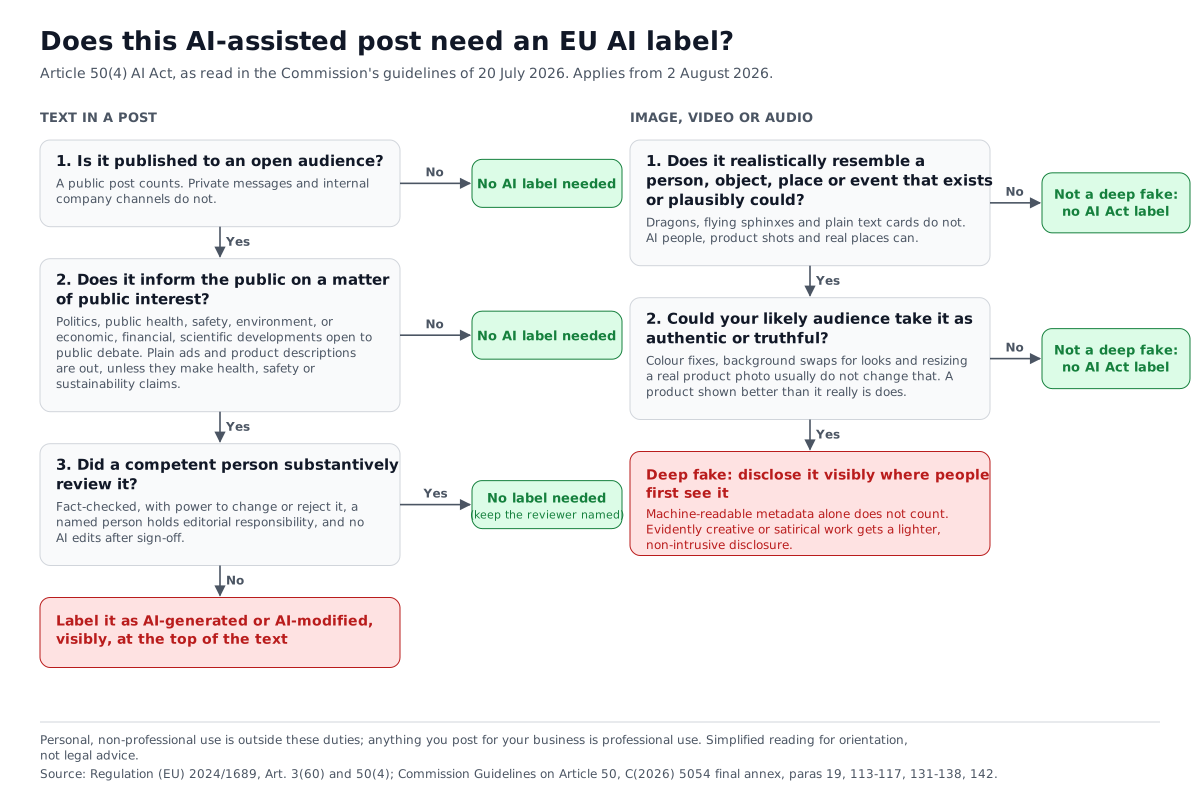
Figure 1. My simplified reading of Article 50(4). Source: AI Act Art. 3(60) and 50(4) [2]; Commission guidelines, paras 19, 113 to 117, 131 to 138 and 142 [1].
What changed on 2 August 2026
The EU AI Act entered into force on 1 August 2024 and has been switching on in stages [1]. Article 50, the transparency article, applies from 2 August 2026 [3]. This year's "Digital Omnibus" amendments pushed back the high-risk AI rules but left most of Article 50 on its original date [26]. The only grace period applies to AI providers that were already on the market before 2 August: they have until 2 December 2026 to add machine-readable marks to their outputs. Nothing in it is aimed at the people publishing posts [1].
Article 50 splits the work in two:
- Providers, the companies that make AI tools such as ChatGPT or an image generator, have to mark outputs in a machine-readable way so they can be detected as AI-generated [2].
- Deployers, the businesses that use those tools, have to disclose two things: deep fakes, and AI-generated or AI-manipulated text "published with the purpose of informing the public on matters of public interest" [2].
If you use an assistant to draft your business's posts, you're the deployer.
Three documents now sit on top of the Act. The guidelines (Commission document C(2026) 5054, 20 July 2026) explain the concepts and give examples [1]. The FAQ (24 July 2026) summarises them [3]. The Code of Practice on Transparency of AI-generated Content was finalised on 10 June 2026 [5]. It's voluntary, but the Commission and the AI Board have confirmed it's an adequate way to show you comply. The Commission says about 190 organisations had signed it by the end of July 2026 [5].
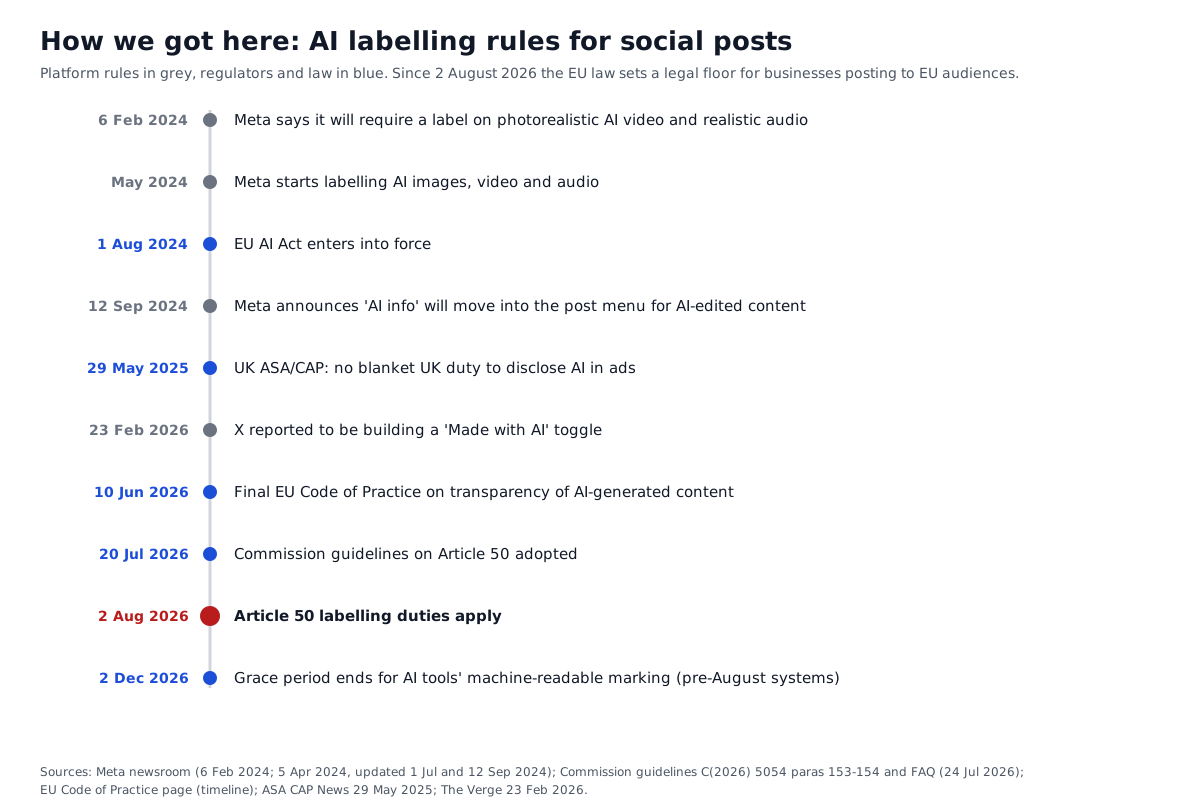
Figure 2. Platforms set their own AI-label rules first. The EU law now sets a minimum. Sources: Meta [9][10]; Commission guidelines [1] and FAQ [3]; Code of Practice page [5]; ASA/CAP [19]; The Verge [16].
Does this apply to you?
Probably, if you post for a business and any of your audience is in the EU.
Personal use is exempt. Business use isn't. The Act doesn't cover people using AI "in the course of a purely personal, non-professional activity". The Commission explains that any activity through which someone "gain[s] an economic benefit on a regular basis" or is involved in a business, trade or freelance activity counts as professional [1]. Posting about your own company counts as professional. Posting AI holiday photos to friends doesn't.
Being outside the EU doesn't take you out of scope. The Act covers deployers based outside the EU "where the output produced by the AI system is used in the Union" [6]. The guidelines say this applies when the deployer foresees its output being used in the EU, "including by posting deep fakes on the globally accessible internet" [1]. I'm a UK founder, and my posts on X and LinkedIn are visible across the EU, so I'm treating this as applying to me.
The penalties exist but scale down for small companies. Breaking Article 50 can cost up to €15 million or 3% of worldwide turnover, whichever is higher. For SMEs and start-ups the cap is whichever is lower [7]. National market surveillance authorities do most of the enforcing, and anyone can file a complaint [3]. I haven't found any published Article 50 enforcement decision yet.
Old posts are fine. Posts published before 2 August 2026 don't have to be labelled retroactively. A text written before that date but published after it does count [1].
Finding 1: most marketing text is out of scope, but not all of it
For text, the duty only applies when three conditions are all met. The text has to be published, it has to be meant to inform the public, and it has to be about a matter of public interest [1].
Published means available to "an indeterminate, fairly large number" of readers. Private correspondence and internal company channels are excluded [1]. A public post on X, LinkedIn, Facebook, Instagram or Bluesky is published. A DM isn't.
Informing the public means communicating "knowledge, opinions or facts". Short texts that don't materially do that are out [1].
Public interest is the condition that does the sorting. The Commission lists politics and democratic processes, public administration, justice, fundamental rights, public security, public health, environmental protection, consumer safety, and "any economic, financial, political, scientific, or cultural development that may be relevant subject of public debate" [1] [3].
In-scope examples include an AI summary of a news article on a town council decision and an AI storm warning on a weather institute's social profile. Out-of-scope examples include AI fantasy novels and, most usefully for founders:
"AI-manipulated text that is part of a company's advertisement or product descriptions (not including any claims related to e.g. health, consumer safety or sustainability)." [1]
So the everyday posts ("we shipped dark mode", "January offer: half price for four weeks", "here's how our studio's 6am class works") look like advertising or product description. On the Commission's own example, they don't need an AI label under the Act.
Two kinds of founder post fall on the other side.
- Promotional posts with health, safety or sustainability claims. The bracket in that example deliberately carves these back in. A gym's "this protocol lowers blood pressure" post, a supplement claim or a "carbon-neutral shipping" line can bring a promotional post into scope.
- Takes on the news. Newsjacking, meaning a quick take on a regulation, a funding round, an interest-rate move or a scientific result, is a standard founder tactic. Those topics are on the Commission's list ("economic, financial, political, scientific… development"). The guidelines don't give a social-media newsjacking example. My reading is that an AI-drafted take on a public policy or economic story is much closer to the in-scope examples than to an ad.
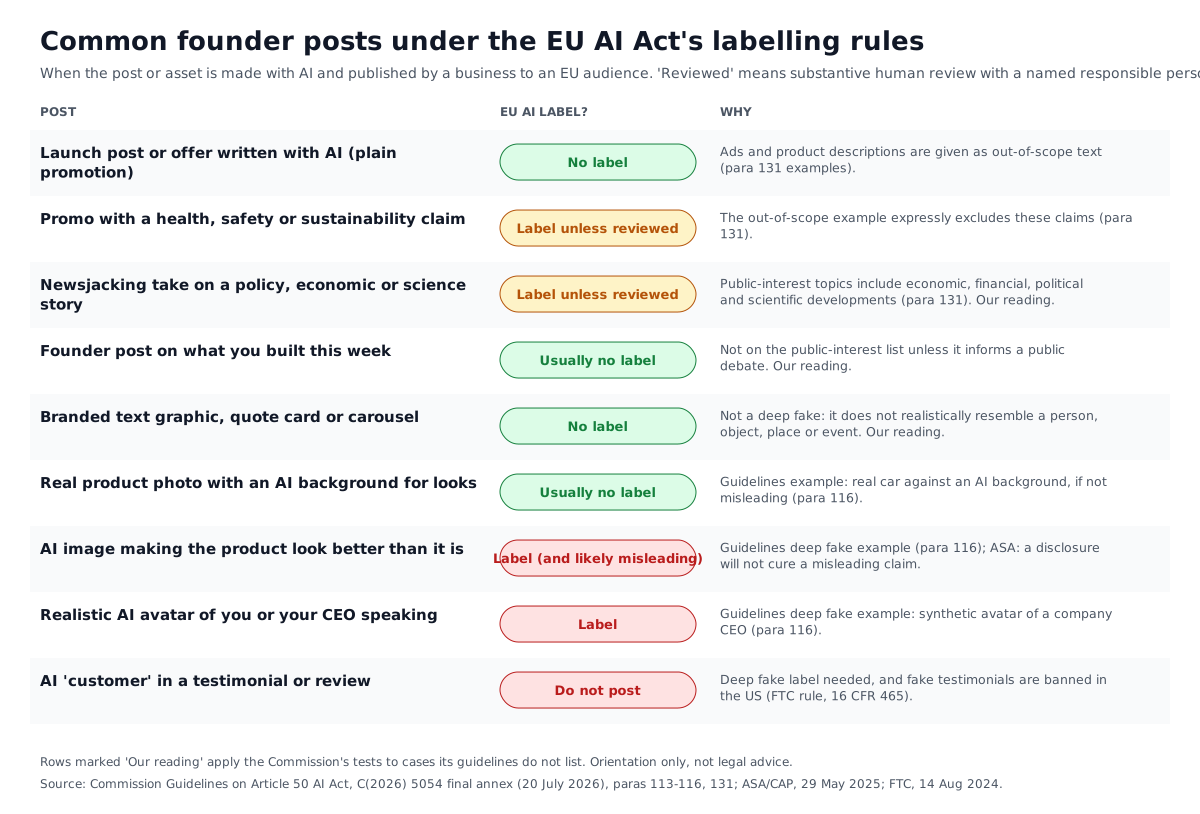
Figure 3. Typical founder posts, sorted using the Commission's tests and examples. Rows marked "our reading" are my interpretation. Sources: Commission guidelines paras 113 to 116 and 131 [1]; ASA/CAP [19]; FTC [20].
Finding 2: an approval click isn't "human review"
In-scope text can still go out unlabelled if two things are both true. It "has undergone a process of human review or editorial control", and "a natural or legal person holds editorial responsibility for the publication" [2]. For anyone with an approval queue, this is the important part, and the guidelines are more demanding than "a human pressed the button".
The guidelines define human review as "the deliberate examination of the substance of the content by one or more natural persons possessing relevant knowledge and professional judgement". They add: "Fact-checking the accuracy of the content is a minimum requirement that should be part of that review" [1].
They also list what doesn't count:
"Superficial, solely formal or procedural checks (e.g. spell-checking or grammatical correction), the mere existence of an editorial policy, automated review processes or cursory editorial approval without substantive engagement by the human reviewer or the editorial entity, cannot fulfil the conditions." [1]
One of the "does not qualify" examples is AI articles "reviewed and edited by another AI system" where a human only does a grammar check [1]. Having one model check another model's draft doesn't count as human review.
Two more details are easy to miss.
- Edits after approval reset the clock. "Any substantive AI intervention occurring after the human review or editorial control process has taken place will therefore cause the exception to become void" [1]. If you approve a draft and then ask the assistant to "make it punchier" before it goes out, the version that's published hasn't been reviewed.
- A named person has to be responsible. Editorial responsibility means "the ultimate legal responsibility over the publication". The identity and contact details of that person or role "should be made publicly available on an easily findable location", for example in your site's legal information [1]. The Code of Practice asks signatories for the same thing: a named person, role and contact details, plus a short description of how review works. It explicitly doesn't require you to "document individual instances of human review" for each post [4].
For a two-person team: if a post is in scope, the approver must have checked the facts, be able to change or reject it, and be named publicly as responsible. If you can't say all three, add the label.
Finding 3: for images, the test is realism, not AI involvement
The image and video rule covers deep fakes: AI-generated or manipulated image, audio or video that "resembles existing persons, objects, places, entities or events and would falsely appear to a person to be authentic or truthful" [3]. This isn't limited to public-interest topics. A deep fake in an ad needs a label too.
The guidelines are specific in both directions [1].
Counted as deep fakes:
- "AI-generated video featuring a realistic synthetic avatar of a company CEO congratulating employees"
- "An AI-generated image of a product in advertisement or packaging that can affect the audience's perception and mislead as to the actual product appearance"
- an AI-generated celebrity influencer in an advertising context
Not counted as deep fakes:
- "AI-generated video of mice arguing in human language over the best type of cheese as part of an advertisement campaign"
- "A real product (e.g., a car) shown in an advertisement against an AI-generated background … as long as the ad is not likely to mislead"
- content depicting things that "defy the laws of nature or physics", such as dragons or elephants driving cars
Minor edits usually don't make something a deep fake either. Colour correction, background replacement "for clearly aesthetic purposes", and re-scaling product images are given as likely to have only a minor impact on whether people see the content as authentic [1].
Two cautions. Photorealism "is not determinative": judge it against your likely audience, including people with lower AI literacy [1]. And there's a lighter regime for "evidently artistic, creative, satirical [or] fictional" work, but it's interpreted strictly. It excludes content whose nature is "exclusively informative or commercial", and one of its "does not qualify" examples is a realistic synthetic influencer testing a sponsored product [1].
My reading for founders: branded quote cards, headline graphics, carousels with text, and stylised illustrations don't realistically resemble a real person or event, so they aren't deep fakes. AI people, AI "customers" and AI product shots are where you need to think.
Finding 4: when a label is required, people have to see it
If something is in scope, the disclosure has to be "clear and distinguishable" and given "at the latest at the time of the first interaction or exposure" [2]. For feeds, the Commission's own example of first exposure is "when encountering AI-manipulated deep fakes when scrolling on social media" [1].
Three consequences:
- Metadata isn't enough. Deployers "cannot rely on the machine-readable marking embedded in the content by the provider", because people can't see it [1]. OpenAI says the same about its own Content Credentials and watermarks: they "do not replace visible labels" [18].
- Hidden labels don't count. Information isn't clear and distinguishable if it can be easily missed, "e.g. only included as part of a manual or hidden under layers of menu options on an online interface" [1].
- There's a standard icon. The Code's EU icon uses the capital letters "AI", with variants reading "AI + GENERATED" and "AI + MODIFIED". User testing found the versions with a text word "performed significantly better" for noticeability and clarity [4]. For text, the Code suggests putting the label "above or at the top of the text, near the headline" [4].
On a social post, that means a first line or a visible line on the image, such as "AI-generated image". Not after "see more", not in the hashtags.
A side note: the Code asks AI providers to watermark generated text longer than 200 tokens [4], and OpenAI says ChatGPT text in the EU now carries an invisible watermark [18]. None of the five networks says it reads these, so labelling doesn't change. But "nobody can tell" is less true than it was.
Finding 5: platform tools help, unevenly
There's a useful clause in the guidelines for anyone posting to big networks. Where a very large online platform (VLOP) gives users a labelling tool that provides "a clear and distinguishable disclosure of the AI-origin", deployers "can rely on such tools to fulfil their transparency obligation" within that platform [1]. Facebook, Instagram, LinkedIn and X are all designated VLOPs. Bluesky isn't on the Commission's list, which was last updated on 15 October 2026 [8].
Here's what each network's own pages say.
Facebook and Instagram. Meta says it requires people to use its disclosure tool "when they post organic content with a photorealistic video or realistic-sounding audio that was digitally created or altered, and we may apply penalties if they fail to do so" [9]. It also labels images automatically when it detects C2PA or IPTC "AI generated" signals from tools such as those made by Google, OpenAI, Microsoft and Adobe [9]. The labels now read "AI info" [11]. One detail matters here. In September 2024 Meta said that for content it detects as only "modified or edited by AI tools", it would move the "AI info" label "to the post's menu" [10]. A label in a menu is hard to square with the Commission's warning about disclosures "hidden under layers of menu options". For an AI-edited image that counts as a deep fake, put the disclosure in the caption too.
LinkedIn. Media signed with C2PA Content Credentials shows a "CR" icon, and in select countries you can self-attest that media was made with AI. LinkedIn says "it's not yet possible to identify and label all AI-generated and modified content" [12]. Its policies remove synthetic or manipulated media that misrepresents real events "without clear disclosure", and it "generally requires" disclosure even for artistic or humorous synthetic media [13]. For text, LinkedIn recommends telling people "if you've relied heavily on AI", and reminds you that "you are ultimately responsible for everything you post" [14]. Whether a small CR icon is "clear and distinguishable" is untested, so I'd treat it as a bonus.
X. X's Authenticity policy bans sharing synthetic or manipulated media as authentic where it "can result in widespread confusion on public issues, impact public safety, or cause serious harm", including "media depicting a real person that has been fabricated or simulated", and it allows "sharing manipulated or out-of-context media in non-deceptive ways" [15]. I couldn't find any post-level AI disclosure tool in X's help pages. The Verge reported in February 2026 that X was building a "Made with AI" toggle [16]. Until X documents one, the disclosure on X is whatever you write in the post or put on the image.
Bluesky. Bluesky's Community Guidelines (last updated 19 September 2025) have no AI-labelling rule. They ban content "intended to misrepresent, defraud, trick, deceive, or mislead" and "undisclosed commercial content, sponsored material, or advertising" [17]. Bluesky isn't a VLOP, so the platform-tool route doesn't apply, and if a label is needed you write it yourself.
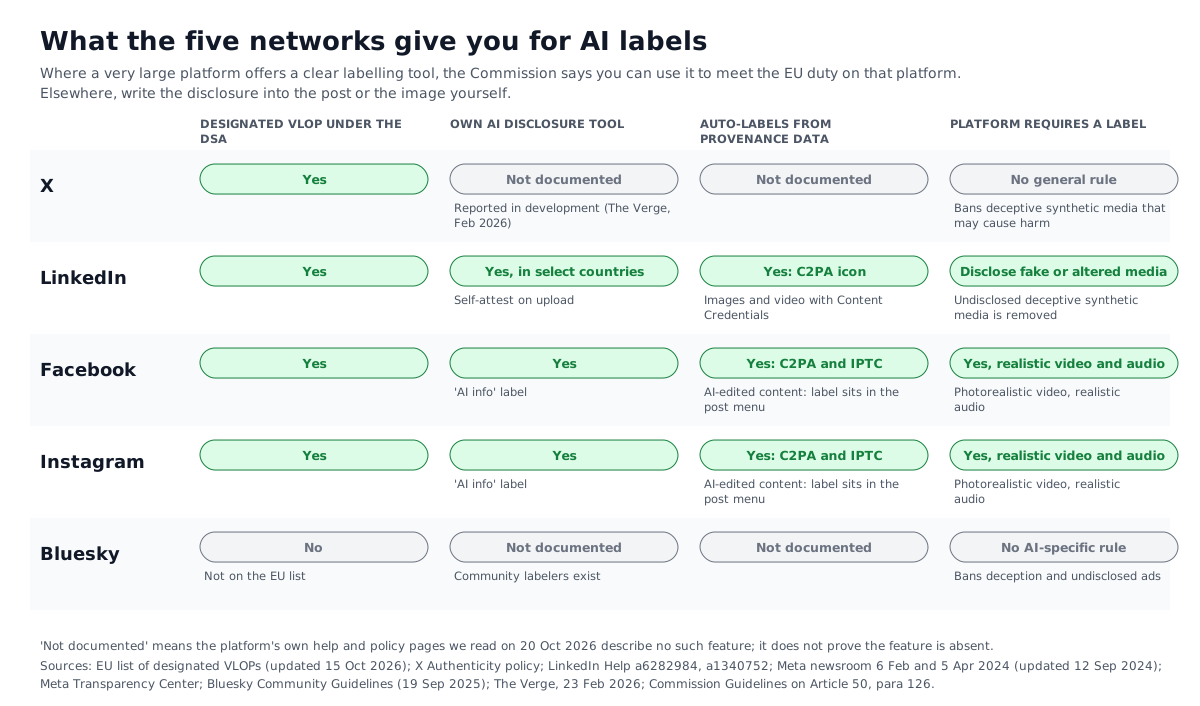
Figure 4. "Not documented" means I couldn't find it on the platform's own pages on 20 October 2026. It doesn't prove the feature is absent. Sources: EU VLOP list [8]; Meta [9][10][11]; LinkedIn [12][13]; X [15]; The Verge [16]; Bluesky [17]; Commission guidelines para 126 [1].
Finding 6: in the UK and US, the test is whether you mislead people
UK. The Advertising Standards Authority says the CAP and BCAP codes "do not contain AI-specific rules", and that "there is no blanket legal requirement in the UK to disclose the use of AI in ads." The existing rules still apply to AI content. It also warns that "disclosure alone is very unlikely to mitigate the harm caused by a fundamentally misleading message". Its example is an AI image of a cosmetic product's effect that doesn't reflect real results [19]. Its test is worth borrowing anywhere: would the audience be misled without a disclosure, and does the disclosure clarify the message or contradict it?
US. There's no federal rule requiring AI labels on marketing posts. But the FTC's rule on consumer reviews and testimonials prohibits reviews and testimonials that "misrepresent that they are by someone who does not exist, such as AI-generated fake reviews", or by someone who didn't actually use the product [20] [21]. An AI "happy customer" isn't a labelling question. Don't post it.
Should you label posts when you don't have to?
This is the question I get after "do I have to?", and the research doesn't support labelling everything "just to be safe".
- Across thirteen experiments, people who disclosed using AI for a task were trusted less than people who didn't. That held "regardless of whether disclosure is voluntary or mandatory". The penalty was smaller than when someone else exposed the AI use [22].
- A 2026 Journal of Consumer Research paper looked at engagement on TikTok after its AI-disclosure policy began and ran eight preregistered experiments. It found that AI-content disclosures "reduce consumer engagement". The cause wasn't worries about quality but reduced "parasocial connection" with the creator, partly because the label signals less effort. Disclosures "that signal greater effort can mitigate reductions in engagement" [23] [24].
So there's a real cost to labelling, and a real cost to being caught not labelling: the trust penalty is bigger when your AI use is exposed by someone else [22]. I take three things from that.
- Label when the law or a platform requires it. Don't skip it to protect reach.
- Don't put a blanket "made with AI" tag on routine marketing posts that the law treats as out of scope.
- When you do disclose, be specific about the human part, for example "My take, drafted with an AI assistant and fact-checked by me". The JCR finding suggests effort-signalling wording costs less.
Neither study tested founder posts on LinkedIn or X, so treat the direction as informative and the size of the effect as unknown for your audience.
Methodology
Question selection. Platform-by-platform label roundups already exist, such as Zolyp's table checked on 15 October 2026 [25], and so do law-firm summaries of Article 50 [26]. I didn't find one that applies the July 2026 guidelines' examples to founder post types on these five networks, or that checks the VLOP-tool clause against how each platform displays its labels.
Sources. I used primary documents wherever they exist: the AI Act, the Commission's guidelines, FAQ and Code of Practice, each platform's own help or policy pages, the ASA, the FTC, and two peer-reviewed papers. X's help pages block automated fetching, so I read X's Authenticity policy from an Internet Archive snapshot dated 14 October 2026. Every key claim was checked against a second source where one exists. Where the only source is the Commission's own guidance, as with the newer interpretive points, I quote it directly.
Interpretation. Figure 3 sorts common post types using the Commission's tests and examples. Where the guidelines don't list a case (newsjacking takes, build updates, text graphics), I've marked it "our reading". Those rows are my judgement, not the Commission's.
What I didn't do. I didn't post test content to measure how platforms label it, and I didn't use any non-public data. I left out engagement figures from secondary write-ups of the JCR paper because I couldn't match them to the paper's abstract.
Practical takeaways
A checklist for founders and small teams posting with an AI assistant:
- Sort before you write. Plain promotion, product news and offers usually don't need an EU AI label. Health, safety or sustainability claims, and takes on policy, economic or science news, do unless they've been substantively reviewed.
- Make your review real for in-scope posts. Check every factual claim against a source, and be someone who can rewrite or bin the draft. "Looks fine, approve" isn't review.
- Approve the final version. If the AI changes anything substantive after you approve, review it again before it goes out.
- Name who's responsible. Put a line in your site's legal or about page saying who holds editorial responsibility for your posts and how to contact them.
- Test images for realism, not for AI. Text cards and stylised art: no label. AI people, AI product shots and realistic AI scenes: label them.
- Make the label visible. Use the first line of the caption or a visible mark on the image. Don't rely on metadata or a menu, and don't push it below "see more".
- Use platform tools where they're clear, and write it yourself where they're not. On X and Bluesky, and for Meta's menu-only label, that means writing it into the post.
- Don't fake people. AI testimonials and AI "customers" are banned in the US and misleading under UK advertising rules, whatever label you add.
- Keep disclosures specific. If you disclose voluntarily, describe the human effort as well as the AI.
Where Deynix fits
Deynix is a review queue at heart: "Every draft lands in Review, whoever wrote it. It schedules only once you approve." That holds whether the draft came from the app, Claude or ChatGPT, and the brand knowledge it drafts from is something "you can inspect and correct".
I want to be precise about what that does and doesn't do. A review step is where the substantive human review the EU guidelines describe can happen: you read the claims, check the facts, rewrite or reject. But clicking approve isn't the same as doing that review, and Deynix doesn't make anyone compliant by itself. It doesn't add AI labels for you either. If a post needs one, write it into the copy before you approve. Deynix's branded images are built from your colours, logo and handle around a headline or screenshot, so on my reading of the guidelines most of them aren't deep fakes. Anything with an AI-generated person or a realistic AI scene is your call, and you should label it.
The habit I'd keep: approve the version that goes out, fact-check anything that touches the news, and when unsure, label it in plain words.
References
- European Commission, Annex to C(2026) 5054 final: Guidelines on the implementation of the transparency obligations for certain AI systems under Article 50 of the AI Act, 20 July 2026. ec.europa.eu (landing page: digital-strategy.ec.europa.eu)
- Regulation (EU) 2024/1689 (AI Act), Article 50, consolidated text as at 27 July 2026, AI Act Service Desk. ai-act-service-desk.ec.europa.eu
- European Commission, "Transparency obligations under Article 50 of the AI Act" (FAQ), 24 July 2026. digital-strategy.ec.europa.eu
- Code of Practice on Transparency of AI-Generated Content, final version, 2026. ec.europa.eu
- European Commission, "Code of Practice on Transparency of AI-generated Content" (timeline and signatories). digital-strategy.ec.europa.eu
- AI Act, Article 2 (Scope), AI Act Service Desk. ai-act-service-desk.ec.europa.eu
- AI Act, Article 99 (Penalties), AI Act Service Desk. ai-act-service-desk.ec.europa.eu
- European Commission, "Supervision of the designated very large online platforms and search engines under DSA", updated 15 October 2026. digital-strategy.ec.europa.eu
- Meta, "Labeling AI-Generated Images on Facebook, Instagram and Threads", 6 February 2024. about.fb.com
- Meta, "Our Approach to Labeling AI-Generated Content and Manipulated Media", 5 April 2024, updated 1 July and 12 September 2024. about.fb.com
- Meta Transparency Center, "Labeling AI Content", updated 19 February 2025. transparency.meta.com
- LinkedIn Help, "Content credentials". linkedin.com
- LinkedIn Help, "False or misleading content". linkedin.com
- LinkedIn Help, "Best practices for content created with the help of AI". linkedin.com
- X Help Center, "Authenticity" (read via Internet Archive snapshot of 14 October 2026). help.x.com (archived copy)
- Jess Weatherbed, "X is working on 'Made with AI' labels", The Verge, 23 February 2026. theverge.com
- Bluesky, Community Guidelines, last updated 19 September 2025. bsky.social
- OpenAI Help Center, "Provenance signals in OpenAI-generated content". help.openai.com
- ASA/CAP, "Disclosure of AI in Advertising: Striking the Balance Between Creativity and Responsibility", CAP News, 29 May 2025. asa.org.uk
- US Federal Trade Commission, "Federal Trade Commission Announces Final Rule Banning Fake Reviews and Testimonials", 14 August 2024. ftc.gov
- 16 CFR Part 465, Rule on the Use of Consumer Reviews and Testimonials, eCFR. ecfr.gov
- Oliver Schilke and Martin Reimann, "The transparency dilemma: How AI disclosure erodes trust", Organizational Behavior and Human Decision Processes, May 2025. sciencedirect.com
- Stephan Carney, Ignacio Riveros and Stephanie M. Tully, "Made With AI: Consumer Engagement With Social Media Containing AI Disclosures", Journal of Consumer Research, 2026. doi.org/10.1093/jcr/ucag013
- Chana R. Schoenberger, "How AI Disclosures Disconnect", Stanford Social Innovation Review, Fall 2026. ssir.org
- Zolyp, "AI Content Labels on Social Media: Rules by Platform", checked 15 October 2026. zolyp.com
- Jones Walker LLP, "Yes, August 2 Still Matters: The EU Approved a High-Risk AI Delay, but Most Transparency Obligations Remain". joneswalker.com
Browse all updates in News.