Two years of the FTC's fake-review rule: what it means for AI testimonials, avatars and bots
The US ban on fake reviews and testimonials turns two today. I read every FTC complaint that cites it, plus the first ten warning letters. AI shows up in only one case, and the rule targets the lie, not the tool. Here's where AI-written quotes, avatar ads and bot engagement cross the line.

By Kyle Kirkby
Published | Updated
The US Federal Trade Commission's rule against fake reviews and testimonials took effect on 21 October 2024, two years ago today [3]. When it was announced, the headline was that it banned AI-generated fake reviews [1]. Since then, almost every founder I talk to has started using AI somewhere near that line. Assistants draft customer quotes for landing pages. Avatar tools turn a script into a "customer" video. Agents write replies to reviews.
So I wanted to know two things. What has the FTC actually enforced in two years? And which everyday AI marketing habits does the rule really cover? Law firms have written good alerts on the enforcement, and the FTC has a staff Q&A. What I couldn't find was the enforcement record read for AI involvement, provision by provision, and set next to the things small teams do with AI every week. So I read the complaints.
This isn't legal advice. It's a careful read of public documents, and where I'm interpreting rather than quoting, I say so.
Executive summary
- Four FTC cases have alleged rule violations in two years, and all four are old-fashioned fakes. Employees posing as customers, paid five-star reviews, staff testimonials passed off as customer results, and Uber drivers paid to review a service they never used [7] [13] [16] [18].
- AI appears once. In the TruHeight case, a contractor ran about 176 bot profiles on Facebook and Instagram, and told the founders the comments were "being generated through ChatGPT". The FTC charged that part as general deception under the FTC Act, not under the rule [13].
- The rule targets the lie, not the tool. The FTC narrowed the rule so it wouldn't ban virtual influencers [2]. Its staff say there's "no blanket prohibition" on AI avatars [4]. In December 2025 it also scrapped an order that had banned the AI writing tool Rytr from generating reviews [11].
- Small businesses are in scope. The first ten warning letters went to six property managers, three personal injury law firms and an accounting firm. The incentives named were as small as $10 coffee gift cards [10].
- The money is real. Knowing violations can cost up to $53,088 each, a figure the FTC kept for 2026 [19]. In TruHeight, the rule was the only legal basis for the monetary award [20].
- Where AI marketing crosses the line: quotes nobody gave, AI faces presented as real customers without a disclosure, AI-written reviews from staff or family, and bot engagement. Drafting your own posts, tidying a real customer's words without changing what they mean, and drafting review replies you approve are all fine.
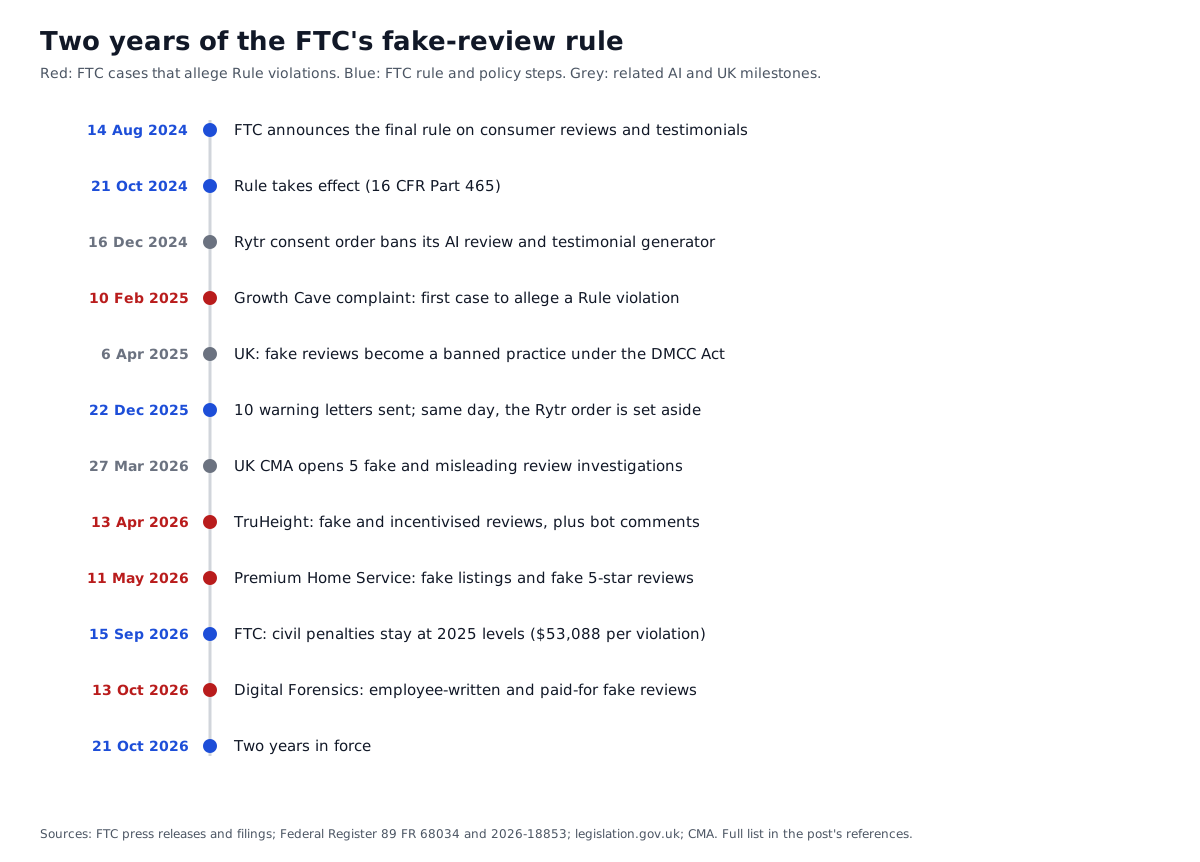
Figure 1. Two years of the rule, with related AI and UK milestones. Sources: FTC press releases and filings [1, 6, 8, 9, 11, 12, 15, 17]; Federal Register [2, 19]; DMCC Act [23]; CMA [26].
What the rule covers, in one minute
The rule is 16 CFR Part 465, the "Rule on the Use of Consumer Reviews and Testimonials" [3]. It applies to any "business", which the rule defines as anyone who sells products or services, so a solo founder counts. Its main provisions:
- §465.2, fake or false reviews and testimonials. A business can't write, create or sell a review or testimonial that materially misrepresents that the reviewer exists, that they used the product, or what their experience was. It also can't buy such reviews, or spread such testimonials, if it "knew or should have known" they were false.
- §465.4, incentives tied to sentiment. You can't pay or reward people for reviews on condition that they're positive (or negative).
- §465.5, insider reviews. Officers, managers and staff need a clear disclosure when they review or give testimonials about their own business.
- §465.6, company-controlled "independent" review sites.
- §465.7, review suppression, such as groundless legal threats, intimidation, or hiding negative reviews while implying you show them all.
- §465.8, fake indicators of social media influence. That means buying or selling followers, views, likes and similar metrics that come from bots, fake accounts or hijacked accounts.
Two definitions matter for AI. A "consumer review" lives on a site or platform built to show reviews. A "consumer testimonial" is any advertising message people are likely to read as a customer's real experience, and that includes images and likenesses, not only words [3]. So a quote on your landing page or a "customer" video in an ad counts as a testimonial, however it was made.
The FTC was explicit about AI when it published the rule: "AI-generated reviews are covered by the final rule" [2]. The rule itself doesn't mention AI, though. Every test is about whether a person, an experience or an opinion has been misrepresented, not about which tool wrote the words.
There's also no private right of action. Customers and competitors can't sue you under the rule. Enforcement is up to the FTC [4].
Finding 1: four cases in two years, and all four are human fakes
I searched the FTC's press releases and case filings for complaints that cite the rule, then read each complaint's counts. DLA Piper's alerts of December 2025 and July 2026 give the same list up to July [21] [20]. One case has been filed since. That makes four:
- Growth Cave (filed February 2025, settled January 2026). It was mainly a business-opportunity case. According to the complaint, four "clients" quoted with results like "$23,000 in one month" were in fact Growth Cave employees. The same four testimonials were then replayed in videos for a follow-on programme, Apex Mind, without disclosing that the speakers worked for Growth Cave or Apex Mind. That replay is the rule count: §465.5(b)(1), undisclosed insider testimonials [7]. The settlements carry judgments of $48,597,538, partly suspended because the defendants couldn't pay [8].
- TruHeight (announced April 2026, final order July 2026). A children's height-supplement brand. The FTC alleged its site carried "several thousand" five-star reviews, many of them written by employees, and that it offered free or discounted products for five-star reviews. The rule counts are §465.2(a) and §465.4 [13]. The order sets a $4 million judgment, suspended once $750,000 is paid [14].
- Premium Home Service (filed May 2026, pending). The FTC and Illinois allege the company created thousands of online profiles for home-repair firms that didn't exist, then propped them up with fabricated five-star reviews from staff, relatives and SEO contractors. The rule counts are §465.2(a), (b) and (c) [15] [16].
- Digital Forensics (filed 6 October 2026, announced 13 October). A "sextortion assistance" company that the FTC says took at least $60 million from victims. The complaint says its "5 out of 5 stars based on 3542 user reviews" rating rested on reviews written by its own India-based staff. It also alleges the company paid Uber drivers to post Google reviews, and made customers post positive reviews before they'd received any service. The rule counts are §465.2(a) and (b) [17] [18].
Two patterns stand out. First, none of these was mainly a reviews case. Each was a wider fraud or false-claims case, and the rule was added on top. DLA Piper notes that in TruHeight the rule was "the only legal basis for the monetary award", and in Premium Home Service it's the only basis for possible money [20]. My reading is that the rule has become the FTC's way to get money out of cases that involve fake reviews.
Second, half the rule hasn't been used yet. No complaint has alleged §465.6 (fake independent review sites), §465.7 (suppression) or §465.8 (fake social metrics). That's true even though Digital Forensics is accused of suppressing negative reviews and TruHeight bought bot accounts.
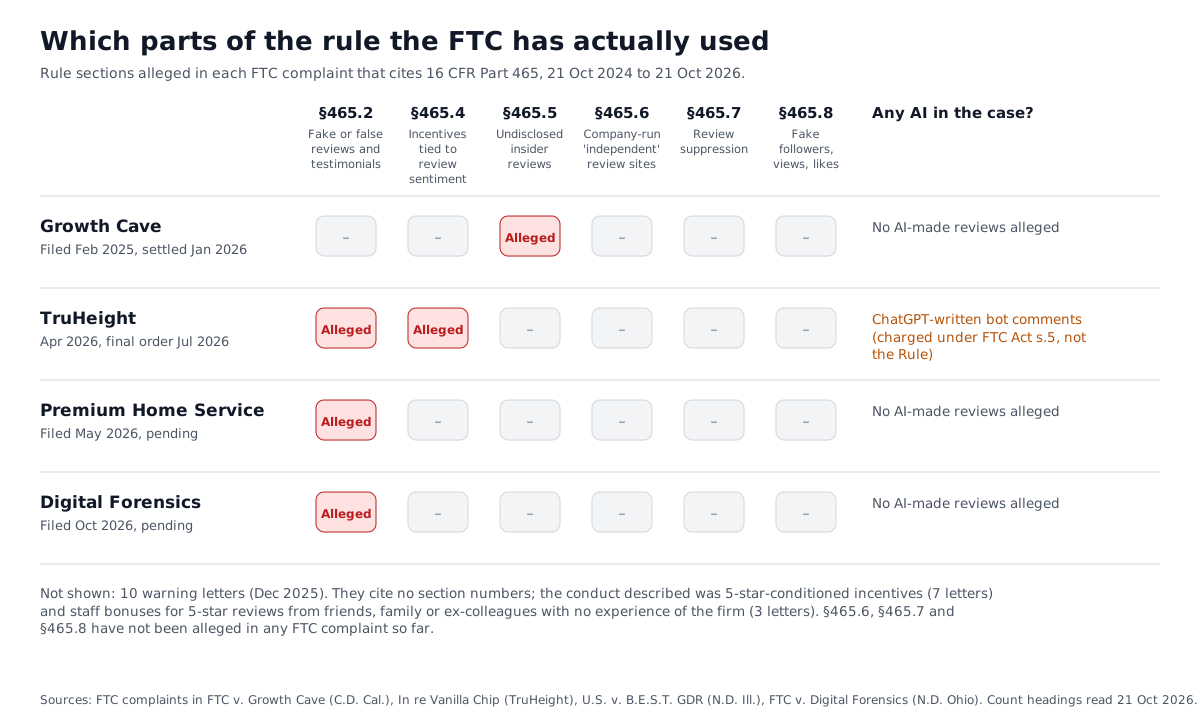
Figure 2. Rule sections alleged in each FTC complaint that cites Part 465. Built from the count headings in each complaint [7, 13, 16, 18].
Finding 2: AI shows up once, and it's a bot farm
The only AI in the two-year record is in TruHeight, and it isn't the use most people worry about. According to the complaint, TruHeight bought "approximately 176 Facebook and Instagram profiles" that posed as real users but were "software-automated bots", posting "fake, software-generated comments" on its pages [13].
The complaint quotes the emails, and they're worth reading as a picture of how this goes wrong. In October 2023 a co-founder told the contractor that "we had almost 50 of the bots suspended last week and the bots are not sounding or looking like real people". The contractor replied that "comments are being generated through ChatGPT", that "we can control the output through good prompts but there's an upper limit to it", and that only "15 comments out of 100" were being flagged [13]. The FTC's own press release describes the same bot profiles [12].
The bot comments fed a general deception count under the FTC Act. The rule counts point to the website reviews and the incentives instead. That's my reading of which paragraphs each count cites [13], and the timing explains it: the bot work began in 2023, before the rule existed. So no FTC case has yet charged AI-generated content under the rule itself.
None of this means AI fakes are safe. It means the FTC has gone after the cases where it can prove a lie about who a reviewer is, and so far those lies have been told by people. The rule covers the AI version in exactly the same terms.
Finding 3: the rule targets the lie, not the tool
Three FTC decisions show where the line sits.
Virtual influencers were carved out on purpose. The draft rule covered reviews and testimonials by someone who doesn't exist. Commenters warned that this could catch harmless speech, and the FTC agreed the wording "could be interpreted to prohibit other potentially non-deceptive speech, such as the use of virtual influencers". It limited the final §465.2 to material misrepresentations [2]. An obviously computer-made brand character isn't lying about existing.
AI avatars aren't banned, but fake testimonials from them are. FTC staff answer this directly, naming TikTok's Symphony Avatars: "The rule has no blanket prohibition on the use of AI-generated avatars in marketing." An AI stock avatar isn't giving a "consumer review", but its use "might be considered a 'testimonial'", and that is prohibited "only if the underlying testimonials were fake or false." Staff add that avatars can still be deceptive under the wider FTC Act, citing the Endorsement Guides. They also say it would violate the rule to use a celebrity's avatar without permission to praise a product, if people would think the celebrity really gave the testimonial [4].
A tool that can write reviews isn't the offence. In December 2024 the FTC had banned Rytr, an AI writing assistant, from offering any service that generates consumer reviews or testimonials. On 22 December 2025 it reopened and set aside that order. It said the complaint's facts didn't show a violation, and the ban "unduly burdens AI innovation". In the words of the Bureau of Consumer Protection's director: "Condemning a technology or service simply because it potentially could be used in a problematic manner is inconsistent with the law" [11].
Taken together, the FTC won't police the tool. It will police whoever uses the tool to invent a customer.
Finding 4: small, local businesses got the first warning letters
On 22 December 2025, the same day as the Rytr decision, FTC staff sent warning letters to ten companies [9]. The FTC didn't name them at the time. The letters were later released under a freedom-of-information request (FOIA 2026-00567) [10]. I read all ten. The release is a scanned PDF, so I ran it through OCR and checked each recipient and the conduct described. My count matches DLA Piper's and Near Media's [20] [22].
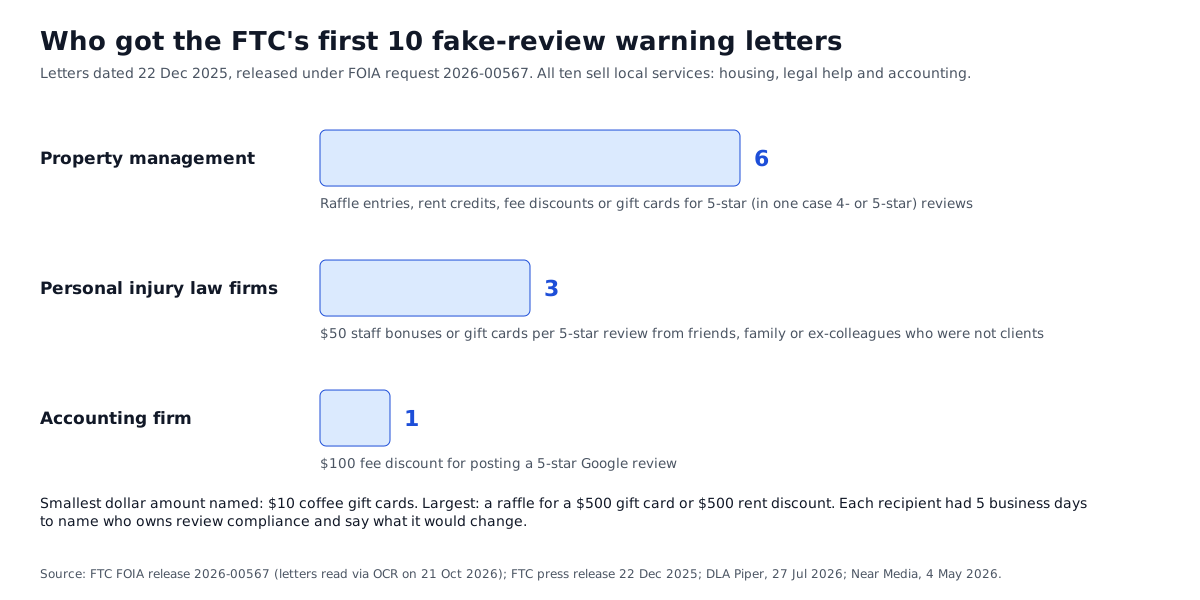
Figure 3. Recipients of the FTC's first ten rule warning letters, by sector, with the conduct each letter describes. Source: FTC FOIA release 2026-00567 [10]; counts match [20] and [22].
The conduct was mundane. Property managers gave raffle entries, rent credits, lease-fee discounts or gift cards (as little as $10 at Starbucks) for five-star reviews. In one case the condition was a four- or five-star review. Three law firms paid staff $50 per five-star review collected from friends, family or former co-workers "who were not clients of the firm". An accounting firm gave a $100 fee discount for a five-star Google review [10].
Each letter says it "does not reflect a formal determination" of a violation. Each asks the business to stop, remove problem reviews where it can, and reply within five business days naming who is responsible for review compliance and what will change. The letters warn that further reports could lead to a federal lawsuit and civil penalties "of up to $53,088 per violation" [10].
Why does a letter matter? Civil penalties under the rule need a "knowing" violation [4]. Once you've had a letter, it's hard to claim you didn't know. The $53,088 cap is the 2025 inflation-adjusted figure, and the FTC confirmed on 15 September 2026 that it won't change in 2026, because the US government shutdown meant October 2025 inflation data was never produced [19].
None of these businesses was a tech company, and none used AI as far as the letters say. Founders should still take note: this is the FTC's model of a rule breach at small scale, and swapping a gift card for an AI-written review doesn't change the analysis.
Finding 5: where everyday AI marketing crosses the line
The rule works alongside the FTC's Endorsement Guides (16 CFR Part 255), which explain how the general ban on deception applies to endorsements [5]. Three provisions in the Guides matter for AI:
- Rewording is allowed, but distortion isn't. An ad "need not present an endorser's message in the exact words of the endorser unless the advertisement represents that it is presenting the endorser's exact words, such as through the use of quotation marks". It "may not be presented out of context or reworded so as to distort" the endorser's opinion or experience (§255.1(b)).
- Swapping the face can be deceptive. "The use of an endorsement with the image or likeness of a person other than the actual endorser is deceptive if it misrepresents a material attribute of the endorser" (§255.1(g)).
- "Real customer" ads need real customers, or a disclosure. Ads presenting endorsements by what are represented as actual consumers should use actual consumers "or clearly and conspicuously disclose that the persons in such advertisements are not actual consumers" (§255.2(c)).
FTC staff add a line that reads as if it was written for AI drafting: "a business shouldn't provide the text for a testimonial without a reasonable basis to conclude that the text is truthful about the testimonialist's experience" [4].
Figure 4 applies these tests to the AI moves I see most. The green, amber and red ratings are my reading, not the FTC's.
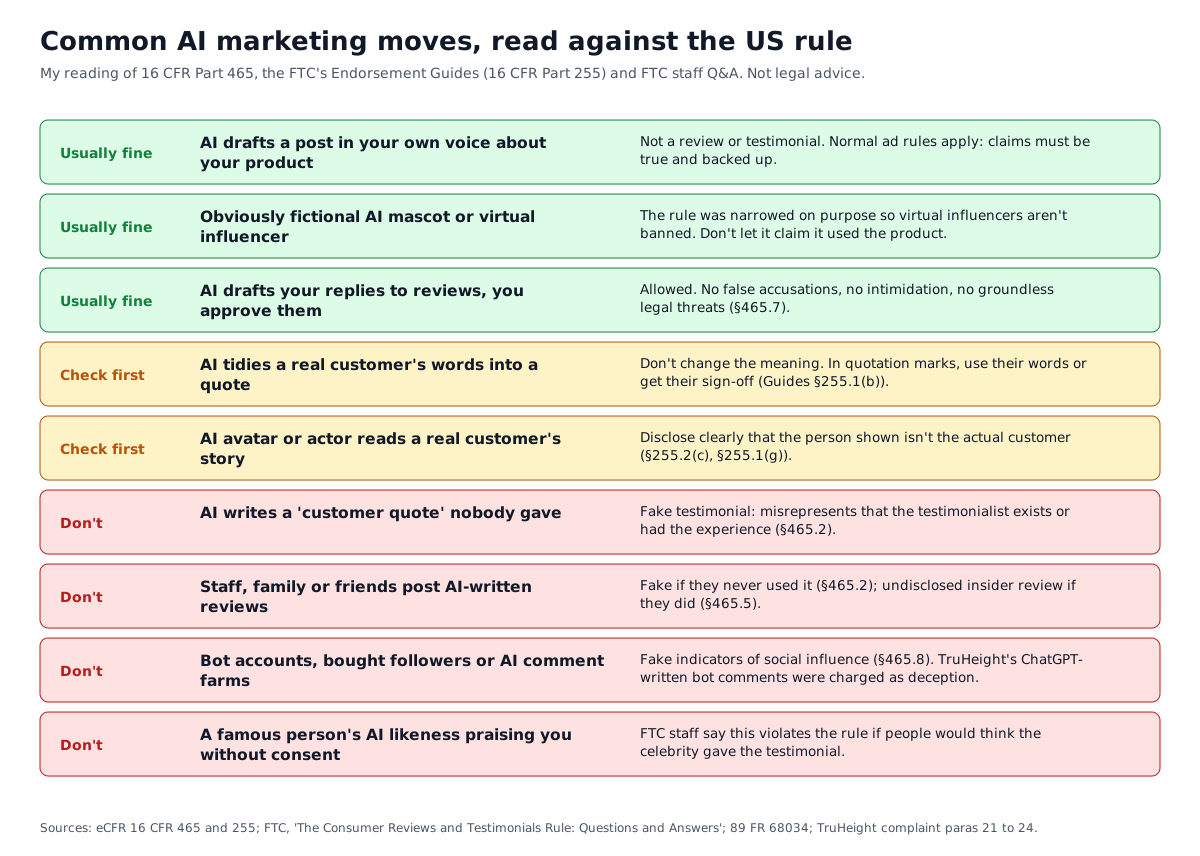
Figure 4. My reading of common AI marketing practices against Part 465 [3], the Endorsement Guides [5] and FTC staff Q&A [4]. Not legal advice.
A few cases deserve more than a row in the chart.
"Polish this testimonial." This is the most common one, and it's mostly fine. If a customer emails "honestly saved me hours every week, the scheduling is great", an assistant can tidy it into a sentence for your site. Don't add a number they didn't give, a feature they didn't mention or enthusiasm they didn't show. If you present it in quotation marks as their words, use their words or send them the edit to approve. The test is §255.1(b): reworded is fine, distorted isn't.
"Write me five testimonials for the landing page." This is the clear red line. If no customer said it, a quote with a name, a face or even just "a customer" attached misrepresents that the testimonialist exists or had that experience. That's §465.2(a), and the business that "writes or creates" it is liable [3]. The FTC's warning that a business shouldn't provide testimonial text without a reasonable basis applies directly.
AI "UGC" video ads. An avatar saying "I tried this and my skin cleared up in a week" is presented as a customer's experience. If it's a real customer's story read by an avatar or actor, the Guides call for a clear disclosure that the person shown isn't the actual customer (§255.2(c)). If the story itself is invented, it's a fake testimonial however good the rendering is. The disclosure standard is strict. The Guides say that on social media a disclosure "should be unavoidable" [5], and the rule's own definition adds that one you have to click or hover to see doesn't count [3]. Staff also warn that a platform's built-in disclosure tool may not be enough on its own [4].
AI-drafted review replies. Replying to reviews is fine, and so is asking a happy customer to update a review. What §465.7 bans is a reply that makes a false accusation about the reviewer, intimidates them, or threatens groundless legal action to get a review removed [3] [4]. An assistant told to "push back hard" on a one-star review can drift into that. Read replies before they go out.
Bots and engagement pods. §465.8 bans buying fake followers, views, likes and comments that you "knew or should have known" were fake, when they misrepresent your influence for a commercial purpose [3]. It hasn't been charged yet, but TruHeight shows how the FTC treats AI comment farms anyway: as deception.
If you also sell in the UK
UK law got here separately, and its wording is broader. Since 6 April 2025, submitting or commissioning a fake consumer review, or one that hides the fact it was incentivised, has been a banned practice under the Digital Markets, Competition and Consumers Act 2024. The Act says "'writing' includes creating by any means", and it also covers publishing reviews in a misleading way [23]. The CMA's guidance gives "Buying reviews which look like they have been written by individual consumers but have in fact been generated by software applications (such as bots)" as an example of a banned practice. It also tells review publishers to correct "AI-generated review summaries" that rely on banned reviews [24].
The CMA can now decide cases itself and fine up to 10% of global turnover [25]. On 27 March 2026 it announced five fake and misleading review investigations, into Autotrader, Feefo, Dignity, Just Eat and Pasta Evangelists. In its consumer tips it warned that "fake reviews can now sound fluent, polished and highly convincing" because of AI [26]. The CMA's case pages were updated on 28 September 2026 to say the investigations are ongoing [28], and Wiggin reported the same day that none had reached a provisional finding [27].
The practical rules are the same on both sides of the Atlantic: no invented reviewers, no undisclosed incentives, and no hiding the bad reviews.
Methodology
Question selection. Law firms track enforcement for in-house counsel; DLA Piper's two alerts were the most complete I found [20] [21]. The FTC's Q&A answers the avatar question in the abstract [4]. I didn't find a piece that checks the whole enforcement record for AI involvement, provision by provision, or that maps founders' AI workflows onto both the rule and the Endorsement Guides.
Case tally. I counted FTC complaints that plead a violation of 16 CFR Part 465. I found them through FTC press releases, case pages and complaint PDFs, and checked them against DLA Piper's lists. For each one I read the counts and recorded the sections cited (Figure 2). I left out FTC cases about reviews that don't plead the rule. Sitejabber (November 2024) was brought under the FTC Act alone. Click Profit (March 2025) relied on the Consumer Review Fairness Act. NextMed (July 2025) alleged fake and suppressed reviews under the FTC Act without pleading the rule. I also left out complaints filed to the FTC by private groups, which aren't FTC actions. If the FTC has a rule case that isn't announced or easy to find, my tally will miss it.
AI involvement. I searched each complaint for "artificial", "AI", "ChatGPT", "bot" and "generated", then read the matching passages. Only TruHeight alleges AI-generated content. Growth Cave mentions AI only as part of the product it sold.
Warning letters. The FOIA release is a 30-page scanned PDF. I converted it to text with Tesseract OCR and read each letter's recipient and conduct paragraph. I don't name the recipients here because the letters aren't findings of wrongdoing.
Interpretation. Figure 4 and Finding 5 apply the rule, the Guides and FTC staff answers to scenarios the FTC hasn't ruled on. Those ratings are my judgement.
What I didn't do. I didn't use non-public data, and I didn't contact the companies named. I left out estimates of how common fake reviews are, because the figures I found were survey-based and inconsistent.
Practical takeaways
A checklist for founders and small teams using AI for social posts, landing pages and ads:
- Never let an assistant invent a customer. No made-up quotes, names, faces or "results". If you don't have a real testimonial yet, use product facts, a founder's note or a demo instead.
- Keep the source for every testimonial. Save the customer's original email, review or call note next to the quote you publish. That's your "reasonable basis".
- Edit for length, not for meaning. AI can tighten a real quote. Don't let it add numbers, features or feelings. If it's in quotation marks, get the customer to approve the edit.
- Disclose AI faces on real stories. If an avatar or actor tells a real customer's story, say so on screen, in the video itself. A link or a caption below "see more" isn't enough.
- Don't ask staff, friends or family for reviews without a disclosure. Never ask people who haven't used the product. Send review requests to all your customers, not just the happy ones.
- Don't tie rewards to stars. If you thank people for reviews, thank them whatever they say, and don't hint that it has to be positive.
- Don't buy engagement. No bot followers, no comment farms, no AI accounts that "join the conversation" on your posts.
- Read AI-drafted review replies before they post. Watch for accusations about the reviewer or legal threats.
- Write it down. One page will do: who owns review and testimonial practices, and what you will and won't do. If a warning letter ever arrives, that's the first thing the FTC asks for.
Where Deynix fits
Deynix drafts posts, images and replies from brand knowledge "you can inspect and correct", and "every draft lands in Review, whoever wrote it". It schedules only once you approve, "and replies work the same way: drafted for you, sent only when you say" [29].
That review step is where the checks above happen. You catch the invented statistic or the "customer said" line before it goes out, and you read the reply to a one-star review before it's sent. Deynix doesn't make anything compliant on its own, and it won't know whether a quote came from a real customer. Only you know that. The habit I'd keep: if a draft puts words in someone else's mouth, check where they came from before you approve it.
References
- US Federal Trade Commission, "Federal Trade Commission Announces Final Rule Banning Fake Reviews and Testimonials", 14 August 2024. ftc.gov
- Federal Trade Commission, "Trade Regulation Rule on the Use of Consumer Reviews and Testimonials", final rule, 89 FR 68034, 22 August 2024. federalregister.gov
- 16 CFR Part 465, Rule on the Use of Consumer Reviews and Testimonials, eCFR. ecfr.gov
- FTC, "The Consumer Reviews and Testimonials Rule: Questions and Answers", November 2024. ftc.gov
- 16 CFR Part 255, Guides Concerning Use of Endorsements and Testimonials in Advertising, eCFR. ecfr.gov
- FTC, "FTC Takes Action to Stop Sprawling 'Growth Cave' Business Opportunity and Credit Repair Scam", 7 March 2025. ftc.gov
- FTC v. Growth Cave, LLC et al., Complaint, C.D. Cal., February 2025. ftc.gov (PDF)
- FTC, "FTC Secures Settlement Banning Growth Cave Defendants from Marketing and Selling Business Opportunities and Credit Repair Programs", 27 January 2026. ftc.gov
- FTC, "FTC Warns 10 Companies About Possible Violations of the Agency's New Consumer Review Rule", 22 December 2025. ftc.gov
- FTC, FOIA Warning Letter Requests, "Material for Release 2026-00567" (ten warning letters dated 22 December 2025). ftc.gov
- FTC, "FTC Reopens and Sets Aside Rytr Final Order in Response to the Trump Administration's AI Action Plan", 22 December 2025. ftc.gov
- FTC, "FTC Takes Action Against TruHeight for Deceptive and Unsubstantiated Advertising of Supposed Height-Enhancing Supplements for Kids and Teens", 13 April 2026. ftc.gov
- In the Matter of Vanilla Chip LLC (TruHeight), Complaint, FTC Docket No. C-4837, 14 July 2026. ftc.gov (PDF)
- FTC, "FTC Approves Final Order Against TruHeight for Deceptive and Unsubstantiated Advertising of Supplements for Kids and Teens", 15 July 2026. ftc.gov
- FTC, "FTC and Illinois Take Action to Stop Deceptive Conduct by Company that Created Thousands of Business Listings of Fake Local Home Repair Businesses", 11 May 2026. ftc.gov
- United States and State of Illinois v. B.E.S.T. GDR, LLC (Premium Home Service), Complaint, N.D. Ill. No. 1:26-cv-05415, 11 May 2026. ftc.gov (PDF)
- FTC, "FTC Sues Operator of Sextortion Relief Scheme for Misleading Consumers into Believing it Would Identify Criminals and End Sextortion Attacks", 13 October 2026. ftc.gov
- FTC v. Digital Forensics Corporation LLC et al., Complaint, N.D. Ohio No. 1:26-cv-02615, 6 October 2026. ftc.gov (PDF)
- FTC, "Civil Penalty Inflation Adjustments", Federal Register notice 2026-18853, 15 September 2026. federalregister.gov
- Michael Atleson, Brian Boyle and James Stewart, "FTC's 2026 enforcement approach to fake reviews takes shape: Takeaways for companies", DLA Piper, 27 July 2026. dlapiper.com
- Brian Boyle, Danny Tobey, Michael Atleson, Andrew Sacks and Dan Caprio, "FTC issues consumer review warning letters and vacates AI consent order: Key points", DLA Piper, 26 December 2025. dlapiper.com
- Near Media, "5-Star Fraud: The FTC Targets Law Firms & Property Managers for Review Abuse", 4 May 2026. nearmedia.co
- Digital Markets, Competition and Consumers Act 2024, Schedule 20, paragraph 13. legislation.gov.uk
- Competition and Markets Authority, "Fake reviews: Guidance on the prohibition under paragraph 13 of Schedule 20 to the DMCC Act 2024" (CMA208), 4 April 2025. gov.uk
- CMA, "CMA to boost consumer and business confidence as new consumer protection regime comes into force", 7 April 2025. gov.uk
- CMA, "Fake and misleading reviews: 5 businesses under CMA investigation", 27 March 2026. gov.uk
- Claire Livingstone, "DMCCA fake reviews investigations: six months on", Wiggin LLP, 28 September 2026. wiggin.co.uk
- CMA, "Feefo: consumer protection enforcement case", case page, last updated 28 September 2026. gov.uk
- Deynix, homepage, read 21 October 2026. deynix.com
Browse all updates in News.