Does a human review step actually catch AI mistakes? What the research on checking AI drafts shows
'A human reviews everything' is the standard answer to AI errors. The experiments say reviewers usually go along with the AI when it's wrong, even experts. And in 2,104 court decisions on AI-hallucinated filings, half the errors in lawyers' briefs cited sources that were real. Here's what the evidence says makes a review step work, and a short checklist for founders approving AI-drafted posts.

By Kyle Kirkby
Published | Updated
If you use Claude or ChatGPT to draft your posts, you've probably settled on the same safety net as everyone else: the AI drafts, a human checks, nothing goes out until you approve it. It's the standard answer to "what if the AI gets it wrong?", and it's how we built Deynix.
So here's the uncomfortable question this post tries to answer. Does a human review step actually catch the AI's mistakes? Or does it mostly add a click?
Most of what's written about this for marketers is either advice ("always have a human in the loop") or vendor surveys with thin methods. One NP Digital survey of 100 companies (August 2026) reports that among those that "always" review AI content, only 14% of reviews catch inaccuracies, but its published method is one line ("surveying 100 companies") and doesn't say how errors were defined or counted [18]. Consultancy pieces list the reasons oversight fails without measuring how often it does [19]. Meanwhile there's a sizeable body of controlled experiments where researchers planted errors in AI output and measured who caught them, plus a public database of more than 2,000 court decisions where AI errors made it into filings, hundreds of them by lawyers whose job is to check. Nobody seems to have put the two together for people who approve AI-drafted posts. So I did, and I ran my own analysis of that database.
This is a research summary. The Deynix part is short and near the end.
Executive summary
- AI drafts are wrong often enough to need checking, but rarely enough that checking gets lazy. Journalists from 22 public broadcasters found that 45% of AI assistants' answers about the news had at least one significant issue, mostly sourcing (31%) and accuracy (20%) [1]. Even when models summarise a document they were handed, the median model on Vectara's leaderboard adds unsupported content to 9.6% of summaries [3].
- When the AI is wrong, most reviewers go along with it, including experts. In a Radiology experiment, inexperienced radiologists got 79.7% of cases right when the AI's suggestion was right and 19.8% when it was wrong. Very experienced radiologists fell from 82.3% to 45.5% [4]. In a 308-person LLM experiment, people agreed with a wrong answer 68% to 83% of the time, depending on what came with it [6].
- A confident explanation makes it worse. Sources help, but most people never click them. Adding an explanation lowered accuracy on wrong answers from 21.8% to 17.2%. Showing sources raised it to 31.8%, but 189 of 308 participants never clicked a source link once [6].
- In the real world, "the source exists" is not the same as "the source says that". I analysed 2,104 court and tribunal decisions that found a filing relied on AI-hallucinated material [12]. In lawyers' filings, half of the 3,098 flagged errors (50.0%) involved real sources that were misdescribed or misquoted, not invented ones. In 15.9% of lawyer cases, every flagged source existed.
- Some review designs work better than others. Highlighting the low-confidence parts of an AI answer roughly doubled the share of people who caught its error, from 26% to 53% (low-confidence parts) or 58% (both high and low) [8]. Asking reviewers to list a draft's assumptions before approving gave the lowest acceptance of flawed drafts (63.0%, vs 70.6% with no prompt), and significantly lower than a "what if" prompt (80.7%) [9]. A short AI-literacy lesson did not reduce overreliance [11].
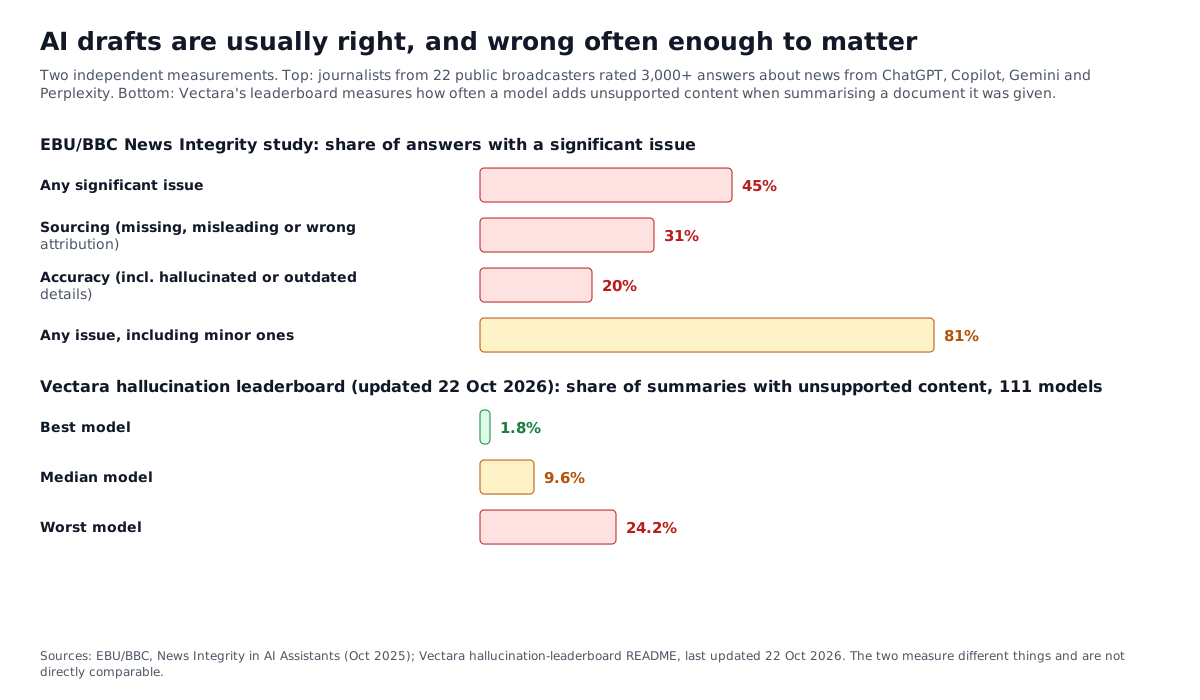
Figure 1. Two independent measures of how often AI output contains errors. They measure different things and aren't directly comparable. Sources: EBU/BBC (2025); Vectara leaderboard, updated 22 October 2026.
Why this matters for founders now
For a small team, AI-drafted posts are attractive because they save time. But the review step is where that time saving and your reputation meet. A post with a made-up statistic, a misattributed quote or a "study" that doesn't say what the post claims is the kind of thing that gets screenshotted.
The examples outside social media are instructive because each one had a review step on paper. In May 2025 the Chicago Sun-Times printed a syndicated summer reading list in which 10 of the 15 recommended books didn't exist, though their authors did. The freelance writer said the list was partly generated by AI and called it a "huge mistake"; the paper's own review then found phony sources and quotes elsewhere in the same 64-page section [13] [14]. In October 2025 Deloitte Australia agreed to partially refund a A$440,000 government report that contained a fabricated quote from a federal court judgment and references to non-existent research. The revised report disclosed that an Azure OpenAI GPT-4o tool chain was used [15] [16]. The refund later disclosed in a Senate hearing was A$97,587 [17].
Neither is a social post. But both are short-form, credibility-dependent content produced by professionals with someone signing it off, which is close to what founders do every day.
Finding 1: AI drafts are mostly right, which is exactly what makes reviewing them hard
The largest independent check of AI assistants I know of is the 2025 News Integrity study led by the BBC and coordinated by the European Broadcasting Union (EBU). Journalists from 22 public service media organisations in 18 countries and 14 languages rated more than 3,000 answers from ChatGPT, Copilot, Gemini and Perplexity [1] [2].
- 45% of answers had at least one significant issue, meaning something that could materially mislead.
- 31% had significant sourcing problems: missing, misleading or incorrect attributions.
- 20% had major accuracy issues, including hallucinated details and outdated information.
- Counting minor issues too, 81% of answers had a problem of some kind.
Gemini was the outlier, with significant issues in 76% of answers, mostly sourcing. The other three were between 30% and 37% [1].
News questions are a hard case: they need current facts and good sourcing. Vectara's public hallucination leaderboard measures an easier one. Each model gets a document and is asked to summarise it, and a classifier checks whether the summary says things the document doesn't support. On the version updated on 22 October 2026, the 111 listed models range from 1.8% to 24.2%, with a median of 9.6% [3]. Several current flagship models from the big labs sit between about 6% and 14%. A classifier isn't a human fact-checker, so treat these as indicative.
Put those together and you get the reviewer's problem. If one draft in ten has a problem, your experience as a reviewer is nine clean drafts for every bad one. That's how habits form. Researchers call it automation bias: the tendency to favour a suggestion from an automated system, even when other information says it's wrong.
Finding 2: when the AI is wrong, most reviewers go along with it, experts included
The cleanest way to measure whether a reviewer catches errors is to plant them. Three experiments do exactly that, in very different settings.
Radiologists. In a study published in Radiology in 2023, 27 radiologists read 50 mammograms with a purported AI system suggesting a standard risk category. In 12 of the 40 test cases the suggestion was deliberately wrong. Inexperienced readers were correct in 79.7% of cases when the AI was right and 19.8% when it was wrong. Moderately experienced readers fell from 81.3% to 24.8%. Very experienced readers, with more than 15 years' experience on average, fell from 82.3% to 45.5% [4] [5]. Expertise helped, but even the most experienced group got fewer than half of those cases right.
Everyday LLM users. In a pre-registered experiment presented at CHI 2025, 308 people answered factual questions with help from an LLM response that was sometimes wrong. When the answer was wrong and came with neither an explanation nor sources, participants agreed with it 78.2% of the time and got the question right 21.8% of the time [6].
Consultants. In a field experiment with Boston Consulting Group, 373 consultants worked on a business case designed to sit just outside what GPT-4 could do well. Without AI, 84.5% reached the correct recommendation. With AI, the two treatment groups managed 60% and 70.6%, an average drop of 19 percentage points [7]. These were capable people with a strong incentive to get it right. They still let the tool lead them.
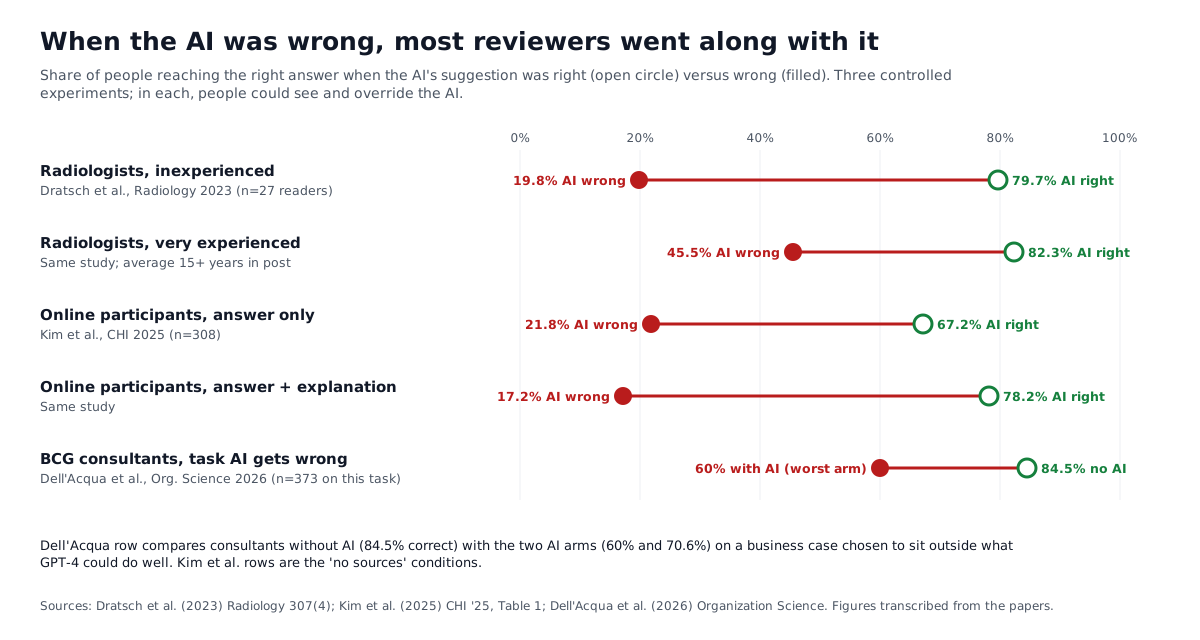
Figure 2. Accuracy when the AI was right versus wrong, in three controlled experiments. Sources: Dratsch et al. (2023); Kim et al. (2025); Dell'Acqua et al. (2026).
None of these is a social media study. But the mechanism is the same one you face when approving a draft: a fluent suggestion arrives first, and your job is to spot what's wrong with it. The pattern holds across medicine, consulting and trivia questions, which is a reason to take it seriously for posts too.
Finding 3: a confident explanation makes wrong drafts more convincing, and few people check the sources
The same CHI 2025 study varied what came with the LLM's answer: nothing, an explanation, sources, or both [6].
- Explanations increased trust whether or not they were deserved. With a correct answer, an explanation raised accuracy from 67.2% to 78.2%. With a wrong answer, it lowered accuracy from 21.8% to 17.2%. People also felt more confident and were far less likely to ask a follow-up question (28.2% vs 71.4% when the answer was correct).
- Sources helped. With a wrong answer and sources only, accuracy rose to 31.8%.
- But most people didn't use them. By the researchers' tracking, 189 of the 308 participants never clicked a source link in any task, and only 45 clicked in all four tasks where sources were offered.
- Inconsistencies were a useful warning. When the LLM was wrong and its explanation contained an internal contradiction, agreement with it fell (69.7% vs 83.3%) and accuracy almost doubled (30.3% vs 16.7%).
For a founder, the parallel is uncomfortable. An AI draft of a LinkedIn post that says "a 2024 Stanford study found..." and explains why it matters reads like a well-sourced post. The explanation is doing the persuading. Whether the study says that is a separate question, and the evidence says most reviewers won't open the link to find out.
Finding 4: in 2,104 court decisions, the hardest errors to spot cited real sources
To see what gets past real reviewers, I used Damien Charlotin's AI Hallucination Cases database. It tracks court and tribunal decisions where a court or tribunal found (or implied) that a party relied on AI-hallucinated material. It's public, licensed CC BY 4.0, and itemises each problem as fabricated, misrepresented, a false quote or outdated advice [12]. Lawyers are a useful test group: they're trained to check citations and professionally obliged to, and the people on the other side of the case check them too.
I downloaded the CSV export at 06:03 GMT on 30 October 2026 (2,242 rows). After removing 25 decisions where AI use was only alleged, and 113 without itemised errors, 2,104 decisions remained, with 6,641 flagged items. The method is below.
The numbers are growing fast. There were 143 decisions dated January to June 2025, 661 in the second half of 2025 and 856 in the first half of 2026. Decisions involving lawyers went from 71 to 271 to 339 over the same periods. The second half of 2026 (390 so far, to 23 October) is still filling in, since decisions reach the database with a lag.
Half the errors in lawyers' filings weren't made-up sources. Of 3,098 flagged items in 860 decisions involving lawyers:
- 49.4% were fabricated: the case, quote or document didn't exist.
- 30.6% were misrepresented: a real source described as saying something it doesn't.
- 19.4% were false quotes: real sources with words put in their mouth.
62.1% of lawyer decisions involved at least one real source that was misdescribed or misquoted. In 15.9% (137 decisions), every flagged source existed. A reviewer who checked only that each citation was real would have passed every error in those filings.
People representing themselves skewed more towards outright inventions (60.2% fabricated), which fits the idea that inventions are the easy catch. The errors that survive review by a professional are the plausible ones.
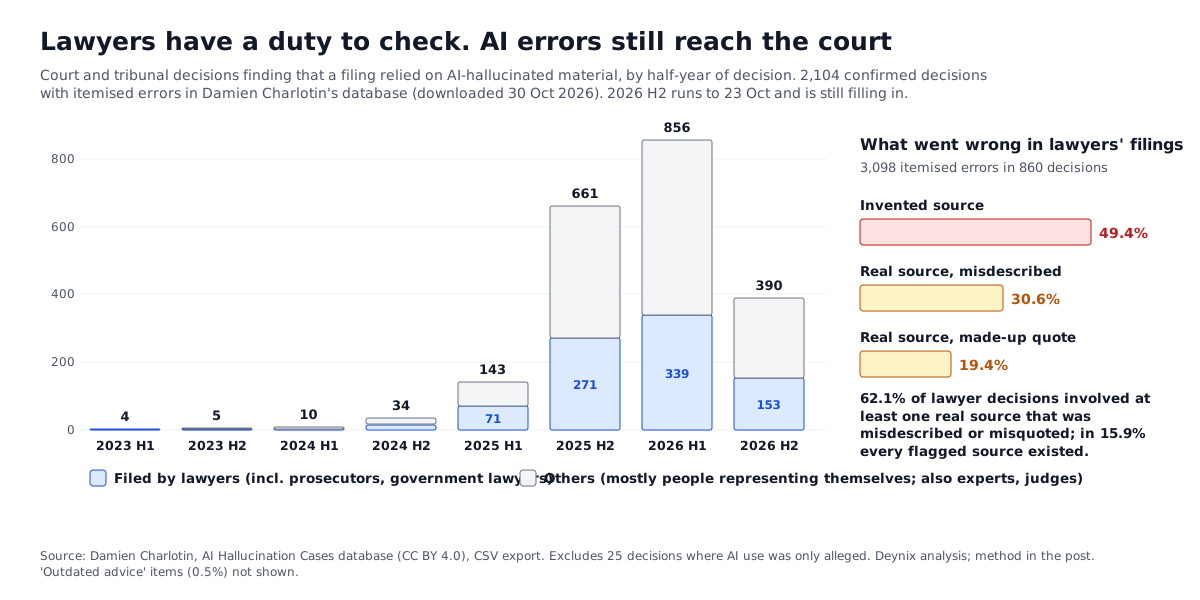
Figure 3. Decisions in the AI Hallucination Cases database by half-year, and the error types in lawyers' filings. Data: Damien Charlotin (CC BY 4.0), downloaded 30 October 2026. Deynix analysis.
The relevance to social posts is direct. The AI errors that cause trouble for founders are rarely an invented company. They're a real report with the wrong number, a real person with a quote they never said, a real study stretched to support a claim it doesn't make. That's the same "real source, wrong claim" category that half of lawyers' errors fall into.
Finding 5: some review designs help, others backfire, and a quick lesson doesn't fix it
If reviewers fail in predictable ways, can you design the review step to fail less? Four studies tested specific fixes.
Flag where the AI is unsure. In the second experiment of a Microsoft Research study on LLM-based search (CHI 2025), people made a product decision using an LLM that gave unreliable information on a hard task. Without help, only 26% got it right. When the interface highlighted low-confidence parts of the answer, 53% did; highlighting both high- and low-confidence parts gave 58% [8]. The researchers also found that in their first experiment most LLM users (60%) issued just one query before deciding.
Make the reviewer think before approving, in the right way. A 2026 Microsoft Research and Max Planck preprint planted errors in AI-generated writing plans and drafts and asked 214 people to review them [9]. With no intervention, participants accepted the flawed draft 70.6% of the time. Asking them to list the assumptions the draft relied on before judging it gave the lowest rate, 63.0%, though only its difference from the "what if" condition was statistically significant. Asking "what if" questions raised it to 80.7%, even though participants rated the "what if" version as more helpful. Combining both did no better than nothing (70.6%). This is a preprint, so treat the exact numbers with care.
Forcing a pause helps, but people dislike it. An earlier experiment with 199 people found that "cognitive forcing" designs, such as making people decide before seeing the AI's suggestion, significantly reduced overreliance compared with simple AI explanations. The catch: participants rated the designs that worked best least favourably [10].
Telling people that AI makes mistakes isn't enough. In a randomised study with high-school students solving puzzles with ChatGPT's advice, which was wrong in half the trials, students adopted the wrong advice in 52.1% of trials. A brief AI-literacy intervention didn't significantly reduce that, and it made students more likely to reject correct advice [11]. It's a preprint with a specific population, but it matches the pattern: awareness doesn't change what people do at the moment of approval.
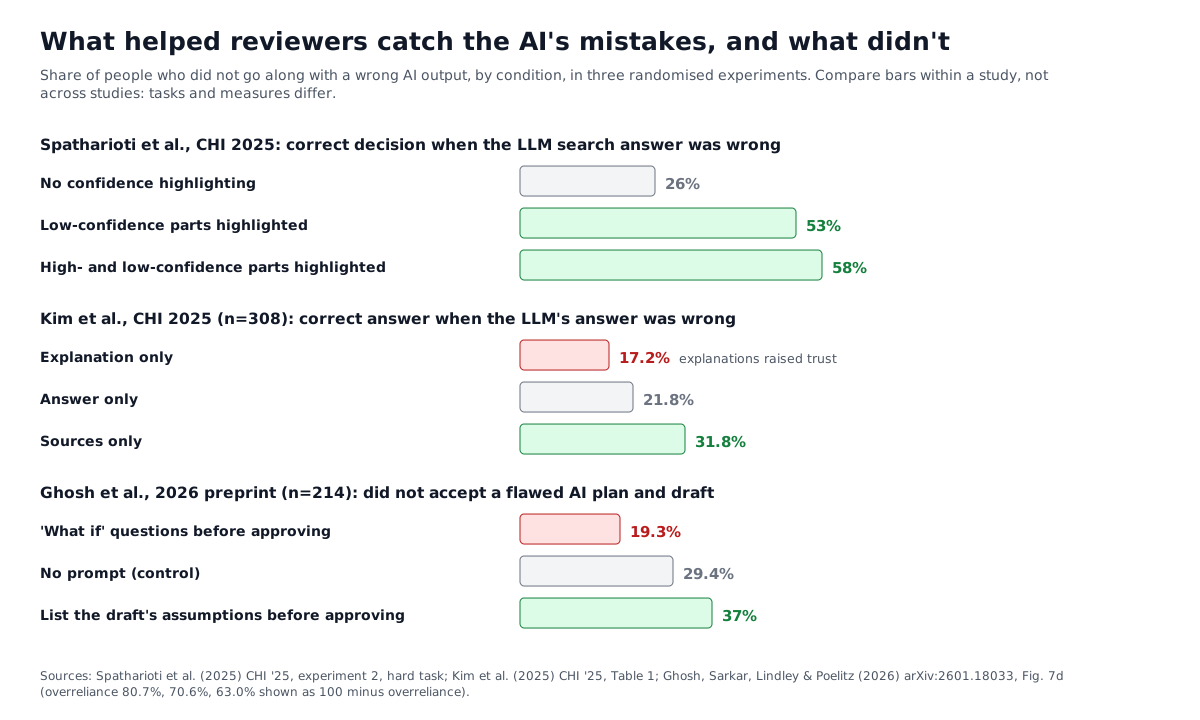
Figure 4. Review designs tested in three experiments. Compare within a study, not across studies. Sources: Spatharioti et al. (2025); Kim et al. (2025); Ghosh et al. (2026, preprint).
The common thread is that what helps is specific. "Be careful" doesn't work. Pointing at where the risk is, giving a source a reviewer can check, and asking a concrete question before the approve button all do.
What the evidence doesn't tell us
There are real gaps here, and I'd rather name them than paper over them.
- No study I found measures error-catching for social posts specifically. The experiments use mammograms, trivia questions, product decisions, business cases and writing plans. The mechanism looks general, but the exact rates won't transfer to a 150-word LinkedIn post.
- We don't know the base rate of errors in AI-drafted social posts. The EBU and Vectara figures are for news answers and document summaries. A post that's opinion and anecdote has fewer checkable claims; a post with statistics has more.
- The court data is a lower bound and a selected sample. It only includes errors that someone caught and a judge wrote about. Most AI-assisted filings that were checked properly never appear.
- Two of the intervention studies are preprints (Ghosh et al. and Puppart and Aru), so their numbers could change in peer review.
- The vendor survey numbers in circulation (such as "14% of reviews catch inaccuracies") don't publish enough method to rely on, so I haven't used them as findings.
Methodology
Question. Does a human approval step catch errors in AI-generated content, and what makes it work better?
Sources. I prioritised peer-reviewed experiments that planted known errors in AI output and measured whether people caught them (Radiology, CHI 2025, Organization Science, CSCW), independent audits of AI error rates (EBU/BBC; Vectara's public leaderboard), and primary reporting on real incidents (the Chicago Sun-Times' own review, NPR, the Guardian, CNA, and Senate evidence reported by the Australian Greens). Every figure in this post was read in the original paper, report or dataset and cross-checked against a second source where one exists (for example the RSNA's summary of the Radiology paper, and the BBC's release alongside the EBU report). Two preprints are labelled as such.
Original analysis. I downloaded the AI Hallucination Cases database CSV from damiencharlotin.com at 06:03 GMT on 30 October 2026 (2,242 rows) and:
- Removed 25 rows marked "Alleged: Yes" (AI use alleged but not confirmed).
- Split the "Hallucination Items" field into individual items (separated by "||") and read each item's category from the prefix before the colon: Fabricated, Misrepresented, False Quotes or Outdated Advice. 113 rows without itemised errors were dropped, leaving 2,104 decisions and 6,641 items.
- Classed a decision as involving a lawyer if the party field mentioned a lawyer, prosecutor or government lawyer (860 decisions), and as a self-represented litigant if it mentioned "Pro Se" and no lawyer (1,208).
- Counted decisions by half-year of the decision date (the latest is 23 October 2026).
The categories are the database's, not mine; I didn't re-code individual cases, though I spot-checked a sample of lawyer cases with no fabricated items to confirm they described real cases misquoted or misdescribed. The analysis script and results are in the source log for this post. The database is a living project and the counts will change.
What I didn't do. I didn't run a new experiment on social posts. Nothing here is a Deynix customer statistic.
Practical takeaways: a review checklist for AI-drafted posts
These follow from the evidence above. None of them needs a tool.
- Triage, then review hard where it matters. Opinion and story posts carry less risk than posts with numbers, quotes, named people, named companies, dates or "research shows". Put most of your attention on the second kind. The consultants' study is a reminder that the AI is weakest where the task needs facts or judgement it doesn't have [7].
- Mark every checkable claim before you judge the post. This is the highlighting finding turned into a habit: underline each number, quote, name and source in the draft, then check those, rather than reading the post for flow [8]. Better still, ask your assistant to list the factual claims in its own draft and how sure it is about each.
- Check the claim, not just the link. Half of what slipped through in lawyers' filings cited real sources [12]. Open the source and find the sentence that supports the claim. If you can't find it in a minute, cut the claim or soften it.
- Don't let the explanation do the checking. A fluent "here's why this matters" makes a wrong claim more convincing, not more true [6]. Ask for the source text or a direct quote instead of a summary.
- Write down the post's assumptions before you approve it. What does this post assume about the reader, the product, the numbers? That was the intervention that reduced acceptance of flawed drafts; "what if" questioning made it worse [9].
- Quotes from real people get a separate check. Never post a quote the AI produced unless you have the original. False quotes were nearly one in five errors in lawyers' filings, and the Deloitte report's fabricated court quote is the same failure [15].
- Don't trust your experience to protect you. The most experienced radiologists got only 45.5% of cases right when the AI's suggestion was wrong [4]. If anything, a long run of good drafts is when to slow down.
- Keep a log of what you catch. Note each error you fix and its type. After a month you'll know whether your drafts tend to invent, misattribute or overstate, and where to look first.
Where Deynix fits
Deynix is built around the approval step: drafts go to Review, you approve every word, and nothing posts until you say so, whether you work in the app or from Claude or ChatGPT [20]. This research is a reminder that approval is only as good as the checking behind it. An approve button doesn't verify a statistic. The checklist above is how we'd suggest using it.
References
- European Broadcasting Union (21 October 2025). "News Integrity in AI Assistants." https://www.ebu.ch/research/open/report/news-integrity-in-ai-assistants
- BBC Media Centre (2025). "Largest study of its kind shows AI assistants misrepresent news content 45% of the time – regardless of language or territory." https://www.bbc.co.uk/mediacentre/2025/new-ebu-research-ai-assistants-news-content/
- Vectara. "Hallucination Leaderboard" (README, last updated 22 October 2026). https://github.com/vectara/hallucination-leaderboard
- Dratsch, T., et al. (2023). "Automation Bias in Mammography: The Impact of Artificial Intelligence BI-RADS Suggestions on Reader Performance." Radiology 307(4), e222176. https://pubs.rsna.org/doi/10.1148/radiol.222176
- RSNA (2 May 2023). "AI Bias May Impair Radiologist Accuracy on Mammogram." https://www.rsna.org/news/2023/may/ai-bias-may-impair-accuracy
- Kim, S. S. Y., Vaughan, J. W., Liao, Q. V., Lombrozo, T., and Russakovsky, O. (2025). "Fostering Appropriate Reliance on Large Language Models: The Role of Explanations, Sources, and Inconsistencies." CHI '25. https://doi.org/10.1145/3706598.3714020 (preprint: https://arxiv.org/abs/2502.08554)
- Dell'Acqua, F., et al. (2026). "Navigating the Jagged Technological Frontier: Field Experimental Evidence of the Effects of Artificial Intelligence on Knowledge Worker Productivity and Quality." Organization Science. https://doi.org/10.1287/orsc.2025.21838
- Spatharioti, S. E., Rothschild, D. M., Goldstein, D. G., and Hofman, J. M. (2025). "Effects of LLM-based Search on Decision Making: Speed, Accuracy, and Overreliance." CHI '25. https://doi.org/10.1145/3706598.3714082 (preprint: https://arxiv.org/abs/2307.03744)
- Ghosh, A., Sarkar, A., Lindley, S., and Poelitz, C. (2026). "An Experimental Comparison of Cognitive Forcing Functions for Execution Plans in AI-Assisted Writing: Effects On Trust, Overreliance, and Perceived Critical Thinking." arXiv preprint 2601.18033. https://arxiv.org/abs/2601.18033
- Buçinca, Z., Malaya, M. B., and Gajos, K. Z. (2021). "To Trust or to Think: Cognitive Forcing Functions Can Reduce Overreliance on AI in AI-assisted Decision-making." Proc. ACM Hum.-Comput. Interact. 5 (CSCW1), Article 188. https://doi.org/10.1145/3449287
- Puppart, B., and Aru, J. "A Brief AI Literacy Intervention Does Not Significantly Reduce Over-Reliance and Increases Under-Reliance on ChatGPT: A Randomized Study." arXiv preprint 2503.10556. https://arxiv.org/abs/2503.10556
- Charlotin, D. "AI Hallucination Cases Database" (CC BY 4.0), CSV export downloaded 30 October 2026. https://www.damiencharlotin.com/hallucinations/
- Chicago Sun-Times (29 May 2025). "Special section with fake book list plagued with additional errors, Sun-Times review finds." https://chicago.suntimes.com/news/2025/05/29/special-section-king-fake-book-list-errors-sun-times-review
- NPR (20 May 2025). "AI-generated summer reading list gets published in major newspapers." https://www.npr.org/2025/05/20/nx-s1-5405022/fake-summer-reading-list-ai
- The Guardian (6 October 2025). "Deloitte to pay money back to Albanese government after using AI in $440,000 report." https://www.theguardian.com/australia-news/2025/oct/06/deloitte-to-pay-money-back-to-albanese-government-after-using-ai-in-440000-report
- CNA (2025). "Deloitte to partially refund Australian government for report with apparent AI-generated errors." https://www.channelnewsasia.com/world/deloitte-partially-refund-australia-government-report-apparent-ai-generated-errors-5387971
- Australian Greens (media release). "Greens slam Deloitte's unethical behaviour and measly refund over AI report." https://greens.org.au/news/media-release/greens-slam-deloittes-unethical-behaviour-and-measly-refund-over-ai-report
- Neil Patel. "Does Human Review Actually Fix AI Content Inaccuracies?" https://neilpatel.com/marketing-stats/human-review-ai-content-inaccuracies/
- Boston Consulting Group (2025). "You Won't Get GenAI Right if Human Oversight is Wrong." https://www.bcg.com/publications/2025/wont-get-gen-ai-right-if-human-oversight-wrong
- Deynix, homepage, accessed 30 October 2026. https://www.deynix.com
Browse all updates in News.