Personal-brand LinkedIn posts for founders, in your voice.
Posts under your name, from your real context, approved before they go out. Not a persona someone else invented.
7-day free trial · You approve every post · Works in Claude, ChatGPT or our app

Personal brand is a reputation, not a content pillar named "you"
Founders get sold personal branding as a posting schedule with a headshot. That is backwards. People remember you when they can predict the kind of thing you would say. That takes a lane, evidence and repetition.
The lane is narrow on purpose. If you build infrastructure for developers, your LinkedIn should mostly be about that world. A post about airport coffee does not widen the brand. It blurs it.
The evidence is your work. Shipping, selling, hiring, getting something wrong. If the post could be written by a founder in a different category, it is not yet personal.
The repetition is a cadence you can keep. Personal brand dies when it is a three-week performance. See founder-led LinkedIn you can keep up.
How to build it without becoming a full-time creator
Write from context you already own. Site, product, past posts, saved thoughts. That is the raw material. A prompt that says "make me a personal brand" will invent one, and it will be made of stock lessons.
Separate the founder from the product. Your personal profile can mention the company. It should still sound like a person with judgement. If every post is a feature drop, you do not have a personal brand. You have a second company page.
Use AI as a shaper, not as the source. Ask it to turn a specific note into a LinkedIn post in your register. Then read it. The sentences that feel slightly too smooth are the ones to cut. How to do that pass: LinkedIn posts with AI that still sound like you.
Approve under your own name. This is the whole ethic. A personal brand you do not read is a fiction. Deynix will not publish the draft until you approve it. Keep that rule even when you are busy. Especially then.
Ignore vanity as a strategy. This page will not quote a follower target or a "personal brand framework" with seven steps. The useful test is whether someone in your niche would forward the post because it was specific.
What belongs on a founder profile
A decision, with the trade-off
What you chose, what you gave up, who it was for. That is a person. A slogan is not.
A lesson that cost you something
Time, money, a wrong hire, a missed ship date. Cheap lessons read as content. Costly ones read as experience.
A view of the category
What you think is overrated, under-built or about to break. Opinion without evidence is still a take. Attach the work.
The occasional product story
When the product is the evidence for the point, not the point itself.
How Deynix holds a founder voice without stealing it
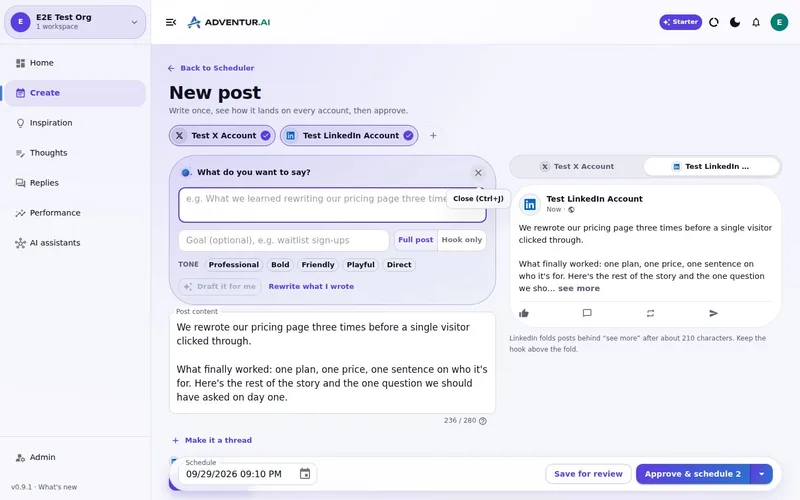
Deynix is an AI marketing employee. For personal brand that means: remember the founder context, draft LinkedIn posts from it, wait in Review, publish when you approve.
It can also hold a product workspace next to the personal one, so the company voice does not leak into your name. That split is the difference between a founder and a mascot.
It will not invent a biography. It will not run ads against your profile. It will not promise that personal branding "converts". It will not post from a ghostwriter's queue while you look the other way.
The honest offer is a drafting and approval loop that makes it cheaper to stay visible as yourself.
Draft from a real belief, not a personal-brand prompt
Connect the profile you actually use. Ask for a post from something you would defend on a call. Approve it only if the voice is yours.
What this
is for.
Founders who want to be known for a point of view on LinkedIn, without becoming a content operator or hiring one.
Publish under your name from material you actually have.
Keep founder voice and product voice from collapsing into one caption.
Make approval the habit that protects the brand you are building.
Ask in the chat
you already use.
Connect Deynix to Claude, ChatGPT or Cursor and ask for the week. Your assistant uses your brand, drafts the posts and visuals, and everything waits in Review for you.
See how it connectsYou: Turn what I learned hiring our first engineer into a LinkedIn post and a carousel. Tool call list_top_posts: Story posts lead on LinkedIn Tool call create_carousel: 6-slide carousel · your brand Tool call create_draft_post: LinkedIn draft in Review Agent: The post opens with the mistake, not the lesson. The carousel is attached. Want it on Thursday morning? You: Yes, approve it. Tool call approve_post_group: Scheduled Thu 08:30 LinkedIn post, Pending approval: Our first engineering hire nearly didn't happen. I'd written the wrong job description.
Illustrative demo. Your numbers and drafts will differ.
Three steps
to your first week.
Connect the brand
Point it at your site, social history and Notion so drafts start from real context instead of a blank prompt.
Inspect what it learned
Correct positioning, audience and voice once. That correction applies to every future draft.
Approve the first batch
Scroll, edit or reject. Nothing public goes out until you approve it.
Questions, answered.
Is a personal brand on LinkedIn just posting more?
No. A personal brand is a recognisable point of view, repeated. Volume without a point of view is noise. A quiet profile with a clear lane beats a busy one that could belong to anyone.
Should my personal account and the company say the same things?
They can share facts. They should not share a voice. Your name is for judgement and lessons. The product account is for the product. Deynix keeps workspaces separate so those do not bleed.
Will AI ruin a personal brand?
Unreviewed AI will. A draft from your own context, that you still approve, is a writing assistant. A weekly dump of generic posts under your photo is how you train people to skip you.
Updated 19 October 2026
Try it on
a real week.
Connect a brand, ask for a week of posts and approve the ones that sound like you. Nothing publishes until you say so.
7-day free trial · Card needed, cancel any time