Does saying 'ad' cost you engagement? Why the studies disagree, and what it means for founder posts
One 2026 report says #ad posts get more likes. Another says labelled posts get a third less. I lined up seven field studies and three meta-analyses on one yardstick. The drop comes mostly from the post being an ad, not from the label, and small accounts barely see it. Here's what that means when you post about your own startup.

By Kyle Kirkby
Published | Updated
Last week I wrote about whether you need to label posts about your own startup as ads. In the UK the short answer was usually yes, unless it's obvious from the post itself [22]. The question I got back most was the next one. If I put "ad" on it, will anyone still engage?
The research looks like it can't make up its mind. In February 2026, the UK's Influencer Marketing Trade Body and HypeAuditor reported that Instagram posts tagged #ad got more likes and comments than sponsored posts without a tag [4]. In October 2026, Virev reported that posts carrying Instagram's paid-partnership label got about a third less engagement than the same creators' normal posts [7]. Both headlines get shared as the answer.
They're both right, because they answer different questions. So I collected the field studies and meta-analyses I could find on ad disclosure and engagement, noted what each one compared against, and put the numbers on the same yardstick where the papers allowed it. Then I looked for anything about founders or employees posting about their own company. I found nothing that tests it directly, so the last part of this post is an inference, and I say so.
This is a research summary, not legal advice. The Deynix part is short and near the end.
Executive summary
- The studies disagree because they use different comparisons. Some compare labelled ads with unlabelled ads. Others compare ads with the same creator's normal posts. On the second yardstick, every study I found shows disclosed sponsored posts getting less engagement than normal posts: from 0.83x of a creator's usual post down to 0.42x in Germany after its 2016 rules [1] [2] [7].
- Most of the drop comes from the post being an ad, not from the label. In the Instagram study with the most controls, ads with no disclosure still got only 93.4% of a normal post's likes. After correcting for misclassified posts, the author estimated that up to 60.1% of the gap between disclosed ads and normal posts comes from the post's advertising nature rather than the disclosure [1].
- Against unlabelled ads, labels win in some studies and lose in others. Labelled posts got 34% more likes in a 2023 Facebook and Instagram study that compared the same post with and without the platform's tag [3]. They got 11.6% to 21.3% fewer in a 2024 Instagram study [1]. In the 2026 UK data, #ad posts had higher median likes (153 against 127) but lower median reach (2,067 against 2,421) [5].
- Hiding it doesn't pay over time. The same 2024 study found that creators who disclosed all their ads in the previous 42 days got up to 5.5% more likes on later normal posts. Creators who disclosed none got up to 4.3% fewer [1].
- In experiments, labels change what people notice, not what they think of the brand. A 2025 meta-analysis of 37 studies found disclosure raised ad recognition (d = 0.394) and brand recall (d = 0.460), cut the influencer's credibility a little (d = −0.137), and had no significant effect on attitudes, intention to interact or purchase intention [10].
- Small accounts barely lose anything. In Virev's data, sponsored posts by creators with 1,000 to 10,000 followers got 0.91x their usual engagement. Creators with over a million got 0.50x [8].
- Nobody has measured this for founder posts. Every study I found is about creators paid by someone else's brand, mostly on Instagram. The one LinkedIn study is about paid creator posts [9]. One paper says outright that it couldn't separate self-promotion from other ads [1].
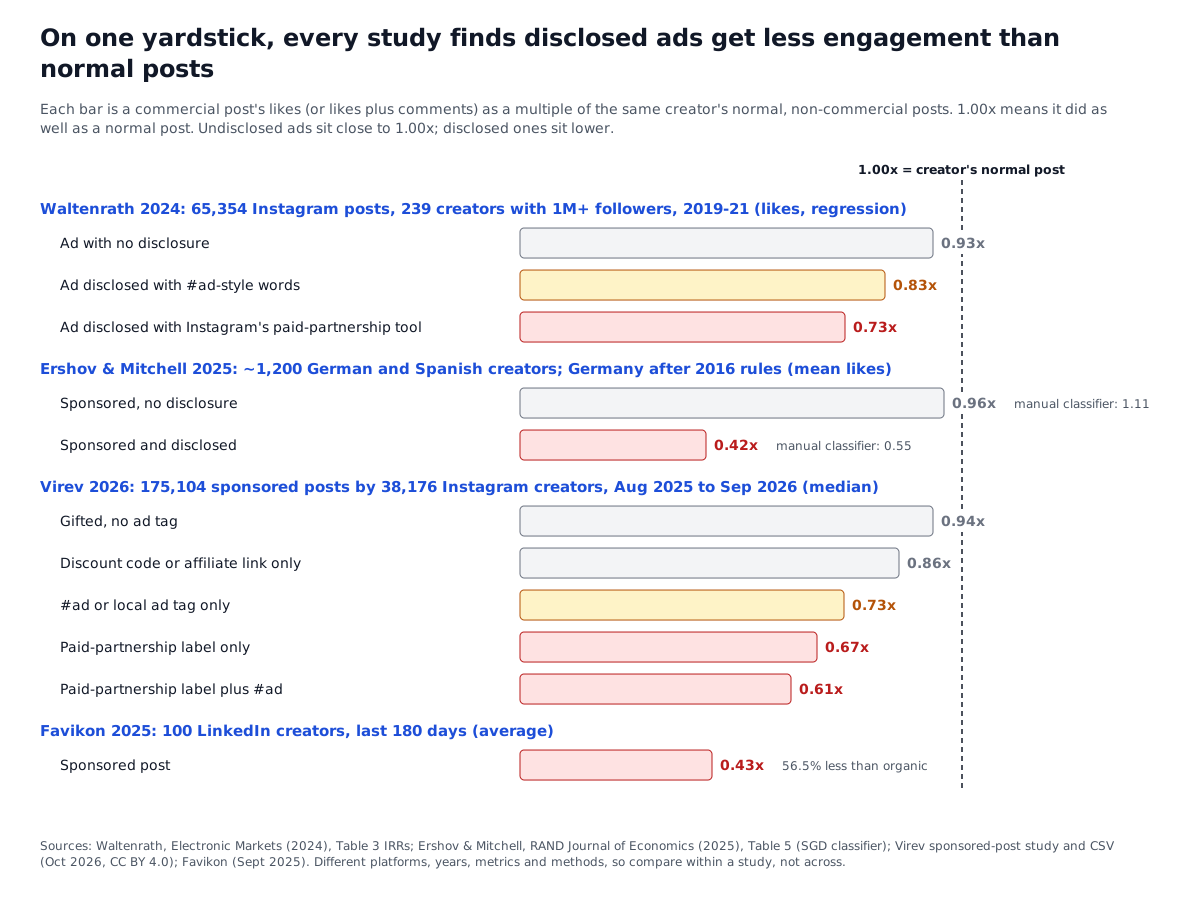
Figure 1. Commercial posts measured against the same creator's normal posts. Different platforms, years and methods, so compare bars within a study rather than across studies. Sources: [1], [2], [7], [8], [9].
Why two 2026 reports say opposite things
Start with the two headlines, because the gap between them explains most of the confusion.
The IMTB and HypeAuditor report looked at 583,000 sponsored Instagram posts from UK creators. It compared posts that used #ad with sponsored posts that didn't [6]. The #ad posts had higher median likes (153 against 127) and higher median comments (15 against 10). Average likes were 742 against 650 [5]. IMTB's headline was that #ad "does not harm engagement" [4], and the trade press ran it as "Disclosure doesn't damage social media ads" [16].
The same coverage reported two numbers that point the other way. Median reach was 2,067 for #ad posts and 2,421 for undisclosed ones. The average engagement rate was 1.3% with #ad and 1.4% without [5]. So whether #ad "won" depends on which metric you pick. The full report is behind a form, and the public coverage doesn't say how undisclosed sponsored posts were identified or whether creator size was controlled for. These are raw medians, not a controlled comparison.
Virev's study asked a different question. It read 20.2 million public posts from 391,731 Instagram creators with at least 1,000 followers, dated August 2025 to September 2026. It divided each commercial post's likes and comments by the median of the same creator's normal posts [7]. A typical sponsored post got 0.69x. Posts with only the paid-partnership label got 0.67x, posts with the label and #ad got 0.61x, and posts with #ad alone got 0.73x [8].
Put side by side, these don't conflict. HypeAuditor compares labelled ads with unlabelled ads. Virev compares ads with normal posts. Both can be true at once: an ad gets less engagement than your normal post, and a labelled ad can get about the same as, or more than, an unlabelled one.
Virev is careful about this. It says its study "shows what sponsored posts get, not why," and points out that paid posts come with a brief, a deadline and talking points, while gifted posts are usually only posted if the creator likes the product [7]. It also found 5 to 8 undisclosed promotions in a sample of 100 "normal" posts, which would make its measured drop slightly smaller than the true one.
What happens when you hold the post constant
The studies that come closest to isolating the label itself are academic, and they don't agree on direction either.
Waltenrath (2024) looked at 65,354 English-language Instagram posts by 239 creators with over a million followers, posted between August 2019 and March 2021 [1]. To find undisclosed ads, the author trained a model on creators from Germany, Austria and Switzerland, where disclosure rules are strictly enforced. The model agreed with human coders 79.8% of the time. The regression controlled for each creator, the month and post features such as links, video and discount codes.
The result: compared with normal posts, ads with no disclosure got 93.4% of the likes. Ads disclosed with words like "ad" or "sponsored" got 82.6%. Ads disclosed with Instagram's built-in paid-partnership tool got 73.5%. So the label cost between 11.6% and 21.3% of likes compared with an undisclosed ad, and the more prominent platform tool cost more [1].
Two details in that paper matter more than the headline. First, undisclosed ads were penalised too. People spot ads without labels, from discount codes, brand tags and the tone of the post. After a correction for misclassified posts, the author concluded that "up to 60.1% of the effect of disclosures stems from a post's inherent advertising nature rather than from the disclosure."
Second, the paper followed what happened next. Creators who had disclosed all their ads in the previous 42 days got up to 5.5% more likes on their later normal posts. Creators who had disclosed none got up to 4.3% fewer. Over longer windows, the effects grew to +11.5% and −11.3% [1]. The paper's reading is that a label costs the ad itself, while hiding the ad costs the account later. It also reports that a mixed-model check made the positive effect for disclosers weaker and not significant, while the penalty for undisclosed ads mostly held. So the long-run benefit is less certain than the long-run cost.
Cao and Belo (2023), a preprint, found the opposite for the label itself [3]. They collected 810,168 Facebook and Instagram posts from 1,355 creators who had verified accounts on both, posted between June 2017 and June 2018. Some sponsored posts carried the platform's "paid partnership" header on one platform and not the other, so they could compare the same post with and without it. In their preferred specification, the header added about 34% more likes and 14% more comments. They also ran two online experiments and read the result as transparency making people more favourable.
Ershov and Mitchell (2025) looked at what happened when Germany tightened its rules in late 2016, using about 600 German and 600 Spanish creators as a comparison [2]. Disclosure went up sharply. Sponsored content also rose by about 12%. Average likes per post in Germany fell by 483 from a pre-rule mean of 769. The authors read this as consistent with more sponsored content drawing less attention, so it isn't a pure label effect. After the rules, disclosed sponsored posts got 0.42x the likes of normal posts on one classifier and 0.55x on another. Sponsored posts that stayed undisclosed got 0.96x and 1.11x [2].
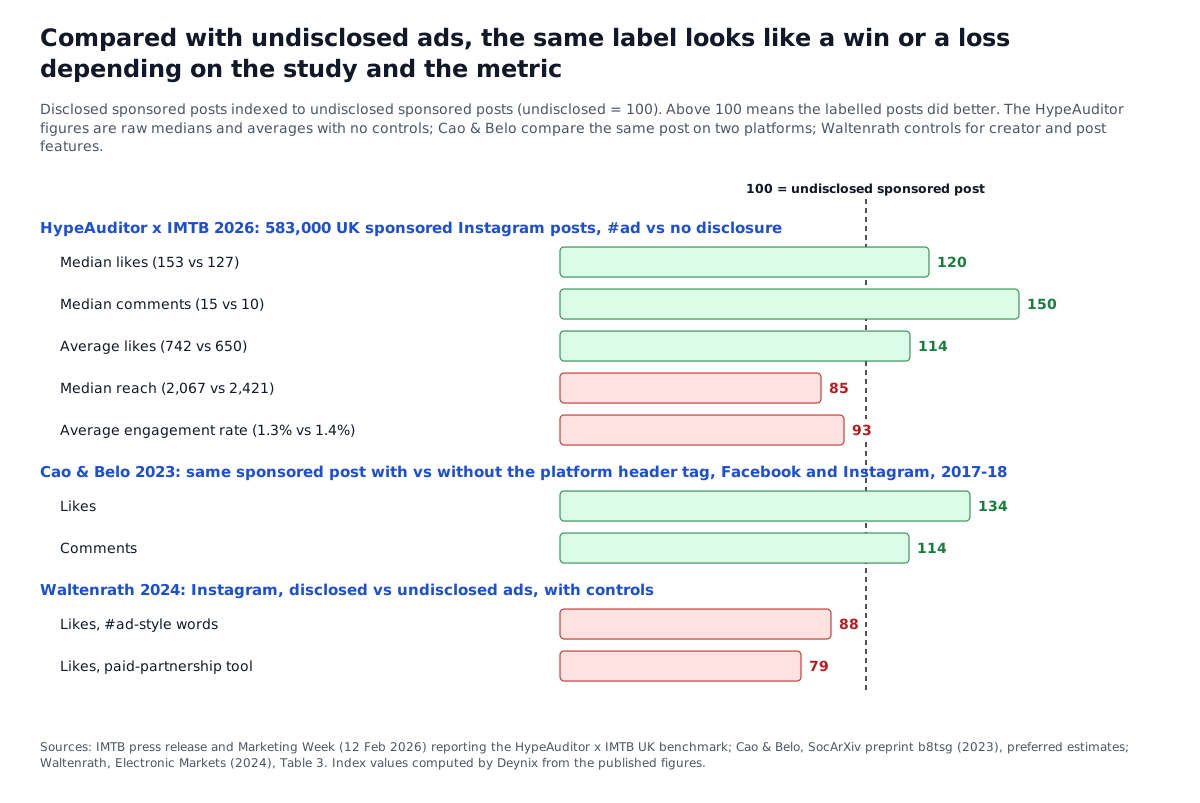
Figure 2. Labelled ads compared with unlabelled ads. Index values calculated by Deynix from the published figures. Sources: [1], [3], [4], [5].
Why might labels help in one dataset and hurt in another? The papers offer a few reasons, and none can be settled from the data alone. The Cao and Belo data is from 2017 and 2018, when platform labels were new and rare (under 1% of posts). The Waltenrath data covers macro creators in 2019 to 2021, and the author is open that the model's errors push the estimates in one direction. The German data shows creators changing what they post once rules bite, so the label isn't the only thing that changed. And some labelled posts are simply the most scripted, brand-controlled deals, which Virev suggests explains why label plus #ad did worst [7].
What lab experiments add
Field data tells you what happened to likes. Experiments can tell you what changed in people's heads, at the cost of artificial settings.
Three reviews pool those experiments:
- Liu and Zhao (2025) combined 288 effect sizes from 37 studies with 12,721 participants, published from 2014 to 2024 [10]. Disclosure raised persuasion knowledge, which means recognising the post as an ad (d = 0.394), and brand recall (d = 0.460). It lowered influencer credibility (d = −0.137), and message credibility fell by a marginal amount (d = −0.369, p ≤ 0.1). It had no significant effect on attitudes toward the influencer, message or brand, on intention to interact, or on purchase intention. Hashtag disclosures had larger effects than written statements.
- Eisend and colleagues (2020) pooled 61 papers across sponsored content in all media [11]. Disclosure "reduced brand attitudes, credibility, and source evaluation but increased recognition, persuasion knowledge, and resistance". Effects on attitude toward the ad, behavioural intention and brand recall were not significant.
- Pan and colleagues (2025) reviewed 1,531 effect sizes from 251 papers on what makes influencer marketing work [12]. On sponsorship disclosure, they "observed no significant effects" on marketing outcomes overall, and found it helped attitudes for self-expressive products more than for functional ones.
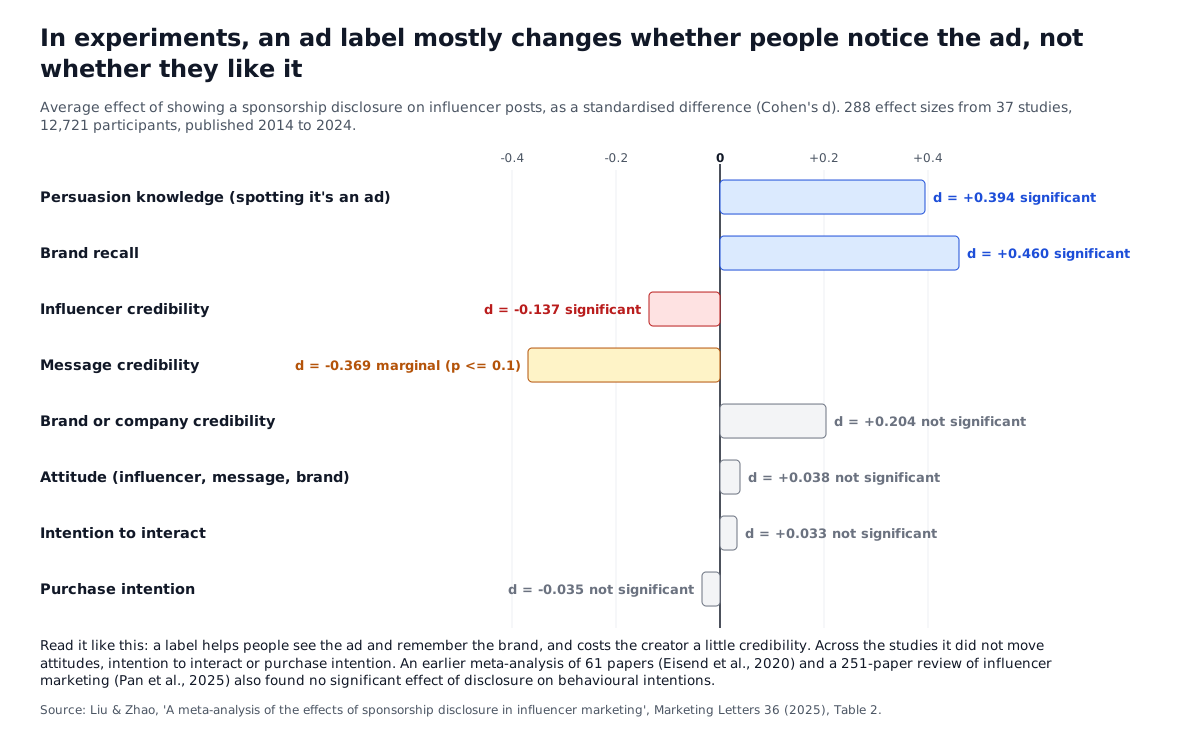
Figure 3. What a disclosure changes in experiments. Source: Liu and Zhao, Marketing Letters (2025), Table 2 [10].
There's also a large field experiment outside social media. Sahni and Nair ran one with over 200,000 users of a mobile restaurant-search app, varying how ads were labelled [13]. They found "no evidence of deception under typically used formats of disclosure". The ads still worked, and mostly by making people look at the advertiser and choose it later, not by tricking them into clicking.
Put together, the lab and field evidence points one way. A label makes people notice that a post is selling something. Noticing costs some likes on that post and a little credibility for the poster. It doesn't seem to make people like the brand less or buy less.
Do people even see the label?
Labels only matter if people notice them, and in feeds many don't. In February 2026 the ASA published research with 1,900 UK participants aged 13 to 64 [15]. In its "Spot the Sell" test, about three in four people said a brand's own ad was "definitely an ad". For influencer ads, around half said "definitely", 19% said "maybe", and 27% didn't think the post was advertising at all.
People said they want labels anyway. 80% said they prefer it when influencers are clear about advertising, and 79% said labels should be upfront with no extra clicks. "Paid Partnership" was the label most often ranked among the clearest (37% put it in their top three of 16), followed by "Ad" or "#ad" (27%) and "Commission Paid" (25%). "#gifted" and "#thanks" were among the weakest [15]. The ASA's summary says clear "Ad" labels and prominent platform disclosures "performed best" [14].
This fits the field data. The more visible the disclosure, the more people recognise the ad, and the bigger the drop in likes on that post. Instagram's tool cost more than caption words in Waltenrath's data [1], and a tool label plus #ad cost the most in Virev's [8].
Account size changes the picture
Virev's tables break the drop down by follower count. Sponsored posts from creators with 1,000 to 10,000 followers got a median 0.91x of their usual engagement. Creators with 10,000 to 100,000 got 0.74x, 100,000 to 500,000 got 0.60x, and over a million got 0.50x [8].
The one LinkedIn study I found shows the same shape. Favikon looked at 100 LinkedIn creators who had published at least three sponsored posts, using each creator's posts from the previous 180 days. On average, sponsored posts got 56.5% less engagement than the creator's organic posts. But a creator who usually got about 100 engagements might get about 86 on a sponsored post, while one who usually got about 1,000 might get about 550 [9]. Favikon also noticed that some of the worst performers started the hook with "#AD", and suggested LinkedIn's brand-partnership toggle instead. That's an observation from reading posts, not a tested result.
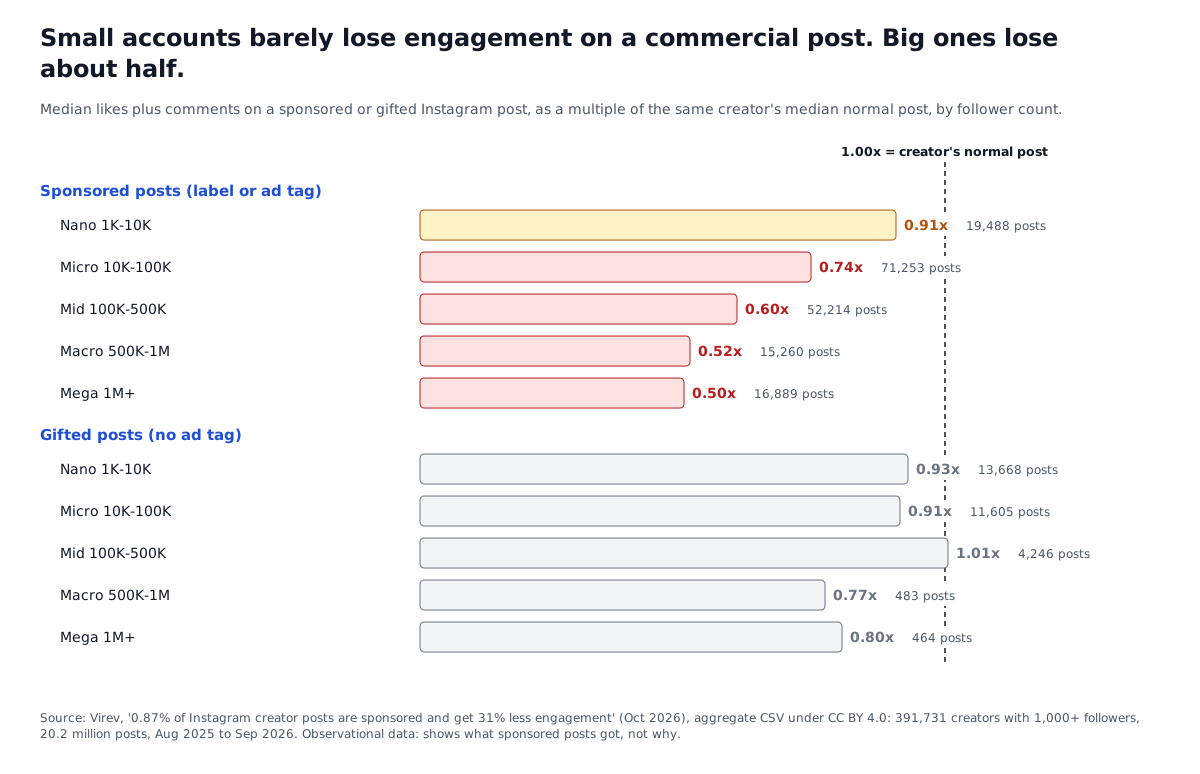
Figure 4. Commercial posts by follower count, Instagram, August 2025 to September 2026. Source: Virev aggregate CSV, CC BY 4.0 [8].
Neither study can say why small accounts lose less. Plausible reasons include a closer audience, fewer and less scripted deals, and posts that look more like the creator's usual work. Treat it as a pattern, not a rule.
What this means for founder posts
Here's the gap. Every study above is about creators promoting someone else's brand in exchange for money, products or commission. I couldn't find one that tests what an ad label does to a founder's or employee's post about their own company. Waltenrath says directly that the model "cannot learn to predict self-promotion", because self-promoting posts don't need the same disclosure on Instagram [1]. The platform labels aren't built for it either. Meta tells you not to use its paid-partnership label for "your own products", because there's no business partner, while reminding you that you may still have legal disclosure duties [17]. LinkedIn's brand-partnership toggle is for posts made "in an exchange for value" [18]. X added a native paid-partnership label in March 2026, aimed at sponsored creator posts [19].
The rules still apply to founders, though. CAP's guidance says that when someone is the "owner, employee, shareholder, director" of a brand, "any content featuring or referring to the brand will need to be obviously identifiable as advertising" [20]. In the US, the FTC asks for a disclosure when a connection "might materially affect the weight or credibility" of a post and the audience wouldn't expect it [21]. Last week's post covers what that means in practice [22].
So here's my inference, using the evidence above and labelled as an inference. For a founder, the "is this an ad?" penalty is mostly already priced in. When you post about your own launch, readers can see it's promotional from the content, the link and your bio, just as Instagram users spotted undisclosed ads in Waltenrath's data. A short, plain line such as "my company" or "we built this" probably adds a small, short-term cost to that one post. The evidence suggests it's smaller than the cost of the post being promotional in the first place, and smaller still for small accounts. In return, you get the long-run credibility effect, and you avoid the one outcome every source agrees is bad: followers working out later that you hid it.
What I can't tell you is how big the cost is on LinkedIn or X for a founder with 3,000 followers. Nobody has published that. You can measure it yourself, though.
Practical takeaways
- Compare against your own usual post, not against an unlabelled ad. The fair question for a founder is "how does a post about my product do against my normal posts?" Virev's method is simple to copy: divide a post's likes plus comments by the median of your recent non-promotional posts [7]. A result of 0.8x is normal for a promotional post, so don't read it as the label failing.
- Make the connection obvious early, in plain words. The ASA's participants preferred clear labels placed upfront, and the ASA has ruled against disclosures hidden behind "more" [15] [22]. "I'm the founder of X" in the first line does that job without starting with "#AD".
- Use platform labels for what they're for. If someone pays you, gives you something or pays you commission, use LinkedIn's brand-partnership toggle, X's paid-partnership label or Instagram's tool. For your own company, Meta says not to use its partnership label, so say it in the post itself [17].
- Make promotional posts look like your best normal posts. In both Virev's and Favikon's data, the commercial posts that did well were the ones the creator would have made anyway: a useful how-to, a real result, their usual format [7] [9]. The label didn't decide those outcomes. The content did.
- Ask your team for the same honesty. If teammates post about the company, the same disclosure logic applies to them. A shared one-line wording ("I work at X") keeps it consistent.
- Don't use the HypeAuditor or Virev headline as your forecast. One shows raw medians without controls. The other shows creators paid by brands on Instagram. Neither measures a founder on LinkedIn or X.
Where Deynix fits
Deynix drafts posts and replies in your voice and puts every draft in a Review queue, so nothing goes out until you approve it [23]. That's the point to add the line that says it's your company, before it's public. Its Outlier posts view already compares each post with your usual over the last 60 days [23], which is the same yardstick as takeaway 1. It won't tell you whether a post legally needs a label. That's still your call.
Methodology
Question. Does labelling a social post as an ad reduce engagement, and what does the evidence imply for founders posting about their own company?
Search. On 2 November 2026 I searched the web, Google Scholar-indexed repositories and publisher sites for field studies, experiments and meta-analyses on sponsorship disclosure and engagement. Search terms included "sponsorship disclosure engagement", "#ad engagement", "paid partnership label engagement", "disclosure regulation Instagram" and LinkedIn- and employee-specific variants. I also checked industry reports cited in recent coverage.
What I included. Field studies with a stated comparison and sample (Waltenrath 2024; Ershov and Mitchell 2025; Cao and Belo 2023; Virev 2026; HypeAuditor and IMTB 2026; Favikon 2025), the three meta-analyses above, the Sahni and Nair field experiment, and the ASA's 2026 recognition research. For each, I recorded the platform, period, sample, metric and the comparison group (normal posts or undisclosed ads).
Common yardstick. Figure 1 uses only figures the sources report relative to the creator's normal posts: incidence rate ratios from Waltenrath's Table 3, the post-rule like ratios in Ershov and Mitchell's Table 5, Virev's median post ratios from its published CSV, and Favikon's stated 56.5% average drop (shown as 0.435x). Figure 2 indexes disclosed ads to undisclosed ads. I calculated the HypeAuditor index values from the medians and averages reported by IMTB and Marketing Week, and the Waltenrath values from its reported ratios (82.6/93.4 and 73.5/93.4). The Cao and Belo values are the authors' preferred estimates. Figure 3 is transcribed from Liu and Zhao's Table 2, and Figure 4 from Virev's CSV. The chart code and CSV copy are kept with this post's working files.
Limitations. The studies differ in platform, years, metric (likes, likes plus comments, engagement rate), method (regression, raw medians, cross-platform matching) and how they detect undisclosed ads. Several are industry studies by companies that sell influencer tools. The HypeAuditor report is behind a form, so I relied on the figures its publisher and Marketing Week reported. Cao and Belo is a preprint. Engagement isn't the same as sales or trust. No study I found covers founders or employees posting about their own company, so the founder section is an inference.
References
- Waltenrath, A. (2024). "Consumers' ambiguous perceptions of advertising disclosures in influencer marketing: Disentangling the effects on current and future social media engagement." Electronic Markets 34, article 8. https://link.springer.com/article/10.1007/s12525-023-00679-8
- Ershov, D., and Mitchell, M. (2025). "The Effects of Advertising Disclosure Regulations on Social Media: Evidence From Instagram." The RAND Journal of Economics 56(1), 74–90. https://doi.org/10.1111/1756-2171.12493
- Cao, Z., and Belo, R. (2023). "Effects of Explicit Sponsorship Disclosure on User Engagement in Social Media Influencer Marketing." SocArXiv preprint. https://osf.io/preprints/socarxiv/b8tsg
- Influencer Marketing Trade Body (12 February 2026). "NEW REPORT: New data shows #AD on influencer content does not harm engagement." https://imtb.org.uk/effective-influencer-disclosure-does-not-harm-engagement/
- Marketing Week (12 February 2026). "Influencers: Ad transparency and performance 'no longer in conflict'." https://www.marketingweek.com/influencer-ad-disclosure-engagement-2026/
- HypeAuditor and IMTB. "Does #Ad Hurt Engagement? UK Influencer Advertising Benchmark 2025." https://hypeauditor.com/resources/whitepapers/does-ad-hurt-engagement/
- Virev (October 2026). "0.87% of Instagram creator posts are sponsored and get 31% less engagement." https://virev.ai/blog/sponsored-post-engagement-study
- Virev (October 2026). sponsored-post-engagement-2026.csv (aggregate tables, CC BY 4.0). https://virev.ai/_blog/covers/sponsored-post-engagement-study/sponsored-post-engagement-2026.csv
- Favikon (15 September 2025). "Sponsored LinkedIn Posts Generate 56.5% Less Engagement (Compared to a Creator's Average)." https://www.favikon.com/blog/sponsored-linkedin-posts-generate-less-engagement-compared-to-a-creators-average
- Liu, X., and Zhao, H. (2025). "A meta-analysis of the effects of sponsorship disclosure in influencer marketing." Marketing Letters 36, 519–532. https://doi.org/10.1007/s11002-024-09757-z
- Eisend, M., van Reijmersdal, E. A., Boerman, S. C., and Tarrahi, F. (2020). "A Meta-Analysis of the Effects of Disclosing Sponsored Content." Journal of Advertising 49(3), 344–366. https://doi.org/10.1080/00913367.2020.1765909
- Pan, M., Blut, M., Ghiassaleh, A., and Lee, Z. W. Y. (2025). "Influencer marketing effectiveness: A meta-analytic review." Journal of the Academy of Marketing Science 53, 52–78. https://link.springer.com/article/10.1007/s11747-024-01052-7
- Sahni, N. S., and Nair, H. S. (2020). "Sponsorship Disclosure and Consumer Deception: Experimental Evidence from Native Advertising in Mobile Search." Marketing Science 39(1), 5–32. https://doi.org/10.1287/mksc.2018.1125
- ASA (12 February 2026). "Consumer awareness and understanding of influencer marketing – summary." https://www.asa.org.uk/resource/consumer-awareness-and-understanding-of-influencer-marketing-summary.html
- ASA (February 2026). "Consumer Awareness and Understanding of Influencer Marketing" (research report, PDF). https://www.asa.org.uk/static/7f587e51-7876-4415-9f2457da7c54b650/Consumer-awareness-and-understanding-of-influencer-marketing-research-report.pdf
- MediaCat UK (12 February 2026). "Study: Disclosure doesn't damage social media ads." https://mediacat.uk/study-disclosure-doesnt-damage-social-media-ads/
- Instagram Help Center. "What is considered branded content." https://help.instagram.com/616901995832907/
- LinkedIn Help. "Label post as brand partnership." https://www.linkedin.com/help/linkedin/answer/a1627083
- Engadget (2 March 2026). "X adds 'Paid Partnership' labels so users can more easily identify ads." https://www.engadget.com/social-media/x-adds-paid-partnership-labels-so-users-can-more-easily-identify-ads-183528227.html
- CAP. "Recognising ads: Brand-owned and paid social media." AdviceOnline. https://www.asa.org.uk/advice-online/recognising-ads-brand-owned-and-paid-social-media.html
- 16 CFR 255.5, Disclosure of material connections (eCFR). https://www.ecfr.gov/current/title-16/chapter-I/subchapter-B/part-255/section-255.5
- Deynix (29 October 2026). "Do you need to say 'ad' when you post about your own startup?" /news/founder-posts-ad-disclosure-research
- Deynix, homepage, accessed 2 November 2026. https://www.deynix.com
Browse all updates in News.