“Made with AI” or “edited by me”? What the research says about wording an AI disclosure
Founder guides say a line like “AI drafted it, I reviewed it” keeps your audience's trust. The experiments disagree. I read ten peer-reviewed studies and re-ran three of the experiments from the authors' own data. Adding “I reviewed it” changed nothing. Describing a genuinely smaller AI role did. Getting caught was worst of all.

By Kyle Kirkby
Published | Updated
If you use Claude or ChatGPT to help with your posts, you've probably wondered whether to say so, and how. The usual advice in founder guides is to add a reassuring line, something like "AI helped with the structure, the thinking is mine and I reviewed every word." It sounds sensible. It's also mostly untested advice. Several of the guides I read quote trust statistics I couldn't trace back to any published study.
There is real evidence on this, though. Between 2024 and 2026, marketing and psychology researchers ran dozens of experiments that change one thing, the disclosure line, and measure what happens to trust, likes and word of mouth. Two of the teams published their raw data. So I read ten of these papers, re-ran three of the experiments from the authors' own data, and set the results next to the labels the big platforms now attach to posts.
The short version: how you word the disclosure matters less than people hope, and in a different way from what the founder guides suggest. Adding "I reviewed it" bought nothing. Describing a smaller AI role, when that's the truth, bought a lot. And being found out was worse than any wording.
This is about wording, not law. Whether you need to label a post at all is a separate question, and I covered the EU side in an earlier post.
Executive summary
- Disclosure has a cost almost everywhere it has been measured. On TikTok, posts with an AI label got roughly 7–8% fewer likes than the same creator's unlabelled posts with the same number of views, across 1,135,817 posts [1]. In a series of 13 experiments, people who disclosed AI use were consistently trusted less than people who didn't [3].
- "Reviewed and revised by me" doesn't help. In a test of six wordings, adding that a human had reviewed and revised the AI's work scored 3.03 out of 7 for trust, against 3.04 for the plain disclosure and 4.55 for no disclosure [3] [12]. In a separate lab, "AI wrote it, a person edited it" was no better than AI alone [4].
- Explanations and caveats don't help. Saying why you used AI didn't help in realistic Instagram-style ads, and sometimes made things worse [6]. Warning that "AI-generated content may contain errors" scored lowest of the six wordings [3].
- What helps is a smaller AI role, described accurately. "Proofread by ChatGPT" recovered most of the lost trust (4.03 against 3.04) [3]. "Written by a person, edited by ChatGPT" beat both AI-written versions [4]. On social posts, a label naming a specific editing tool cost nothing measurable, while "Made with AI" cost about a fifth of like intent [1] [2].
- Owning up in your own caption was no better than a platform label (3.27 against 3.34 out of 7) [1] [2].
- Getting caught is worst. When a third party exposed an adviser's AI use, trust fell to 2.49, against 3.15 when he disclosed it himself and 4.02 when nothing was said [3].
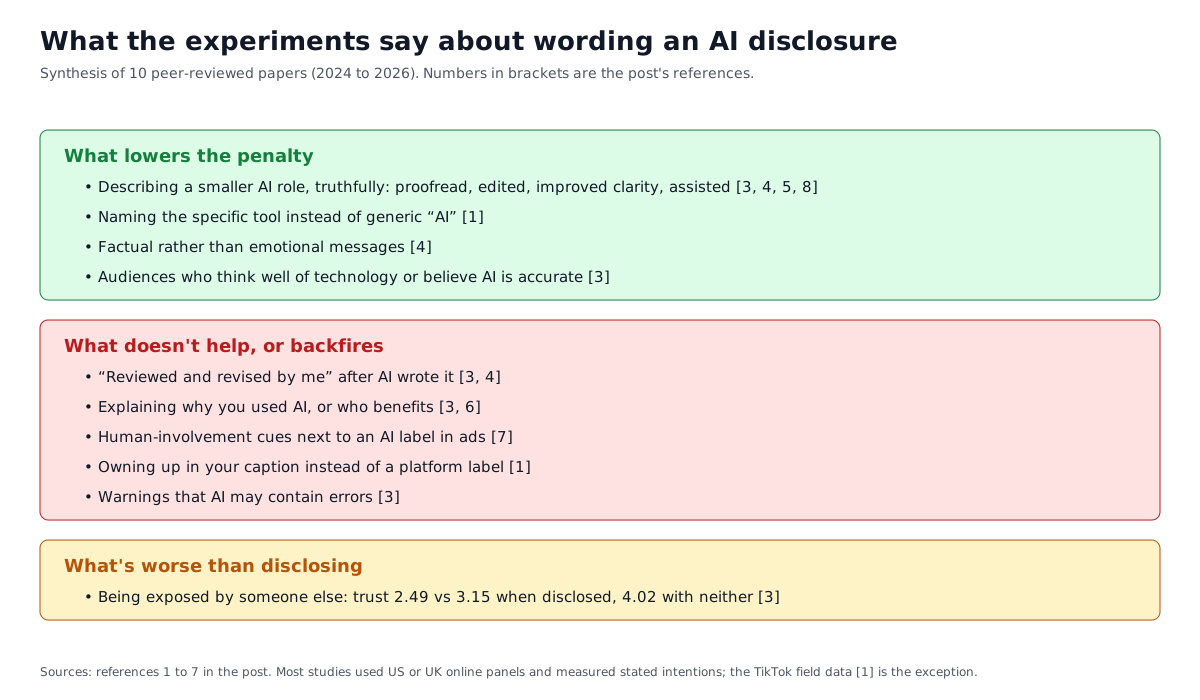
Figure 1. What ten peer-reviewed papers say about wording an AI disclosure. Sources: references 1 to 8.
Why this question, and why now
Two things have changed this year. First, AI labels have moved from the edges to the default. TikTok may add an "AI-generated" label automatically, for example when you use its AI effects or upload content made on certain other platforms, and it offers creators a "Creator labeled as AI-generated" toggle [14]. YouTube labels videos when creators tick its "AI use" setting, and may apply labels itself when it finds C2PA metadata [15]. Meta renamed its label from "Made with AI" to "AI info" in July 2024 because, in its words, the labels "weren't always aligned with people's expectations", for example on photos with minor AI retouching [13]. The EU has published optional icons that separate "Fully AI-Generated" from "Partially AI-Modified" content, and says its user testing worked better when the icon came with a text label [17].
Second, LinkedIn now recommends that members "let others know (if it isn't obvious from the context) if you've relied heavily on AI to help create or modify the content" [16]. That puts the wording in your hands, on the network where most founders post.
So the question for a founder isn't only "do I have to label this?" It's "when I do say something, what should it say?" Platforms have mostly answered a different question. TikTok says adding its label "won't affect the distribution of your video" [14], and YouTube says disclosure "alone won't limit a video's audience" [15]. Those are statements about reach. The research below is about what people do once they've seen the post.
Finding 1: the penalty is real, but it's smaller than the headlines
The biggest real-world dataset comes from Stephan Carney, Ignacio Riveros and Stephanie Tully at USC, published in the Journal of Consumer Research in May 2026 [1]. TikTok introduced its AI disclosure policy in September 2023. The team collected posts from US creators for the three months before and six months after, ending up with 1,135,817 posts from 8,650 creators. Comparing posts by the same creator, and holding views constant, posts with an AI label got roughly 7–8% fewer likes and about 7% less combined engagement.
Two details matter for reading that number. Labelled posts were rare: 2,749 out of about 822,000 posts after the policy, or around 0.3%. And labelled posts also got fewer views in the raw data, but the authors can't say whether that's the algorithm or the kind of content, which is why they compare engagement at equal views.
Lab studies point the same way. Oliver Schilke and Martin Reimann ran 13 experiments across emails, job applications, reports, tax estimates and graphic design, and found that people who disclosed AI use were trusted less every time [3]. One study is uncomfortably close to home. Participants imagined working at a small startup and read the founder's bio. When the bio said it was prepared with generative AI, trust in the founder fell from 5.63 to 4.55 out of 7 [3]. The penalty held whether participants were told disclosure was voluntary or legally required.
Not every study finds a cost. A CHI 2025 experiment with 911 participants tested ten label designs on images and found the labels changed what people believed about the image but didn't significantly change their stated likelihood to like, comment or share [9]. One study of AI-made ads found that disclosure reduced trust through one route but raised it through another [11].
An eye-tracking study of an Instagram post found AI labels didn't change where people looked, but did raise resistance to the message and lower its credibility [10].
My reading: the cost shows up most when there's a relationship to lose. The TikTok paper's explanation is that a label reduces the one-sided bond people feel with a creator, partly because it makes the creator look like they put in less effort [1]. An image from a stranger has no bond to dent. A founder's post usually does.
Finding 2: "I reviewed it" doesn't buy you anything
This is the result that surprised me most, because it's the line almost every founder guide recommends.
In Study 9 of the Schilke and Reimann paper, 518 US participants read a job applicant's motivation letter. Under it was either nothing or one of six disclosure lines. I downloaded the authors' data from OSF and re-computed the means [12]. They match the paper exactly.
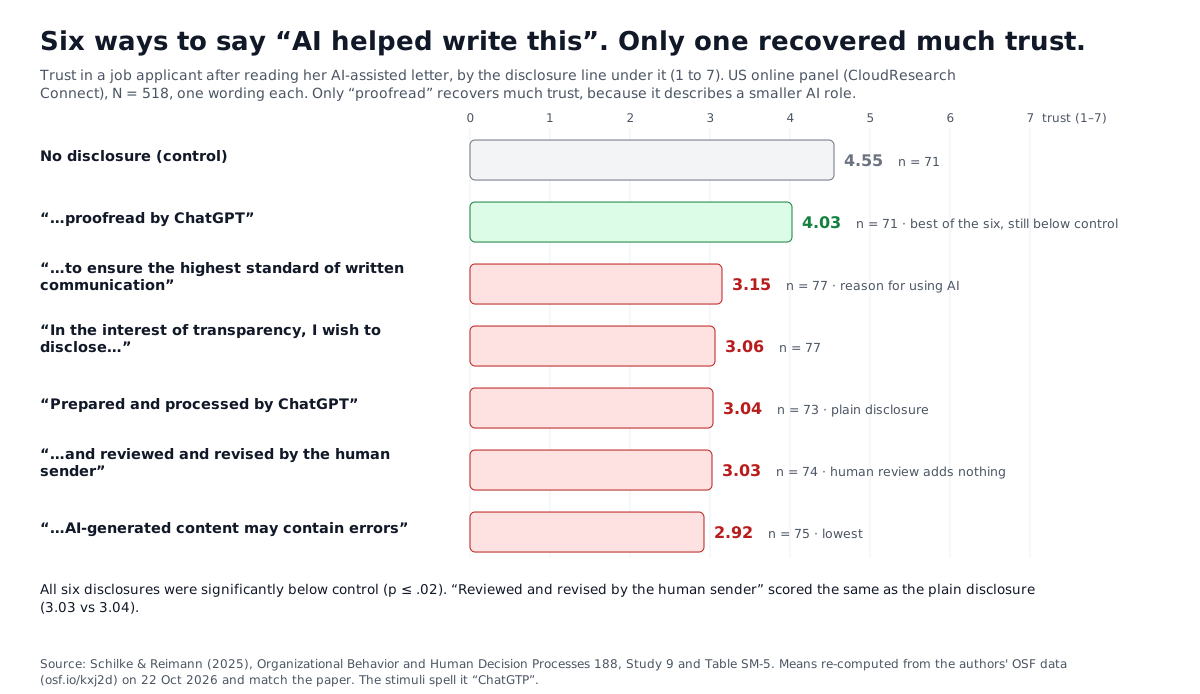
Figure 2. Trust by disclosure wording, Schilke and Reimann Study 9 (N = 518). Source: [3], re-computed from the authors' data [12].
Read down the chart:
- Plain disclosure ("This letter was prepared and processed by ChatGPT, generative artificial intelligence"): 3.04.
- Plus human review ("…and reviewed and revised by the human sender"): 3.03. No difference at all (p = 0.99 in my re-run).
- Plus a reason ("…to ensure the highest standard of written communication"): 3.15.
- Plus a transparency preamble ("In the interest of transparency, I wish to disclose…"): 3.06.
- Plus a caveat ("Please note that AI-generated content may contain errors…"): 2.92, the lowest.
- A smaller role ("This statement was proofread by ChatGPT…"): 4.03. Still below no disclosure, but most of the gap is gone.
A second lab found the same pattern with a different task. Colleen Kirk and Julian Givi ran seven preregistered experiments on emotional marketing messages [4]. In Study 3, 400 people received a condolence email from a local business after its founder died. The line under the signature changed. A line saying ChatGPT prepared the letter and the president edited it did no better than the ChatGPT-only version. A line saying the president prepared it and ChatGPT edited it did much better [19].
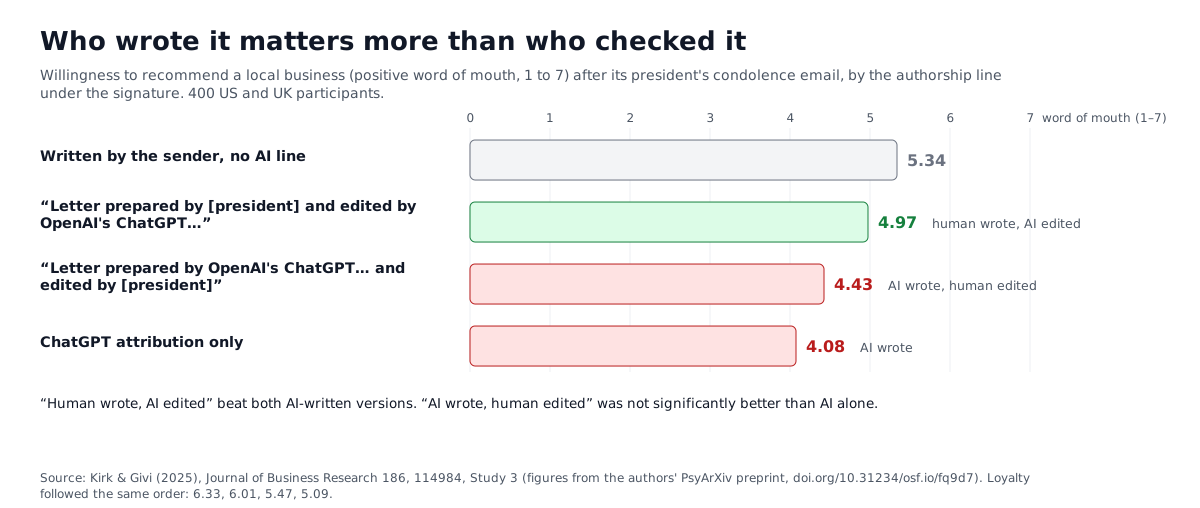
Figure 3. Who wrote it matters more than who checked it. Kirk and Givi Study 3 (N = 400). Sources: [4], [19].
Why would "I reviewed it" do nothing? Both papers point to the same idea. People judge the message by who they think originated it. Schilke and Reimann describe disclosure as a hit to perceived legitimacy, a sense that the work wasn't done the way it should be [3]. Kirk and Givi find a hit to authenticity, plus a measurable sense of moral disgust when an emotional message turns out to be machine-written [4]. Reviewing someone else's draft doesn't make you its author.
Finding 3: explaining yourself makes it worse
The next instinct is to justify the AI use: it saves time, it helps me post more, it's better for you. A team led by Timo Schreiner tested exactly that, across three preregistered studies published in August 2026 [6].
In a plain text test with 339 people, explanations overall were no better than a bare "Created with AI" label. More specific explanations did help a little there. But once the same disclosures sat inside realistic Instagram-style ads (359 people for a car brand, 359 for a soft drink), the benefit disappeared. In the soft-drink study, explanations made attitudes to the ad and the brand significantly worse. Whatever reason the ad gave, between 82% and 93% of people who noticed the disclosure still assumed the company was the main beneficiary. The explanations mostly raised suspicion of manipulative intent.
Ripinka Koli Patil and Dan Hamilton Rice found something similar for brand ads across eight studies, including one in the field [7]. AI disclosure made ads look less effortful and the product lower quality. Adding cues about human involvement made the negative effect stronger, while cues about automated production weakened it. I could only read the abstract of that paper, so I'm not quoting its effect sizes.
And on social posts specifically, saying it yourself doesn't soften the blow. In Study 4 of the TikTok paper, 565 people saw a travel creator's photo where AI had added falling snow [1]. The creator either said so cheerfully in the caption, or the platform added a label, or both, or neither. I re-ran this one from the ResearchBox data too [2].
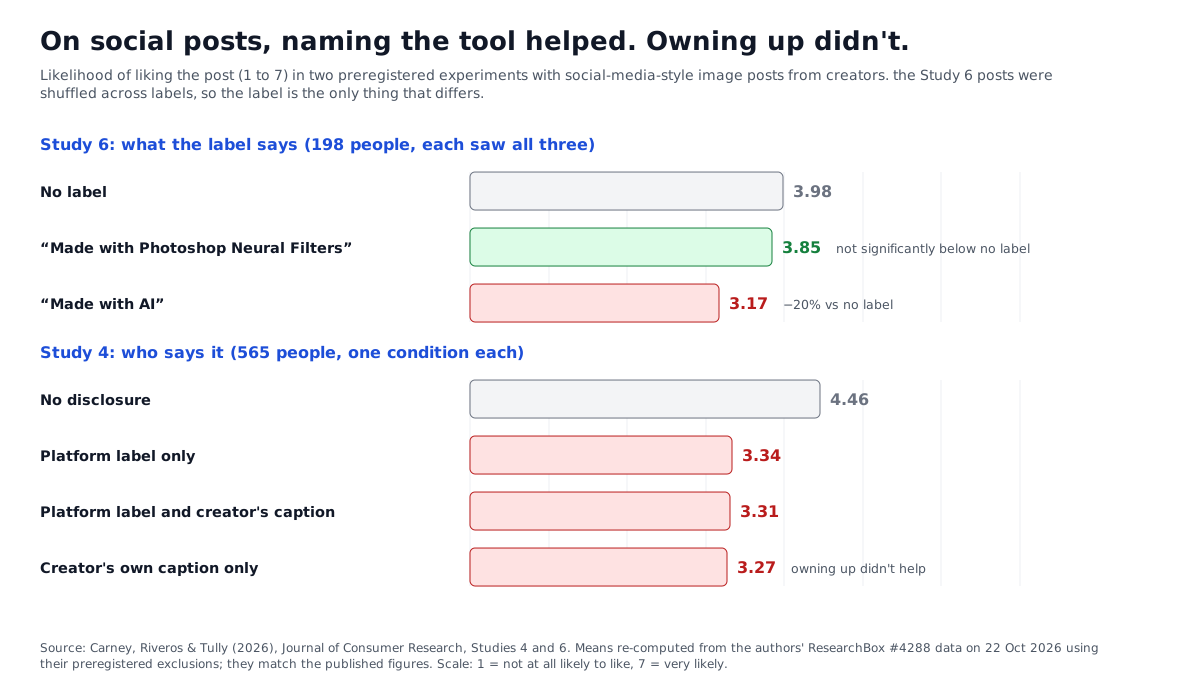
Figure 4. On social posts, naming the tool helped and owning up didn't. Carney, Riveros and Tully Studies 6 (N = 198) and 4 (N = 565). Source: [1], re-computed from [2].
The caption-only version (3.27) was no better than the platform label (3.34; p = 0.74 in my re-run). Both were well below no disclosure (4.46). What people react to is the admission, not who makes it or how cheerfully.
Finding 4: a smaller, specific AI role is the only wording that reliably helps
Every wording that worked in these studies has one thing in common. It tells people AI did less, or did something narrower, than they would otherwise assume.
- Proofreading. "Proofread by ChatGPT" recovered most of the trust gap in Schilke and Reimann's test (4.03, against 3.04 for the plain disclosure and 4.55 for none) [3].
- Editing, not writing. A human-written message edited by ChatGPT scored 4.97 for word of mouth, against 4.08 when ChatGPT wrote it [4].
- Assisting, not replacing. Jasper Brüns and Martin Meißner tested how followers react to brands that use generative AI for social posts. Over three experiments, negative reactions were weaker when AI assisted people rather than replaced them [8].
- Naming a specific tool. In Study 6 of the TikTok paper, 198 people saw three sets of posts, each with a different label. "Made with AI" cut like intent from 3.98 to 3.17, about 20%. "Made with Photoshop Neural Filters", which is also AI, scored 3.85, not significantly different from no label (p = 0.32 in my re-run) [1] [2]. A pre-test confirmed people see Photoshop as more effort to use.
- Defining the label. Sacha Altay and Fabrizio Gilardi tested news headlines with 4,976 people in the US and UK [5]. A bare "AI-generated" label lowered belief in headlines, even true and human-written ones, because people assumed AI had done everything. When participants were told it meant AI had improved clarity and style, or had written a first draft from the journalist's sources, the skepticism went away. It came back only when they were told AI chose the topic and wrote the whole article.
Two cautions. First, naming a tool isn't magic. Schilke and Reimann named ChatGPT in every wording, and it didn't stop the penalty. The Photoshop effect seems to come from the tool reading as effortful craft, and ChatGPT doesn't read that way. Second, none of this works if it isn't true. "Proofread with AI" on a post that AI wrote is a misleading claim, and Finding 5 shows what happens when that comes out.
There's one more lever, which is the kind of post. Kirk and Givi found the AI-authorship penalty was smaller for factual messages than for emotional ones [4]. A product update or a how-to is different from a post about your co-founder leaving.
Finding 5: being found out is the worst outcome
In Schilke and Reimann's Study 13, people imagined a human tax adviser preparing their refund estimate [3]. Trust was 4.02 when nothing was said about AI and 3.15 when he disclosed it himself. When a news article revealed, through an anonymous leak, that he'd used generative AI for all his estimates, trust fell to 2.49.
For founders that's the strongest argument for saying something when your AI use is significant. It's also getting harder to hide. TikTok and YouTube can apply labels automatically, and in some cases creators can't remove them [14] [15]. LinkedIn lets members flag posts as "Seems like AI slop" [16]. If a platform labels your image before you've said anything, you're closer to the exposure condition than the disclosure one.
Methodology
Question. What does the published evidence say about how the wording of an AI disclosure affects trust and engagement, and what should a founder who posts with an AI assistant write?
Gap check. On 22 October 2026 I searched for founder-facing guides on wording AI disclosures. The most visible ones, from agencies and tool vendors, recommend lines like "the thinking is mine; AI polished it", and some quote trust figures attributed to Edelman, ScienceDirect or MarketingProfs that I couldn't find in any published study. Practitioner summaries of the academic work exist, but each covers one paper. I found none that set the wording tests from different labs side by side, and none that noticed the human-review result.
Inclusion. Peer-reviewed journal or conference papers, 2024 to 2026, that either changed the wording or source of an AI disclosure experimentally or measured labelled versus unlabelled content in the field. Ten papers met that bar [1] [3] [4] [5] [6] [7] [8] [9] [10] [11]. I read the full text of six and the abstracts of the other four, and I only quote effect sizes I read in full text or re-computed myself.
Re-analysis. Two teams published their data. From Schilke and Reimann's OSF repository [12] I re-computed the Study 9 means for all seven conditions (N = 518). From Carney, Riveros and Tully's ResearchBox [2] I re-computed Study 4 (N = 565, after the preregistered attention and bot-check exclusions in the authors' SPSS syntax) and Study 6 (198 participants, 594 ratings). All the means match the published figures. The p-values in Findings 2 to 4 are my own simple t-tests (independent samples for between-subjects designs, paired for Study 6). They are there to show which gaps are noise, not to replace the authors' models.
Platform labels. Taken from the platforms' own help and policy pages, read on 22 October 2026 [13] [14] [15] [16] [17].
Limitations.
- Most experiments used US or UK online panels and asked what people would do, not what they did. The TikTok dataset is the only behavioural field evidence here, and its labels were partly self-applied, so labelled posts aren't a random sample.
- None of the studies tested a founder's text post on LinkedIn or X directly. The closest are a founder's bio, a job applicant's letter and a business's email (Schilke and Reimann; Kirk and Givi). The social-post studies used images.
- Effects are averages. Schilke and Reimann found the penalty was smaller among people with positive attitudes to technology and among people who think AI is accurate [3], and an AI-savvy audience may react differently.
- Norms are moving. Kirk and Givi found the effect shrank when people believed most marketing is written by AI [4]. These numbers may age.
What I'd do as a founder
- Decide whether to disclose before deciding how. If AI did a lot of the writing or made a realistic image, say so. LinkedIn recommends it when you've "relied heavily on AI" [16], and being exposed later is the worst outcome in the data. If AI only helped with things YouTube itself doesn't ask creators to disclose, like an outline, idea generation or a caption [15], a label is a judgement call.
- Describe what AI actually did, in a few words. "Proofread with Claude." "Image made in Midjourney." "AI drafted this from my notes." A narrow, accurate description beats a generic "Made with AI" in every study that compared them.
- Drop the padding. Don't add "I reviewed every word", "in the interest of transparency", a reason, or a warning that AI can make mistakes. None of these helped. Explanations sometimes made things worse, and the caveat scored lowest of all [3] [6].
- If you want a cheaper label, change the workflow, not the wording. The only disclosures that kept most of the trust described a smaller AI role. You can't write "proofread with AI" honestly unless you wrote the post. So on the posts where you are the point (a lesson you learned, a customer story, a hiring post), write the first draft yourself and use AI to tighten it. Save AI-first drafting for factual posts like product updates and how-tos, where the penalty is smaller [4].
- Expect platforms to label images for you. If you post AI images to TikTok or YouTube, assume a label may appear whether you add one or not [14] [15]. On Meta, an image detected as AI-generated shows "AI info" on the post; for AI-edited images the label sits in the menu [13]. Say it first, in your own specific words.
- Measure per view, not per post. If you test labels on your own account, compare likes per impression, the way the TikTok study did [1]. Labelled posts may also reach fewer people, and raw likes mix the two effects.
A note on how we work at Deynix
I build Deynix, so I should say how this applies to us. Deynix drafts posts in your voice from your site, your Notion and the thoughts you save, and nothing goes out until you approve it [18]. This research is a useful check on that design. By itself, an approval step doesn't change how a disclosure reads: "I reviewed it" bought nothing in the experiments. What matters is how much of the post started with you. That's why it writes from your own site, Notion and saved thoughts rather than a blank prompt, and why you can edit or reject anything in Review that doesn't sound like you.
This post was researched and drafted with an AI assistant. Every number was checked against the papers and the authors' data before it went up.
References
- Stephan Carney, Ignacio Riveros and Stephanie M. Tully, "Made With AI: Consumer Engagement With Social Media Containing AI Disclosures", Journal of Consumer Research, published 7 May 2026, ucag013. doi.org
- Carney, Riveros and Tully, supplementary data and code, ResearchBox #4288 (Study 4 and Study 6 data used for re-analysis). researchbox.org
- Oliver Schilke and Martin Reimann, "The transparency dilemma: How AI disclosure erodes trust", Organizational Behavior and Human Decision Processes 188 (2025), 104405. doi.org
- Colleen P. Kirk and Julian Givi, "The AI-authorship effect: Understanding authenticity, moral disgust, and consumer responses to AI-generated marketing communications", Journal of Business Research 186 (2025), 114984. doi.org
- Sacha Altay and Fabrizio Gilardi, "People are skeptical of headlines labeled as AI-generated, even if true or human-made, because they assume full AI automation", PNAS Nexus 3(10), October 2024, pgae403. doi.org
- Timo Schreiner, Yakov Bart, Koen Pauwels, Cosima Schütze and Fabian Buder, "'Made with AI' but why? How consumers interpret beneficiary-framed AI disclosures in advertising", Journal of Marketing Analytics, published 27 August 2026. link.springer.com
- Ripinka Koli Patil and Dan Hamilton Rice, "Is that your best effort? How AI-use disclosure in digital advertising affects perceived effort and engagement", Journal of Business Research 215 (2026), 116354. doi.org
- Jasper David Brüns and Martin Meißner, "Do you create your content yourself? Using generative artificial intelligence for social media content creation diminishes perceived brand authenticity", Journal of Retailing and Consumer Services 79 (2024), 103790. doi.org
- Dilrukshi Gamage, Dilki Sewwandi, Min Zhang and Arosha K. Bandara, "Labeling Synthetic Content: User Perceptions of Label Designs for AI-Generated Content on Social Media", CHI 2025. arxiv.org
- Marie Berner and Petra Dickel, "It's just a tiny label… or not? How AI labels can backfire in communication", Journal of Marketing Communications, published July 2026. doi.org
- Britta Koning and Hilde A. M. Voorveld, "Disclaimer! This Content Is AI-Generated: How AI-Disclosures Influence Trust in Advertisements and Organizations", Journal of Interactive Advertising 25(3) (2025). doi.org
- Schilke and Reimann, data and syntax repository for "The transparency dilemma", Open Science Framework (Study 9 data used for re-analysis). osf.io
- Meta, "Our Approach to Labeling AI-Generated Content and Manipulated Media", 5 April 2024, updated 1 July and 12 September 2024. about.fb.com
- TikTok, "AI-generated content", read 22 October 2026. tiktok.com
- YouTube Help, "Disclosing use of GenAI content", read 22 October 2026. support.google.com
- LinkedIn Help, "Best practices for content created with the help of AI", read 22 October 2026. linkedin.com
- European Commission, "EU Icons for labelling AI-generated content", read 22 October 2026. digital-strategy.ec.europa.eu
- Deynix, homepage, read 22 October 2026. deynix.com
- Kirk and Givi, "The AI-Authorship Effect" (preprint with full Study 3 results), PsyArXiv. osf.io
Browse all updates in News.