Claude and ChatGPT now watermark their text. Can anyone tell from your LinkedIn post?
Since August, Claude's newer models hide a statistical watermark in their text, and OpenAI has started doing the same for ChatGPT in the EU. I checked what the providers, the EU's Code of Practice and the research say about short text, then ran an open test at social-post lengths. Most posts sit below the length where these marks are reliable, light edits weaken them fast, and nobody outside vetted groups can check them yet. None of that changes when you need to say AI helped.

By Kyle Kirkby
Published | Updated
Since August, text from Claude's newer models has carried an invisible watermark. Anthropic announced it on 14 August 2026 and applies it worldwide [5]. On 5 October, OpenAI said it would add its own text watermark, textGrain, to ChatGPT and Codex output in the EU "over the coming weeks", and let API customers anywhere opt in [7]. Google has watermarked Gemini text with SynthID for longer [11]. All three are responding to the EU AI Act, which since 2 August 2026 has required AI providers to make their output detectable by machine [4].
Founders I talk to keep asking the same two things. If I draft a LinkedIn post with Claude, can LinkedIn, a client or a competitor tell? And do I need one of the "humanizer" tools that promise to strip the mark?
Most of what's been written so far either lists which models watermark, or sells a way around it. What I couldn't find was anyone setting the length of real social posts against the length these watermarks need, using the providers' own numbers. So I did that, and ran a small open test to fill in the short end of the curve, where the providers publish little. I also checked who can actually run a detector today and what the disclosure rules say.
This is a research summary, not legal advice. The Deynix part is short and near the end.
Executive summary
- Most social posts are shorter than the length where text watermarks start to work. The EU's Code of Practice says current methods reach "at least a basic level of reliability" at about 200 tokens, and it treats anything shorter as "very short text" that providers don't have to watermark [1]. A full 280-character X post is about 53–70 tokens. The median LinkedIn post, 1,011 characters, is about 190–250 tokens, right on the line [15] [16]. About half of LinkedIn posts are below it.
- Detection gets better with length, and the providers say so. At a 1% false-positive rate, OpenAI's detector found its watermark in about 80% of 200-token passages and about 95% of 400-token passages, with "substantially lower" rates for maths-style content [7]. Anthropic says detection "doesn't work well on small samples" [5]. In my open test, a stronger-than-commercial watermark was caught in 66% of posts at 50 tokens and 93% at 100 tokens at a similar false-positive rate.
- Editing wears it down quickly. In OpenAI's test on 400-token passages, swapping 10% of words for synonyms cut detection from about 92% to 66%, and swapping 25% cut it to 17% [7]. In my test, swapping a quarter of the tokens in a 200-token post cut detection from 100% to 46%. An AI paraphraser cut one research watermark from 100% to 57% at 300 tokens [14]. Anthropic says light editing "probably won't remove" its mark and a complete rewrite will [5].
- Almost nobody can check yet. Anthropic's and OpenAI's text detectors are limited to approved organisations and researchers [5] [7]. Google's public SynthID Detector checks images, video and audio, not text [10]. LinkedIn's and Meta's published AI labels read metadata on images and video, and I found nothing from either saying they read text watermarks [19] [21].
- A watermark isn't a disclosure, and removing one doesn't remove a duty to disclose. The Commission's guidelines say people publishing AI content "cannot rely on the machine-readable marking embedded in the content by the provider" to meet their own labelling duty [3]. OpenAI says a watermark doesn't establish "whether disclosure was required" [7]. Your obligations are the same whether the mark is there or not.
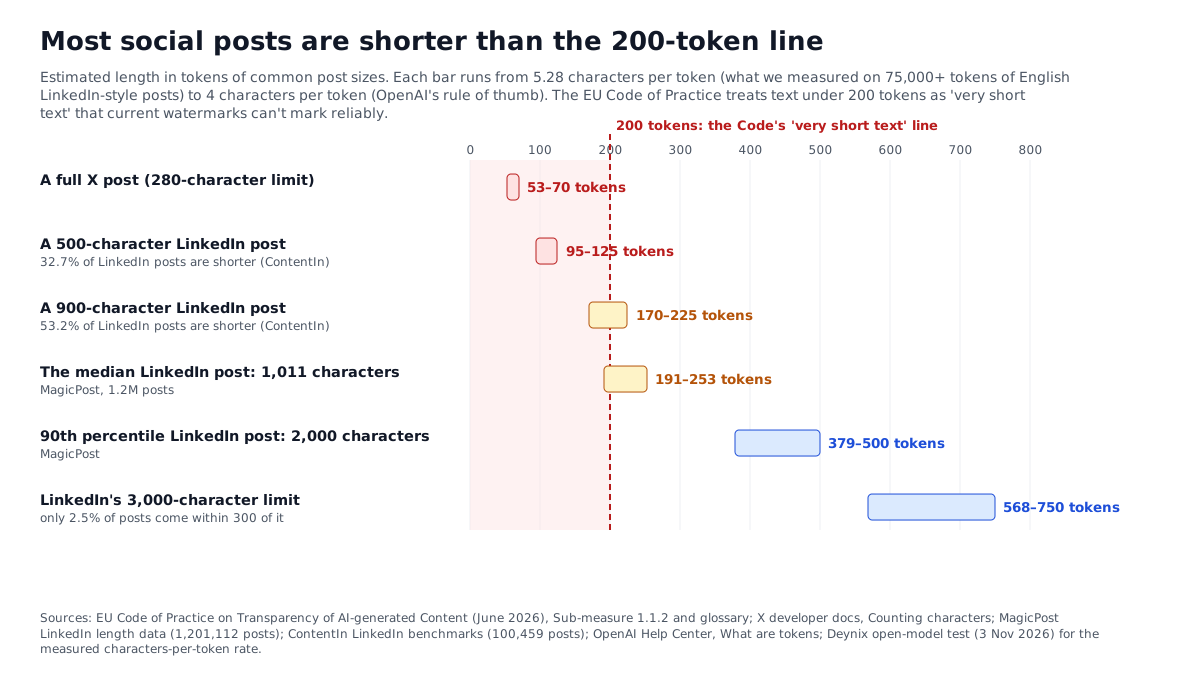
Figure 1. Common post sizes converted to tokens, at 5.28 characters per token (measured on my test posts) and 4 characters per token (OpenAI's rule of thumb). Sources: [1], [15], [16], [17], [18].
What changed this autumn
The EU AI Act's Article 50(2) requires providers of AI systems that generate text, images, audio or video to mark their output "in a machine-readable format and detectable as artificially generated" [4]. It has applied since 2 August 2026. Providers whose systems were already on the market before that date have until 2 December 2026 [3].
How to do it is set out in the Code of Practice on Transparency of AI-generated Content, finalised on 10 June 2026 and signed by about 190 organisations by the end of July [2]. For text, it asks for an "imperceptible watermark, with the exception of very short text". For free-form text longer than 200 tokens, it says watermarking "still needs to be applied, even though it may have lower reliability", and that detection may be limited to "verified expert users" to compensate [1]. Signatories also have to make their detectors work together by 2 February 2027 [1].
Here's where each of the big three stands as of 3 November 2026:
- Anthropic uses "a version of the SynthID-Text approach" and applies it globally, because it doesn't "yet have a durable way to scope it by region". It says the mark adds no characters, costs nothing extra and "can't be traced to a specific person, organization, or chat" [5]. Its Help Center lists text watermarking on 9 of the 16 models in its table, including Opus 5.5, Sonnet 5.5 and Haiku 5.5. Older models, including Sonnet 4.6 and Haiku 4.5, don't have it yet, and Anthropic says they'll get it "over the coming months" [6] [5]. The Help Center says the mark survives copy and paste and also applies when you use Claude through AWS, Google Cloud or Microsoft Foundry [6].
- OpenAI's textGrain is opt-in and off by default in the API worldwide. It's being added to "eligible ChatGPT and Codex users across all plans in the EU only", and OpenAI says it is "not making text watermarking a global default at launch" [7]. The Verge reported the same split [9]. So if you write in ChatGPT from London, your text isn't watermarked today. A colleague in Dublin will soon be getting watermarked text.
- Google published SynthID-Text in Nature in 2024, after testing it on about 20 million Gemini responses, and open-sourced it [11]. The open version is in Hugging Face Transformers [23].
All three schemes work the same basic way. When the model chooses between words that would do equally well, a secret key settles the choice instead of pure chance. Anthropic's example is "cold and..." followed by "overcast" or "grey". Anyone with the key can then count how often the text made the key's preferred choices [5]. One word tells you nothing. A few hundred words add up to a strong statistical signal. That's why length matters so much.
Finding 1: most posts are below the line
To compare posts with the 200-token threshold, you need two numbers: how long posts are in characters, and how many characters make a token.
Post lengths. X's standard limit is 280 characters [15]. On LinkedIn, MagicPost's analysis of 1,201,112 posts found a median of 1,011 characters and a 90th percentile of 2,000. Only 2.5% came within 300 characters of the 3,000-character cap [16]. ContentIn's sample of 100,459 posts from 1,054 personal profiles splits by length band. Of the 98,921 posts in its bands, 32.7% were under 500 characters and 53.2% under 900 [17]. The two studies line up: about half of LinkedIn posts are under about 1,000 characters.
Characters per token. OpenAI's rule of thumb is that one token is about 4 characters, or ¾ of a word, in English [18]. On the 192 LinkedIn-style posts from my test (396,794 characters), OpenAI's o200k tokenizer averaged 5.28 characters per token. Claude, Gemini and GPT models each use their own tokenizers, so I've used both rates as a range rather than claim one exact figure.
That gives the ranges in Figure 1:
- A full X post is about 53–70 tokens, well under 200. A reply is usually shorter still.
- A 900-character LinkedIn post is about 170–225 tokens.
- The median LinkedIn post is about 191–253 tokens, so it sits right on the threshold.
- Only long posts, around the 90th percentile and above, get to 380–750 tokens, where the providers' detection rates are highest.
If I interpolate within ContentIn's bands, somewhere between 48% (at 4 characters per token) and 61% (at 5.28) of LinkedIn posts are under 200 tokens. That interpolation assumes posts are spread evenly within a band, so treat it as "about half" rather than a precise figure.
Two things follow. First, the Code doesn't require providers to watermark text under 200 tokens at all [1]. OpenAI's help page makes the same point, putting 200 tokens at "about 150 words in English" [22]. Neither OpenAI nor Anthropic says it skips short responses, so I'm assuming short outputs may still carry a mark, just a weak one. Second, the watermark lives in the words the model chose. A draft that you cut from 400 tokens to 150 keeps only the signal in those 150 tokens.
Finding 2: detection depends on length, and short text is the weak spot
The providers' own figures are blunt. OpenAI reports that at a 1% false-positive rate, textGrain was detected in about 80% of 200-token passages and about 95% of 400-token passages of psychology-style answers. For maths answers, where "there is less flexibility in word choice", rates were "substantially lower" [7]. Anthropic says detection "doesn't work well on small samples" and is "sparser on factual passages" and on proofreading [5]. Google's SynthID paper and the open-source docs say the same: detection is probabilistic and gets stronger with more text [11].
A 1% false-positive rate also matters at scale. It means about one in a hundred human-written passages of that length would be flagged. That's one reason OpenAI gives for limiting its detector to "approved researchers and expert organizations" [7].
Nobody publishes numbers below 200 tokens, which is where X posts and replies live. So I ran a test. I took the open watermark from Kirchenbauer and colleagues' 2023 paper, which Hugging Face Transformers implements [12] [23]. I had a small open model write 96 founder-style LinkedIn posts with the watermark and 96 without, then ran the detector on the first 25, 50, 75, 100, 150, 200, 300 and 400 tokens of each. The full method is below.
This is not Claude's or OpenAI's watermark, and I don't have access to either detector. I set the watermark strength to the paper's standard setting, which nudges word choice harder than the quality-neutral commercial schemes do. That's why my 200-token result (100%) beats OpenAI's (about 80%). Read my curve as a best case for detection. Real schemes will sit at or below it.
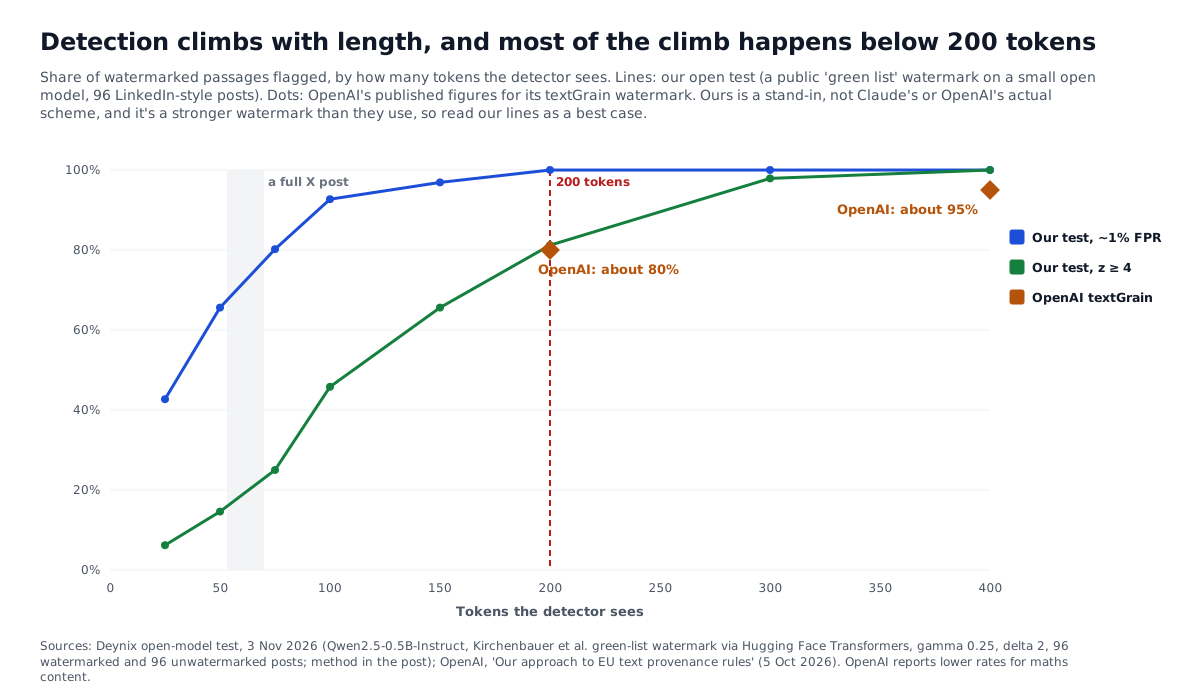
Figure 2. Detection rate by length. Lines are my open test (96 watermarked posts per point). Diamonds are OpenAI's published textGrain figures for psychology content. Sources: [7], [12], and my analysis.
Even with a strong watermark, results at X-post length were mixed. At a threshold with about a 1% false-positive rate, my detector caught 66% of 50-token passages and 80% of 75-token ones. At the strict threshold the Kirchenbauer paper recommends (z ≥ 4, a theoretical false-positive rate of about 3 in 100,000), it caught 15% at 50 tokens and 25% at 75 [12]. It flagged none of the 96 unwatermarked posts at the strict threshold, and 0–3% at the looser one.
So the honest answer for a single X post or reply is that a detector set to avoid false accusations will usually miss it. A long LinkedIn post or an article written mostly by the model is a different story.
Finding 3: edits weaken the mark fast, but don't wipe it
OpenAI tested editing on 400-token passages. Swapping 10% of the words for synonyms cut detection from about 92% to 66%. Swapping 25% cut it to 17% [7]. Anthropic says "light editing probably won't remove the watermark completely; a complete rewrite where every word is replaced will" [5].
I ran a similar test. I replaced a random 10%, 25% or 50% of tokens in each watermarked post with the next-best token the model would have picked without the watermark. That's a rough stand-in for swapping a word, not a human edit.
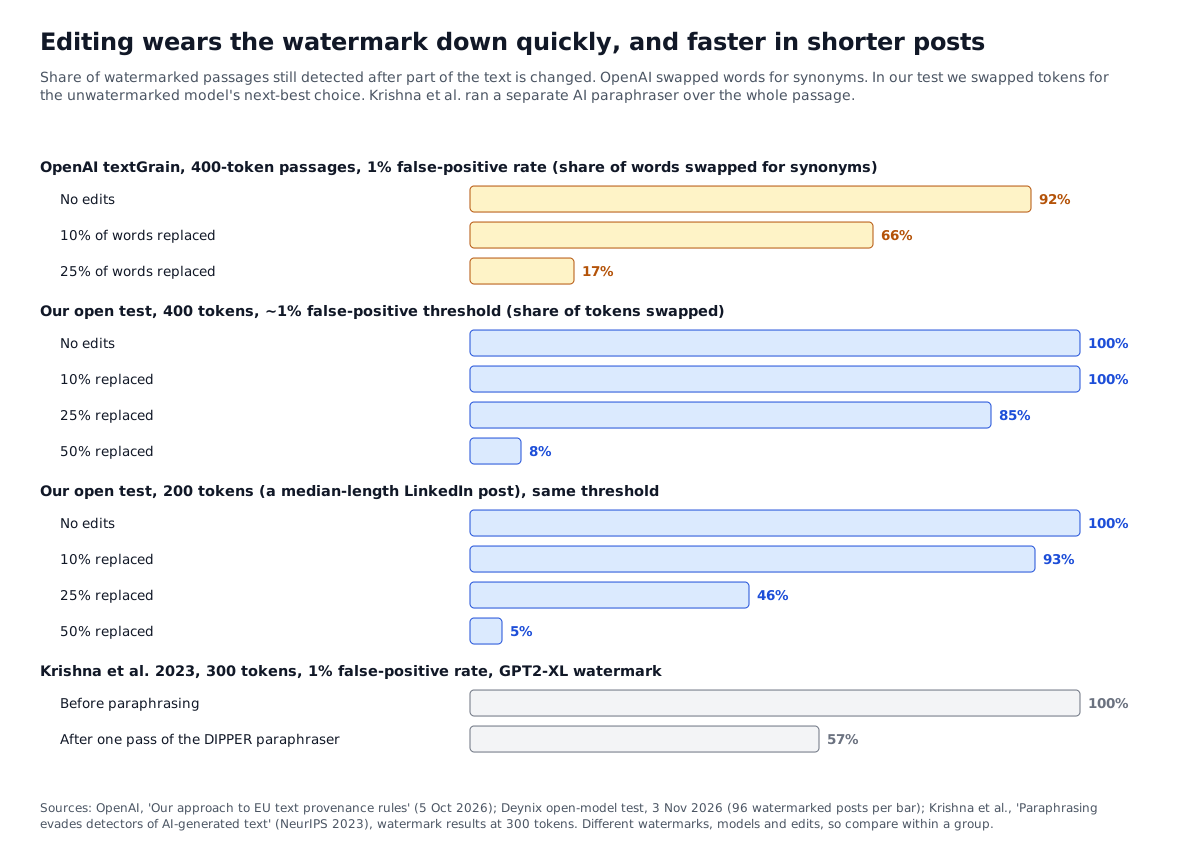
Figure 3. Detection after editing. The watermarks, models and kinds of edit differ, so compare bars within a group. Sources: [7], [14], and my analysis.
The pattern is the same in all three sources: the shorter the text, the less editing it takes. My 400-token posts still came up 85% of the time after a quarter of their tokens were swapped. At 200 tokens, the same edit brought it down to 46%. Half the tokens swapped left almost nothing at either length.
AI paraphrasing does more damage. Krishna and colleagues ran watermarked text through their DIPPER paraphraser. At 300 tokens and a 1% false-positive rate, detection fell from 100% to 57.2% for one model and from 99.9% to 52.8% for another [14]. The same paper showed DetectGPT, a style-based detector, falling from 70.3% to 4.6% [14].
The marks don't disappear easily on longer text, though. Kirchenbauer's follow-up study found that, after strong paraphrasing by people, the watermark could still be detected once the detector saw about 800 tokens on average, at a 1 in 100,000 false-positive rate. They also found that 150 watermarked tokens mixed into 600 human-written tokens could still be picked out reliably, with an AUC above 0.95 [13]. Translation doesn't help either. Anthropic says a translation by Claude "carries a watermark, because in this case every word is chosen by Claude" [5].
For founders, this means a short post you've rewritten in your own words is very unlikely to carry a usable signal. A long newsletter pasted in with only light edits may well carry one.
Finding 4: who can check today
Even when a mark is there, someone needs the key to read it, and access is tight:
- Anthropic's detection API is in private preview. It's available to "eligible organizations as required under EU law", including regulators, media, fact-checkers and researchers, and to enterprises that need it for their own compliance [5].
- OpenAI's text detector is open to applications from approved researchers and expert organisations. OpenAI says it isn't making it public "given the risk of missed watermarks and false positives" [7].
- Google's SynthID Detector has been open to everyone since 7 October 2026, but for images, video and audio only. It doesn't check text [10].
- Each key only checks its own model. Anthropic says its key can't tell whether text came from another AI, even one that uses watermarks [5]. The Code's 2 February 2027 interoperability deadline is meant to make detection work across providers [1].
On the platforms, LinkedIn's Content Credentials label shows C2PA metadata on images and video [19]. Meta's labelling approach uses C2PA and IPTC metadata on images and relies on self-disclosure for video and audio [21]. I found nothing from LinkedIn, Meta or X saying they read text watermarks, and nothing in Anthropic's or OpenAI's lists of who gets detector access names a social platform. Some websites claim LinkedIn already reads them. I couldn't find any primary source for that, so I'd treat it as unproven.
So today a client, a recruiter or a competitor can't check your post for a Claude or ChatGPT watermark. They can still use the style-based "AI detectors", which have nothing to do with watermarks and have their own accuracy problems [5]. That's likely to change over 2027 as detectors open up and connect, so don't plan around it staying this way.
Finding 5: a watermark is not a disclosure
This part matters most, and it's where the "humanizer" pitch goes wrong.
The watermark is the provider's duty under Article 50(2). Your duty as the person publishing is separate. Under Article 50(4), deployers who publish AI-generated text "with the purpose of informing the public on matters of public interest" have to disclose it, unless it has gone through human review or editorial control and someone holds editorial responsibility for it [4]. The Commission's guidelines say deployers "cannot rely on the machine-readable marking embedded in the content by the provider", because people can't see it [3]. OpenAI's help article says its provenance signals "do not replace visible labels" [22].
The reverse holds too. OpenAI says a watermark doesn't tell you "whether disclosure was required", how much human judgement went in, who the user was or whether the text is accurate [7]. Anthropic says a watermark "doesn't say anything about ownership or authorship" [5].
In practice:
- If you didn't need to disclose, the watermark doesn't create a duty to. Most marketing posts fall outside the EU text rule, as I covered in the EU post [24].
- If you did need to disclose, stripping the watermark doesn't fix it. That includes a post on a matter of public interest you haven't properly reviewed, or a platform rule that asks you to label heavily AI-assisted content. LinkedIn's guidance says you're responsible for what you post and recommends being open when you've relied heavily on AI [20].
- The review exemption depends on what you actually did, not what's in the text. The Commission wants substantive human review, not a rubber stamp [3]. I covered what counts in the human review post [25].
Practical takeaways
- Don't pay for a humanizer to hide short posts. For an X post or a typical LinkedIn update, there's usually little signal to hide and nobody outside vetted groups who can read it. For long text, Anthropic's position is that you'd have to rewrite almost everything [5], at which point you've written it yourself.
- Assume long-form AI drafts carry a mark. Articles, newsletters, LinkedIn documents and long posts over about 400 tokens (roughly 1,600–2,100 characters) are where detection is strong, even after light edits and translation [7] [13]. If it matters to you that something reads as your own work, rewrite it properly rather than tidying it.
- Decide on disclosure using the rules, not the watermark. Ask whether the post informs the public on a matter of public interest, whether you've reviewed it properly, and what your platform and advertising rules ask. The watermark doesn't change any of those answers [3].
- Keep a short record of your review. If anyone ever runs a detector on your work, a note of who checked the post and when is more useful than an argument about the statistics. The human review exemption depends on that review having happened [4].
- Know which tools mark what. Claude's current models watermark text everywhere. ChatGPT does so in the EU only, and the API only if the developer opts in [6] [7]. Files and images from Claude and ChatGPT carry C2PA metadata, and LinkedIn already shows that on images and video [6] [7] [19].
- Revisit this in February 2027. That's the Code's deadline for detectors to work together, and providers say they'll widen access over time [1] [5].
Where Deynix fits
Deynix drafts replies, quotes and posts in your voice, and nothing posts without your approval. You can use it in the app or from Claude, ChatGPT or Cursor [26]. Most of what it drafts is short: X replies, which you post yourself, and posts for X and LinkedIn [26]. As this research shows, that's where text watermarks are weakest. But the length of a post was never the point. Every draft waits in Review until you approve it [26]. That's the step where you check the substance and add any disclosure the post needs. Deynix won't decide that for you.
Methodology
Sources. I read the EU AI Act's Article 50, the Commission's July 2026 guidelines and the final Code of Practice (the PDF itself, for the 200-token passages). I read Anthropic's and OpenAI's announcements, the Claude Help Center model table, OpenAI's textGrain technical report [8] and Google's SynthID paper and Detector announcement. I cross-checked the provider details against news coverage, including The Verge [9]. The textGrain report covers the method but doesn't repeat the detection rates, so those come from OpenAI's announcement. Post lengths come from two independent LinkedIn datasets and X's developer documentation. All sources were accessed on 3 November 2026.
Converting characters to tokens. I used two rates: 4 characters per token (OpenAI's rule of thumb [18]) and 5.28, which I measured by running OpenAI's o200k tokenizer over the 192 English posts in my test (396,794 characters, 75,154 tokens, 0.81 words per token). Claude and Gemini use their own tokenizers, so treat token counts as ranges. The "about half" share interpolates linearly within ContentIn's length bands.
Open watermark test. I used Qwen2.5-0.5B-Instruct, a small open model, to write 96 LinkedIn-style posts. That's 24 founder topics (such as hiring a first engineer or losing a big customer) in 4 formats, each of about 300 words. I generated each prompt twice, with and without the Kirchenbauer et al. watermark from Hugging Face Transformers (green-list ratio 0.25, bias 2.0, one-token context). Sampling used temperature 0.7 and top-p 0.95, with exactly 400 new tokens per post. I scored the first 25 to 400 tokens of every post with the library's detector, ignoring repeated token pairs. I report two thresholds: z ≥ 2.326 (about a 1% false-positive rate in theory) and z ≥ 4 (the paper's recommended threshold). For the edit test, I replaced a random 10%, 25% or 50% of tokens with the model's most likely alternative token at that position, without the watermark. The scripts, generated posts and results are kept with this post's working files.
Limitations. My test uses an open research watermark on a small model, not Anthropic's, OpenAI's or Google's schemes, and I had no access to their detectors. My watermark is stronger than the commercial ones, so it overstates detection. With 96 posts per point, each rate is accurate to within about ±5–10 percentage points. Fixing every post at 400 tokens means some ran past a natural ending. Swapping a token is cruder than a human edit. The post-length datasets come from companies that sell LinkedIn tools. Platform policies and detector access are changing month to month, and I could only check what's published.
References
- European Commission (10 June 2026). "Code of Practice on Transparency of AI-generated Content" (final text, PDF). https://ec.europa.eu/newsroom/dae/redirection/document/129555
- European Commission. "Code of Practice on Transparency of AI-generated Content" (policy page). https://digital-strategy.ec.europa.eu/en/policies/code-practice-ai-generated-content
- European Commission (20 July 2026). "Guidelines on the transparency obligations for providers and deployers of AI systems under Article 50 AI Act", C(2026) 5054. https://ec.europa.eu/newsroom/dae/redirection/document/131215
- AI Act Service Desk. "Article 50: Transparency obligations for providers and deployers of certain AI systems." https://ai-act-service-desk.ec.europa.eu/en/ai-act/article-50
- Anthropic (14 August 2026, updated 1 September 2026). "How Claude's text watermark works." https://www.anthropic.com/news/claude-text-watermark
- Claude Help Center. "How Claude marks AI-generated content." https://support.claude.com/en/articles/16266773-how-claude-marks-ai-generated-content
- OpenAI (5 October 2026). "Our approach to EU text provenance rules." https://openai.com/index/eu-text-provenance/
- Li, X., Wen, G., Chen, X., Long, Q., Jain, A., Joly, F., Lam, M., Song, Q., and Su, W. (5 October 2026). "textGrain: Entropy-Calibrated Watermarking for Language Model Text." OpenAI technical report (PDF). https://cdn.openai.com/pdf/e9508624-d767-41b6-a26d-e34ca798ada6/textgrain-entropy-calibrated-watermarking-for-language-model-text.pdf
- The Verge (5 October 2026). "OpenAI is adding text watermarking in ChatGPT and Codex." https://www.theverge.com/ai-artificial-intelligence/1004880/openai-chatgpt-text-watermarks-eu-ai-act
- Google (7 October 2026, updated 29 October 2026). "Google expands SynthID Detector for AI content." https://blog.google/innovation-and-ai/models-and-research/google-deepmind/synth-id-ai-content/
- Dathathri, S., et al. (2024). "Scalable watermarking for identifying large language model outputs." Nature 634, 818–823. https://www.nature.com/articles/s41586-024-08025-4
- Kirchenbauer, J., Geiping, J., Wen, Y., Katz, J., Miers, I., and Goldstein, T. (2023). "A Watermark for Large Language Models." ICML 2023. https://arxiv.org/abs/2301.10226
- Kirchenbauer, J., et al. (2024). "On the Reliability of Watermarks for Large Language Models." ICLR 2024. https://arxiv.org/abs/2306.04634
- Krishna, K., Song, Y., Karpinska, M., Wieting, J., and Iyyer, M. (2023). "Paraphrasing evades detectors of AI-generated text, but retrieval is an effective defense." NeurIPS 2023. https://arxiv.org/abs/2303.13408
- X Developer Platform. "Counting characters." https://docs.x.com/fundamentals/counting-characters
- MagicPost. "How many characters in a LinkedIn post? Limits + data." https://magicpost.in/blog/how-many-characters-in-a-linkedin-post
- ContentIn. "LinkedIn Engagement Benchmarks 2026: Median Data From 100,000 Posts." https://contentin.io/blog/linkedin-engagement-benchmarks/
- OpenAI Help Center. "Understanding and counting tokens." https://help.openai.com/en/articles/4936856-what-are-tokens-and-how-to-count-them
- LinkedIn Help. "Content credentials." https://www.linkedin.com/help/linkedin/answer/a6282984
- LinkedIn Help. Best practices for using AI-generated content. https://www.linkedin.com/help/linkedin/answer/a1481496
- Meta (6 February 2024, updated). "Labeling AI-Generated Images on Facebook, Instagram and Threads." https://about.fb.com/news/2024/02/labeling-ai-generated-images-on-facebook-instagram-and-threads/
- OpenAI Help Center. "Provenance signals in OpenAI-generated content." https://help.openai.com/en/articles/8912793-provenance-signals-in-openai-generated-content
- Hugging Face Transformers documentation. "Utilities for Generation" (watermarking configs and detectors). https://huggingface.co/docs/transformers/main/en/internal/generation_utils
- Deynix (20 October 2026). "Your AI drafts, you approve: do your social posts need an AI label in the EU?" /news/eu-ai-act-labels-ai-drafted-social-posts
- Deynix (30 October 2026). "Does a human review step actually catch AI mistakes? What the research on checking AI drafts shows" /news/human-review-ai-drafts-research
- Deynix, homepage, accessed 3 November 2026. https://www.deynix.com
Browse all updates in News.