Has the UK ad watchdog ever banned an ad for using AI? What 34 ASA rulings show
I went through every published ASA ruling I could find that involves AI, from 2023 to this month. None was upheld just because AI was used or not labelled. The trouble came from what the AI made the ad say or show: invented founders, AI 'experts', product shots that didn't match, and claims nobody checked.

By Kyle Kirkby
Published | Updated
If you're a UK founder using Claude or ChatGPT to draft posts, make images or write ad copy, you've probably wondered whether that's a problem in itself. Do you need to say a post was made with AI? Could an AI image get you in trouble with the regulator?
Most of the advice out there answers this in general terms. The Advertising Standards Authority (ASA) and its sister body CAP have published good guidance, and law firms write up the odd notable ruling. What I couldn't find was anyone counting what the ASA has actually ruled on. So I searched the ASA's published rulings for AI, read every match, and coded the 34 rulings that turned out to involve AI. The method is below so you can check it.
The short version: in none of the 34 did the ASA find a breach just because AI was used or not disclosed. In every case the problem was what the ad said or showed. But AI made it easy to say or show something untrue, and an "AI-generated" label didn't fix anything.
This is a research summary, not legal advice. The Deynix part is short and near the end.
Executive summary
- AI is turning up in more rulings. I found 4 AI-related rulings in 2023, 1 in 2024, 9 in 2025 and 20 so far in 2026. Nine of this year's came from an ASA project on ads for AI products, published between 2 September and 14 October [1] [6].
- Using AI isn't the breach. No ruling in the set was upheld because AI was used or not labelled. That matches CAP's own position: the rules are media-neutral, and there's "no blanket legal requirement in the UK to disclose the use of AI in ads" [3].
- Labels don't rescue a misleading ad. A supplement brand's footer said its people were "AI-generated representations", and the ASA still found its AI "experts" implied a health professional's endorsement [13]. A betting brand's video was captioned "ai-generated parody" and still breached the rules on appeal to under-18s [10].
- The founder-sized mistakes are familiar ones. They include an invented AI "cobbler" with a fake closing-down story [9], product images that didn't match the product [15], a statistic an AI summary got wrong [12], and AI-written ad copy promising a "100% Free Service" [14].
- You're responsible for what the tool made. That held when Google's automated ad tools picked the image or assembled the copy [7] [16], and when an affiliate's AI character looked under 25. In that case the ASA pointed out that the prompt never mentioned age [11].
- If you sell an AI product, your claims need evidence. "97% accuracy", "Just AI that does the hard part" and AI before-and-after shots were all ruled misleading without proof [6] [17] [18].
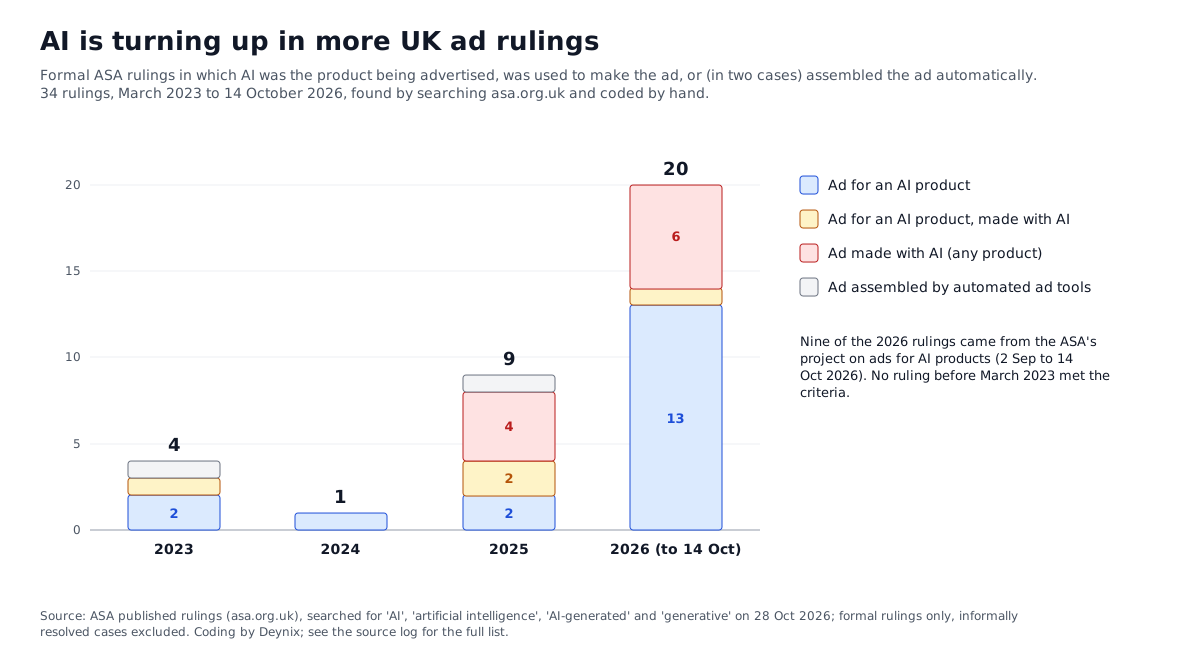
Figure 1. Formal ASA rulings involving AI, by year of publication, coded from 34 rulings found on asa.org.uk on 28 October 2026. Method below.
Why this matters if you only post organically
You might think this is only about paid ads. It isn't. Since 2011 the CAP Code has also covered some of what companies post on their own social media channels. The test is whether the post is "directly connected" with selling your product, and CAP warns that "any content that bears a relationship to the products or services they offer has the potential to be considered directly connected" [5].
Three of the 34 rulings were about organic posts on the brand's own social media accounts, not paid ads. One was a pair of posts on a founder's own Facebook page [12]. Another was a post on a betting brand's X account [10]. The third was on a bingo hall's Facebook page [19]. If your LinkedIn or X post is selling your product, assume the Code applies.
The ASA is also watching more closely than it used to. Its Active Ad Monitoring system uses AI to scan online ads, and the 2025 annual report says it processed "nearly 60 million ads" last year. The same report says the ASA "assessed a growing number of complaints involving AI‑generated advertising content in 2025". It frames the work as covering "ads made with AI, ads for AI and ads placed in AI-based products" [4]. Twelve of the 34 rulings in my set say the ad was found by that monitoring system rather than by a complaint.
Finding 1: no ruling was about using AI as such
In August 2023, CAP wrote that "the ASA has yet to rule, to their knowledge, on any ads using AI generated images" [2]. Since then the AI rulings have piled up, but the reasoning hasn't changed. CAP's 2023 note says the rules apply "regardless of how the ad was created", because the ASA judges ads "based on how the consumers will interpret them". Its June 2026 note on deepfakes says the same: "AI might change how ads are made, but it doesn't change how they're regulated" [20].
I checked this against the rulings. Of the 34, 32 were upheld, 1 was upheld in part and 1 was not upheld. In every upheld ruling the breach was a familiar one: a misleading claim, a claim with no evidence, offensive or harmful content, a health-claims rule or a gambling rule. The AI was how the ad got made. It wasn't what broke the rule.
The one ruling that went the advertiser's way shows this nicely. In 2025 a Buzz Bingo hall posted a cartoon "action figure" in the style of the AI doll trend. The question was whether it would appeal strongly to under-18s, which gambling ads mustn't. The ASA said that "despite the image being computer-generated", it looked realistic, showed an adult and had no exaggerated features. It did not find a breach [19]. The ASA judged what the image showed, not how it was made.
On disclosure, CAP's 2025 guidance is blunt. There's "no blanket legal requirement in the UK to disclose the use of AI in ads". Disclosure is "very unlikely to mitigate the harm caused by a fundamentally misleading message". It could help in some cases, for example making clear that "an influencer is AI-generated" [3]. If you also reach EU audiences, the EU's rules on AI labels are a separate question. We covered them in our EU AI Act post.
Finding 2: what the rulings were actually about
I split the rulings into ads for AI products (22) and ads made with AI (14). Four were both. Two more were about automated ad tools.
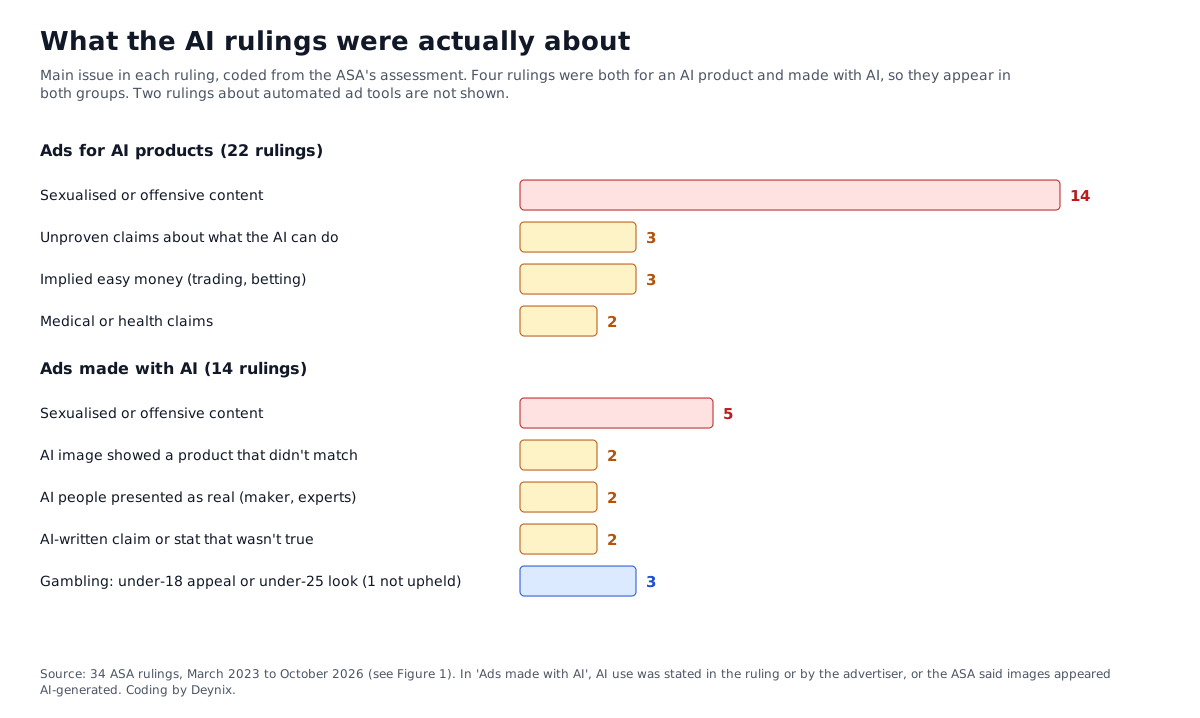
Figure 2. Main issue in each ruling, coded from the ASA's assessment. Four rulings appear in both groups. The two rulings about automated ad tools are left out.
Most of the ads for AI products had nothing to do with founders like you. Fourteen of the 22 were for AI companion, "AI girlfriend", image-to-video or photo-editing apps whose ads were sexualised or objectified women. Five of these were published together on 16 September 2026 [21] [22]. Many of these advertisers were overseas app makers, and 12 of the 22 rulings record that the advertiser breached the rule on responding to the ASA promptly (rule 1.7). Usually that was because they didn't reply at all.
The other 8 are the useful ones for a startup selling software. They come in Finding 4. Most of the ads made with AI, which come next, are the kind of thing a small brand could do by accident.
Finding 3: the rulings that matter to a small brand using AI
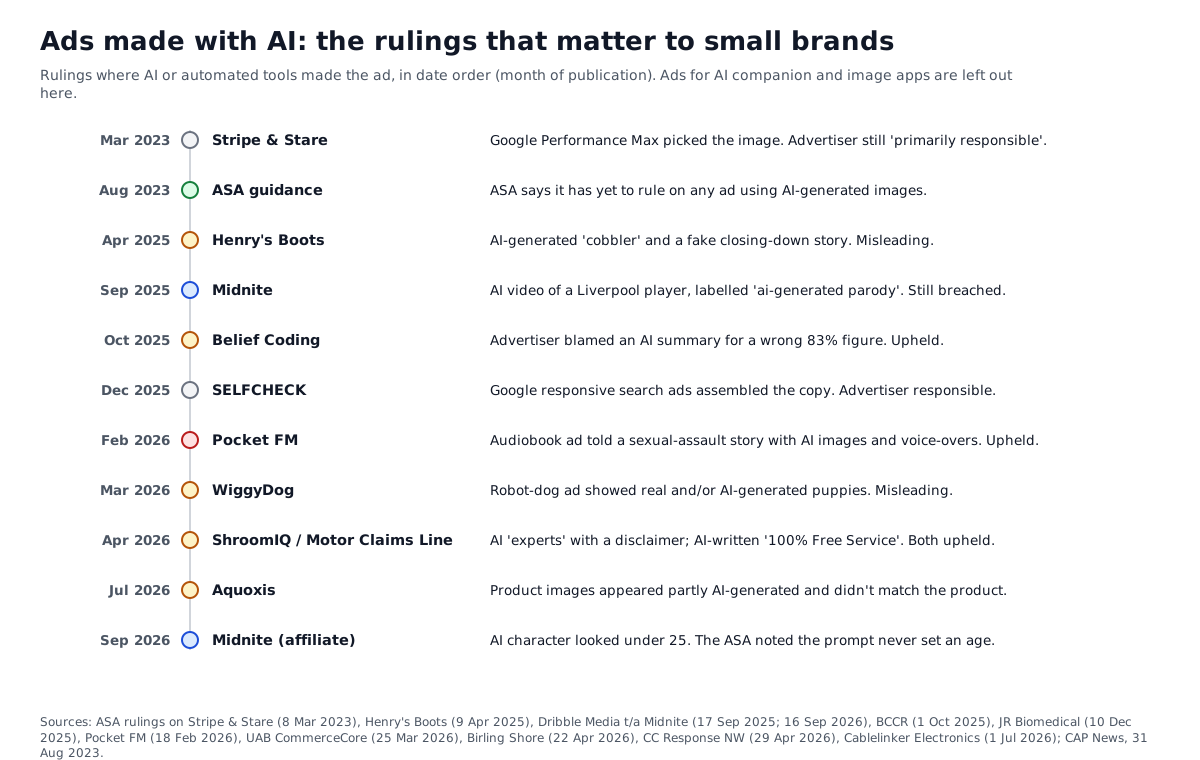
Figure 3. Rulings where AI or automated tools made the ad, by month of publication. Ads for AI companion and image apps are left out. Sources: the rulings cited below and CAP News, 31 August 2023.
Invented people
Henry's Boots (April 2025). A Facebook ad told the story of a cobbler who had "poured my heart into every pair of leather shoes" for three decades and was now closing his workshop. The ASA "understood the images of the man were AI-generated and 'Henry' was not a real person". It found the handmade and closing-down claims unsubstantiated and misleading [9] [23].
ShroomIQ (April 2026). A children's supplement website had a "Meet the Experts" section with people titled "Dr". At the bottom of the homepage it said: "Some images, including product visuals, names and people shown, are AI-generated representations used for illustrative and branding purposes only." The ASA accepted that this "suggested the individuals shown may not be genuine health professionals". It still found that the page "created the overall impression that those health professionals endorsed the claimed health benefits of the product", and that breached the rules on health professionals [13].
For founders, the obvious version of this is the AI-generated "customer", "team member" or "founder story". The FTC has its own rules on fake reviewers and testimonials, which we covered in our post on the FTC rule. The UK result is the same: if the person isn't real, don't present them as real, and a footnote won't save it.
Product shots that aren't your product
Aquoxis (July 2026). The ASA said the pressure-washer nozzle's product images "appeared to have been at least partially generated by artificial intelligence", differed from each other and from the product in the video, and in one case showed "electrical components inside the handle that would have obstructed the flow of water". Without evidence of the cleaning performance shown, the ads were misleading [15].
WiggyDog (March 2026). A robot-dog toy ad showed scenes that, in the ASA's words, "appeared to be of real and/or AI-generated puppies". The ASA found that this gave the impression that the toy was "highly realistic and lifelike", and the advertiser had no evidence of that [24].
For a software company, this means your app's UI. A generated screenshot showing a feature you don't have, or results nobody gets, is the same problem as a generated pressure washer.
Claims nobody checked
Belief Coding (October 2025). Two posts on the founder's own Facebook page said that "83% of people with depression saw a huge improvement" in a clinical trial. In its response, the company said its social media agency had used AI to summarise a published paper, and "the figure had incorrectly been attributed to the paper by the AI tool". The ASA upheld the complaints, finding that the ads discouraged essential treatment and that the efficacy claims weren't backed by adequate evidence [12].
Motor Claims Line (April 2026). The advertiser told the ASA that the claim "100% Free Service" in a Google search ad "had been generated by AI". It said it had removed it and that a director would now approve future ad copy. The ASA still found the ads misleading [14].
These two are the closest to how founders use AI assistants every day. The model writes a confident sentence with a number or a promise in it, nobody checks it, and it goes out under your name. In both cases, saying that the AI wrote it didn't change the outcome.
Real people and AI characters
Midnite (September 2025). A betting brand posted an AI-generated video of footballer Trent Alexander-Arnold on its X page. The video was marked "*ai-generated parody*", and the brand replied to its own post with "All voices / likenesses are fictional". Gambling ads mustn't feature people likely to appeal strongly to under-18s. The ASA said that "although the imagery used was AI-generated, we considered it was a depiction of Mr Alexander-Arnold, which consumers would clearly recognise as being him". The post breached the gambling rules [10].
Midnite, via an affiliate (September 2026). A TikTok ad showed a man gambling on his phone. The affiliate that made it said he was "an AI-generated fictional character", intended to be an adult. Gambling ads mustn't feature anyone who seems to be under 25. The ASA noted that "the prompt used to generate the ad did not refer to the character's age or to the age restrictions that applied to gambling advertising". It said it had seen "no evidence that, when generating the character, AI had been prompted to ensure that the character appeared to be aged 25 or over". The ad breached the Code [11]. CMS's write-up of the ruling advises advertisers to "apply the CAP Code rules when creating prompts and maintain records of the generation process" [25].
That second ruling is the first I found where the ASA looked at the prompt itself. Most founders aren't advertising gambling. But if your sector has rules about who can appear in ads, such as age limits or health professionals, it now seems wise to write those rules into the prompt and keep a copy.
When the tool assembled the ad
Stripe & Stare (March 2023). The brand said its agency ran the ad through Google Performance Max, which "had selected this image for use". The ASA replied that "advertisers were primarily responsible for ensuring that their ads complied with the CAP Code" [7]. CAP has since cited this ruling in its AI guidance [20].
SELFCHECK (December 2025). The company said its ads "were generated by Google responsive search ads" and it hadn't reviewed them. The ASA said this was "an optional feature for advertisers, and it remained the responsibility of the advertiser to ensure their ads complied with the Code" [16].
The pattern is clear. Whether the work was done by an agency, an affiliate, Google's automated ad tools or a chatbot, the advertiser carried the responsibility in every case.
Finding 4: if you sell an AI product, the claims need evidence
Eight of the rulings on ads for AI products weren't about offensive content. They were about what the ad said the AI could do:
- Pixelup (2023): "Enhance your Photos with AI", with a before-and-after image. There was no evidence that the results were achievable, so the ad exaggerated the app [26].
- Motion (2023): an AI calendar ad aimed at people with ADHD, saying "Motion's AI does it all for YOU". Those were medical claims, and the app wasn't registered with the MHRA [27].
- GTO Hero (2025): "AI is changing poker forever". The ad showed real-time help during live games for money, which at least some poker sites don't allow [28].
- Hume Health (2026): "the AI-powered wearable" sold as "YOUR 2026 STROKE DETECTOR". These were medical claims without registration, and the ASA had seen no evidence for the accuracy claimed [29].
- Maxxing (2026): "AI scans your face, style and confidence", with before-and-after shots. There was no evidence that they were genuine, and the ads exploited body-image insecurities [18].
- AI Scorecast, Finelo and ChartPrime (October 2026): football predictions "with a 97% accuracy rate", trading with "Just AI that does the hard part – and 15 minutes a day", and "AI-Powered Backtesting" with "Precise Buy & Sell Signals". The ASA found that these implied easy profit without the risks [6] [17] [30] [31].
CAP summed this up in August 2026 in its note on ads for AI assistants. Marketers should "hold evidence to back up any objective claims about what your product can do", and "what the ad promises, the product should deliver". The same note says that vague productivity claims may count as puffery, which isn't a problem under the Code. But it warns that if a free scan only gives its advice after payment and the ad doesn't say so, the ad is likely to mislead [8].
If you sell AI software, the risky claims are the measurable ones: accuracy percentages, hours saved, revenue made, "replaces your marketer". Keep the evidence before the post goes out.
Methodology
Search. On 28 October 2026 I searched the ASA's published rulings (asa.org.uk) for "AI", "artificial intelligence", "AI-generated" and "generative", and collected every formal ruling listed. That gave 705 unique rulings, because the site's search also matches broader terms. Rulings marked informally resolved were excluded. The search returned rulings dated from 2021 to October 2026.
Filter. I downloaded each ruling and kept those that mention "AI", "artificial intelligence", "deepfake" or "generative" outside the ASA's standard sentence about its AI monitoring system. That left 45. I read each one and dropped 12 where AI was incidental: words like "degenerative" and "regenerative", a company name such as "Parc AI", a joke in a rolling-paper ad, Samsung's "Galaxy AI" in a cashback promotion, a host app's name, a mention of Instagram's or Google's AI review systems, or a TikTok "AI-generated summary" label that played no part in the ruling. I added one ruling that doesn't use the word AI, Stripe & Stare, because CAP's own AI guidance cites it as the example of automated ad tools. That gave 34.
Coding. For each ruling I recorded the date, the outcome, whether the advertised product was AI-based, and whether AI made the ad. For the second, I needed the ruling or the advertiser's response to say AI was used, or the ASA to say the images appeared AI-generated. I also recorded whether automated ad tools assembled the ad, the main issue in the ASA's assessment, whether an AI disclosure was present, and whether the ruling recorded a rule 1.7 (prompt response) breach. The full coding and the scripts are in the source log.
Limits. This only covers rulings where AI shows up in the published text. If an advertiser used AI and nobody said so, it isn't here. The ASA also resolves many more cases informally than it rules on, and those aren't included. The issue coding is my judgement and other readers might split a few rulings differently. Counts are small, so treat the year-on-year rise as a direction, not a precise rate. I didn't compare it with the total number of rulings each year. Finally, ASA rulings apply the CAP Code. They aren't court judgments, and other UK law, such as consumer protection law enforced by the CMA and Trading Standards, can apply too.
Second sources. Every quote above was checked against the ruling or guidance text. For the key rulings I also checked independent write-ups: Osborne Clarke on Henry's Boots [23], CMS on the 2026 Midnite ruling [25], LexisNexis on the 16 September batch [22], and Financial Planning Today on Finelo [31].
Practical takeaways
- Don't worry about AI use itself. Worry about what it says. UK rules don't ban AI-made ads or posts, and there's no general UK duty to label them. Spend your review time on the claims and the images.
- Never present an AI person as real. No AI "founder", "customer", "expert" or "team member" in a role a real person would fill. A footer saying "some people shown are AI-generated" didn't help ShroomIQ.
- Check every number and promise an assistant writes. Belief Coding's 83% and Motor Claims Line's "100% Free Service" both came from AI, by the advertisers' own account. Trace each figure to its source before you post.
- Show your real product. Use real screenshots and real outputs. If an image is illustrative, make sure it doesn't show a feature or result you can't back up.
- Put your sector's rules into the prompt, and keep the prompt. If your sector has rules on age, health claims or financial risk warnings, put them in the prompt and keep a record. The ASA has now looked at a prompt.
- Don't hand responsibility to the tool. Performance Max, responsive search ads, agencies and affiliates didn't shift responsibility in any of these rulings. Someone at your company needs to see what goes out.
- If you sell AI, keep the evidence for each claim. Accuracy figures, time saved and "it does it for you" claims need proof you can show the ASA. And treat your own organic posts like ads when they're selling.
Where Deynix fits
Deynix is for organic social, not paid ads. But as Finding 1 shows, the CAP Code can cover your own posts too. Deynix drafts posts, replies and quotes in your voice, from your site, your saved thoughts, the brand voice you confirm and, once X is connected, your recent posts. It can also make branded images in your colours, logo and handle. Every post waits in Review until you approve it, whether you drafted it in the app or your assistant did through Claude or ChatGPT. Nothing goes out until you say so [32].
Review is where the takeaways above get done: check the numbers, cut any promise you can't back up, and make sure the people and product shots are real. Deynix doesn't check your posts against the CAP Code for you. That part is still your call.
References
- Advertising Standards Authority. Rulings search, accessed 28 October 2026. https://www.asa.org.uk/codes-and-rulings/rulings.html
- CAP News (31 August 2023). "Generative AI & Advertising: Decoding AI Regulation." https://www.asa.org.uk/news/generative-ai-advertising-decoding-ai-regulation.html
- CAP News (29 May 2025). "Disclosure of AI in Advertising: Striking the Balance Between Creativity and Responsibility." https://www.asa.org.uk/news/disclosure-of-ai-in-advertising-striking-the-balance-between-creativity-and-responsibility.html
- ASA and CAP (2026). Annual Report 2025. https://www.asa.org.uk/static/7f13b9d1-104b-4386-8676cccaa844782b/d756c5ab-9a58-4b27-ad5332b548713718/asa-and-cap-2025-annual-report.pdf
- CAP AdviceOnline (4 February 2026). "Remit: Social media." https://www.asa.org.uk/advice-online/remit-social-media.html
- ASA Ruling on HRY Games t/a AI Scorecast (14 October 2026). https://www.asa.org.uk/rulings/hry-games-a26-1345629-hry-games.html
- ASA Ruling on Stripe & Stare Ltd (8 March 2023). https://www.asa.org.uk/rulings/stripe---stare-ltd-a22-1179196-stripe--stare-ltd.html
- CAP News (27 August 2026). "Regulating the Illusion of Intelligence in Ads." https://www.asa.org.uk/news/regulating-the-illusion-of-intelligence-in-ads.html
- ASA Ruling on Person(s) Unknown t/a Henry's Boots (9 April 2025). https://www.asa.org.uk/rulings/person-s--unknown-a24-1267935-person-s--unknown.html
- ASA Ruling on Dribble Media Ltd t/a Midnite (17 September 2025). https://www.asa.org.uk/rulings/dribble-media-ltd-g25-1300959-dribble-media-ltd.html
- ASA Ruling on Dribble Media Ltd t/a Midnite (16 September 2026). https://www.asa.org.uk/rulings/dribble-media-ltd.html
- ASA Ruling on BCCR Ltd t/a Belief Coding Cognitive Rewiring (1 October 2025). https://www.asa.org.uk/rulings/bccr-ltd-a25-1297374-bccr-ltd.html
- ASA Ruling on Birling Shore Ltd t/a ShroomIQ (22 April 2026). https://www.asa.org.uk/rulings/birling-shore-ltd-g25-1323444-birling-shore-ltd.html
- ASA Ruling on CC Response NW Ltd (29 April 2026). https://www.asa.org.uk/rulings/cc-response-nw-ltd-a25-1299398-cc-response-nw-ltd-.html
- ASA Ruling on Cablelinker Electronics Ltd t/a Aquoxis (1 July 2026). https://www.asa.org.uk/rulings/cablelinker-electronics-ltd-g26-1335281-cablelinker-electronics-ltd.html
- ASA Ruling on JR Biomedical Ltd t/a SELFCHECK (10 December 2025). https://www.asa.org.uk/rulings/jr-biomedical-ltd-a25-1303536-jr-biomedical-ltd.html
- ASA Ruling on Finelo Ltd (14 October 2026). https://www.asa.org.uk/rulings/finelo-ltd-a26-1345627-finelo-ltd.html
- ASA Ruling on Glow Up LLC t/a Maxxing (2 September 2026). https://www.asa.org.uk/rulings/glow-up-llc.html
- ASA Ruling on Buzz Group Ltd (9 July 2025). https://www.asa.org.uk/rulings/buzz-group-ltd-g25-1289294-buzz-group-ltd.html
- CAP News (11 June 2026). "AI and Deepfakes: Four Things Advertisers Need to Know Before They Hit 'Run'." https://www.asa.org.uk/news/ai-and-deepfakes-four-things-advertisers-need-to-know-before-they-hit-run.html
- ASA Ruling on Rusto AI-AI Photo Toolbox t/a Rusto AI (16 September 2026). https://www.asa.org.uk/rulings/rusto-ai-ai-photo-toolbox.html
- LexisNexis (16 September 2026). "ASA rulings—16 September 2026." https://www.lexisnexis.co.uk/legal/news/asa-rulings-16-september-2026
- O'Dowd, J. (25 June 2025). "Henry's Boots gets the boot." Osborne Clarke, marketinglaw. https://marketinglaw.osborneclarke.com/advertising-regulation/henrys-boots-gets-the-boot/
- ASA Ruling on UAB CommerceCore t/a WiggyDog (25 March 2026). https://www.asa.org.uk/rulings/uab-commercecore-g25-1321974-uab-commercecore.html
- Soilleux-Mills, A. and Barker, C. (9 October 2026). "ASA rules that AI-generated character in gambling ad appeared to be under 25." CMS. https://cms.law/en/gbr/legal-updates/asa-rules-that-ai-generated-character-in-gambling-ad-appeared-to-be-under-25
- ASA Ruling on Codeway Dijital Hizmetler Anonim Sirketi t/a Pixelup (18 October 2023). https://www.asa.org.uk/rulings/codeway-dijital-hizmetler-anonim-sirketi-a23-1197999-codeway-dijital-hizmetler-anonim-sirketi.html
- ASA Ruling on Nexusbird Inc t/a Motion (18 October 2023). https://www.asa.org.uk/rulings/nexusbird-inc-a23-1197735-nexusbird-inc.html
- ASA Ruling on GTOHero Ltd (2 July 2025). https://www.asa.org.uk/rulings/gtohero-ltd-a25-1275239-gtohero-ltd.html
- ASA Ruling on Hume Health LLC (17 June 2026). https://www.asa.org.uk/rulings/hume-health-llc-g26-1326177-hume-health-llc.html
- ASA Ruling on Chart Prime Trading LLC (14 October 2026). https://www.asa.org.uk/rulings/chart-prime-trading-llc-a26-1345625-chart-prime-trading-llc.html
- Financial Planning Today (14 October 2026). "ASA acts on AI financial 'education' platform ads." https://www.financialplanningtoday.co.uk/news/asa-acts-on-ai-financial-trading-education-platform-ads
- Deynix, homepage, accessed 28 October 2026. https://www.deynix.com
Browse all updates in News.