Will AI images hurt your posts? What the research says about AI visuals, labels and the 'looks like AI' penalty
Founders keep hearing that real photos always beat AI images. I read the field studies, the labelling experiments and the detection research. On average, AI images don't lose. What costs you is an image that looks like AI, or a label that says it is.

By Kyle Kirkby
Published | Updated
If you post as a founder, you've probably wondered whether an AI-generated image will make a post do worse. The advice online is confident and contradictory. One camp says real photos always win because people can smell AI. The other says AI images are now better than stock and you'd be mad not to use them.
Most of that advice rests on a single vendor test or a gut feeling. So I went to the research. That meant two field studies of real ads with real clicks, one of them a Taboola dataset of more than 369 million impressions published in Marketing Science last week, plus labelling experiments on Instagram-style feeds, a small field test on a real Instagram account, and the studies on whether people can actually tell AI images from real ones.
The short version: on average, AI images don't perform worse. In the best evidence we have, the penalty isn't for being made by AI. It's for looking like AI, or for carrying a label that says so. That changes what a founder should check before posting.
This is a research summary, not a product pitch. The Deynix part is short and near the end.
Executive summary
- No average penalty in the biggest field study. Researchers compared 4,633 "sibling ads" on Taboola, where the same advertiser ran AI-generated and human-made images in the same campaign on the same day. Across more than 369 million impressions and 2.5 million clicks, they found no detectable average click-through disadvantage for AI images [1].
- The penalty is for looking like AI. AI images that people didn't read as AI did best of all. In the working-paper version, they averaged a 0.79% click-through rate, against 0.62% for AI images that people did read as AI, and 0.67% and 0.55% for human-made images that didn't and did look AI-made [2].
- The best AI images can beat stock photos, and the worst can lose. In a Meta ad test, a DALL-E 3 image got a 0.80% click-through rate, against 0.53% for a professional stock photo in the same A/B test. The weakest model scored 0.40% [3].
- Labels cost engagement, most of all on emotional posts. When identical Instagram images were labelled "AI-generated", people's stated willingness to engage fell by about 14 to 16 points on a 100-point scale. An "AI-enhanced" label cost about 7 to 8 points. On emotional content, the AI-generated label cut emotional engagement by about 46 points, against about 27 on rational content [4] [5].
- Most people can't tell anyway. In a survey of 3,002 people in the US, Germany and China, accuracy at telling AI images from real ones was between 45.9% and 49.9%, no better than a coin toss [6]. That's why the look and the label matter more than how the image was made.
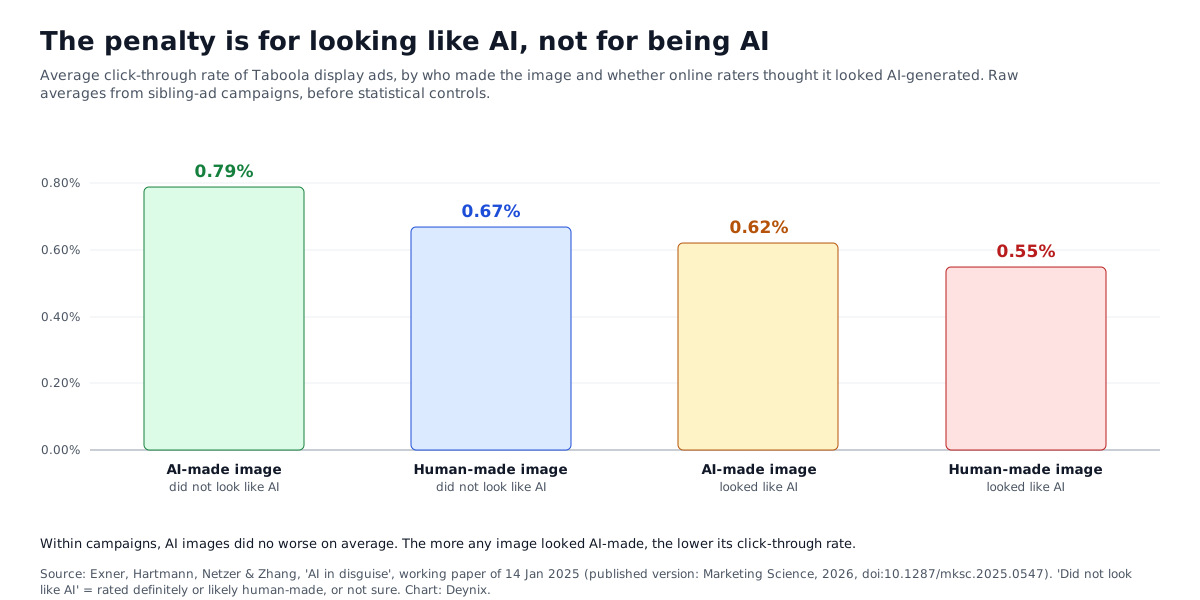
Figure 1. Click-through rate by image source and whether raters thought the image looked AI-made. Raw averages, before controls. Source: Exner, Hartmann, Netzer and Zhang, working paper version of [1], January 2025 [2].
Why this question matters for founders now
Images are no longer a nice extra on a founder's feed. Many scheduling and AI tools now offer to generate one alongside a post. The question used to be "can I afford a decent image?" Now it's "will the image I can make in ten seconds hurt me?"
Two things have changed in the last two years. The images got much better, to the point where most people can't spot them. And the platforms started labelling them. Meta, for example, adds an "AI info" label to images when it detects industry-standard AI indicators in the file or when the person posting discloses it. From September 2024, it moved that label into the post's menu for content that was only edited with AI, and kept it visible for content it detects was generated by AI [7]. So whether a viewer knows your image is AI-made is partly up to you and partly up to the platform.
The existing advice doesn't separate those two things. The research does, and it turns out to matter.
Finding 1: on average, AI images perform about the same as human-made ones
The biggest and newest study is by Yannick Exner and Jochen Hartmann (Technical University of Munich), Oded Netzer (Columbia Business School), Shunyuan Zhang (Harvard Business School) and Ziqian Ding. It was published in Marketing Science on 19 October 2026 under the title "AI in Disguise" [1].
The setting is Taboola, an ad network whose ads run on news and publisher sites. In July 2023, Taboola launched a free GenAI Ad Maker that lets advertisers create ad images inside the platform [2]. The researchers didn't compare AI advertisers with non-AI advertisers, which would mix up the image with everything else about the business. Instead, they used "sibling ads": AI-made and human-made images launched by the same advertiser, in the same campaign, on the same day, with the same landing page. That's about as close to a natural A/B test as observational data gets.
The published abstract reports 4,633 sibling ads, more than 369 million impressions and 2.5 million clicks. The headline: "We do not find a detectable average click-through-rate disadvantage for AI-generated images relative to their human-made siblings" [1].
The earlier working paper, from January 2025, shows how that plays out [2]. The 4,633 ads sat in 1,186 of these natural experiments, run by 202 advertisers. In the raw numbers, AI-image ads had a higher click-through rate (0.76%) than human-image ads (0.65%). Taboola's own announcement of the study gives the same two figures [8]. But once the researchers compared siblings within each campaign and added controls, the difference was not statistically significant. Ads with AI images did as well as ads with human images, no better and no worse.
Two more details from the working paper matter for small businesses. Smaller and less experienced advertisers benefited relatively more from the AI images. And for campaigns aimed at purchases, the AI images made no significant difference to conversion rates [2]. In other words, the people who clicked on AI images went on to buy at much the same rate.
A caution on versions: the published paper is behind a paywall, so I read the January 2025 working paper in full and the published abstract. The headline matches. Some details changed between versions, which I point out below. The detailed numbers in this post come from the working paper.
What this means: "AI images perform worse" isn't supported by the largest real-world comparison. On average, the audience didn't care who made the image.
Finding 2: the penalty is for looking like AI, not for being AI
The average hides the interesting part. The researchers asked online raters to judge every image in the dataset (1,751 unique images, five raters each) on whether it looked human-made or AI-generated [2].
Two things came out of that. First, raters were not good at it. They called 24.87% of the human-made images likely or definitely AI. And they failed to flag 58.92% of the AI images, marking them as human-made or "not sure".
Second, the look mattered more than the truth. In the raw averages shown in Figure 1, AI images that didn't look like AI had the highest click-through rate of any group (0.79%). AI images that did look like AI fell to 0.62%. Human-made images followed the same pattern: 0.67% when they looked human, 0.55% when they looked AI-made. In the regression, the more any image looked AI-made, the lower its click-through rate, and AI images were penalised more steeply for it [2]. The published abstract states the result directly: "ads with AI-generated images outperform human-made ads when the AI images do not 'look like AI'" [1].
So what makes an image look like AI? This is where the two versions differ, so I'll stick to the published one. According to the abstract, AI tends to produce "sharper, clearer, and less blurry images with larger faces", and consumers associate those features with human-made ads. Meanwhile, "aesthetics, lower warmth, and intense color saturation in ads signal AI generation" [1].
The colour finding also shows up in a separate dataset. In a different study of 10,320 AI images rated by people, Hartmann, Exner and Samuel Domdey found that "excessive saturation in AI images is negatively associated with perceived quality, realism, and aesthetics" [3]. They also warn that faces and text are where AI images most often show flaws [3]. Two separate datasets, from overlapping research teams, point to the same advice: turn the saturation down.
A note on ethics, because "disguise" is in the paper's title. Nothing here says you should hide the fact that you used AI. Where a label is required, by a platform or by law, use it. Our earlier post covers when the EU AI Act requires one. The practical point is narrower: an image that looks cheap and synthetic costs you clicks, whoever made it.
Finding 3: model choice matters more than "AI or not"
The second field study is smaller but cleaner, because it's a true randomised test. Hartmann, Exner and Domdey ran it for an online marketing training company on Meta's ad platform, using Meta's A/B testing tool, from 27 February to 2 March 2024 [3].
A marketing expert picked and bought a professional stock photo: two hands holding puzzle pieces against a sunset. The researchers then turned the photo into a text description and gave the same prompt to seven image models, with no prompt engineering. Each image ran as the same banner ad, with the same title and text, at $10 a day per image. In total, the test got 173,022 impressions and 907 clicks for $449.91 [3].
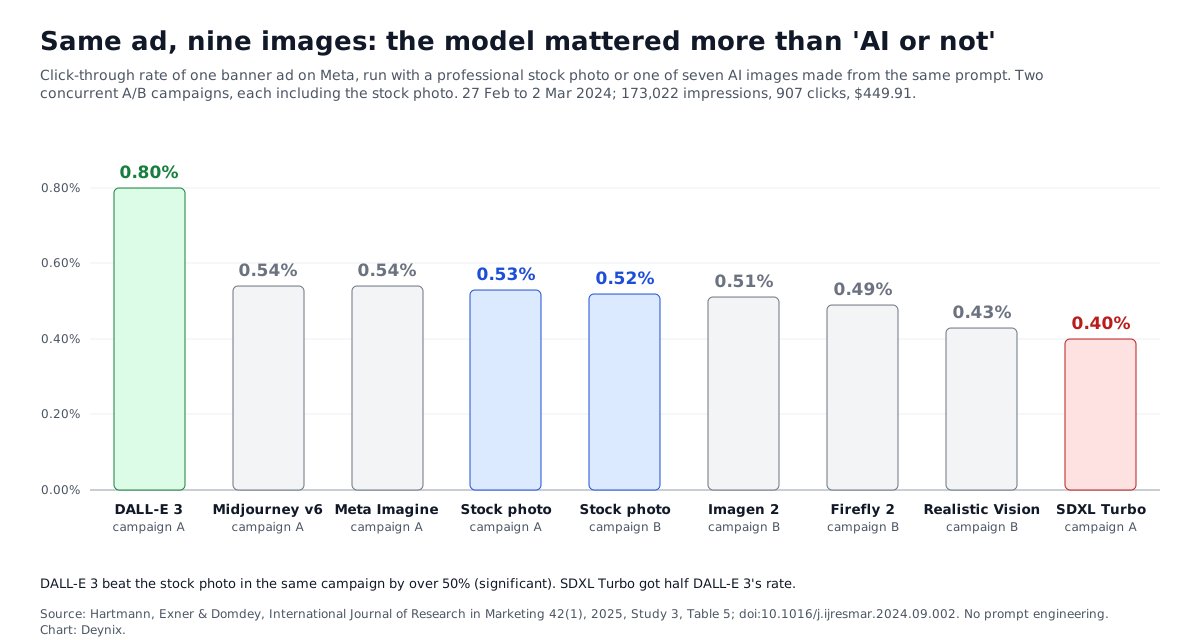
Figure 2. Click-through rate for the same banner ad with a stock photo or one of seven AI images. Meta A/B test, February to March 2024. Source: Hartmann, Exner and Domdey [3].
The DALL-E 3 image got a 0.80% click-through rate. The stock photo in the same A/B test got 0.53%, so the AI image did more than 50% better, a statistically significant difference [3]. Most of the other AI images landed within a few hundredths of a point of the stock photo. The worst, from SDXL Turbo, got 0.40%, half the rate of DALL-E 3.
This is one ad, one audience and one stock photo, so I wouldn't read "AI beats stock by 50%" as a rule. The more useful lesson is the spread. The gap between the best and worst AI image (0.40 percentage points) was bigger than the gap between the stock photo and most of the AI images. The model you use and the image you pick matter more than whether it's AI at all.
The same paper has two lab studies that point the same way. In the first (254,400 human ratings, plus an algorithmic aesthetics score), all seven models beat the human-made source images on algorithmically scored aesthetics, but only one model beat them on realism [3]. And in a test against commissioned freelancers paid $100 an image, with 1,575 participants, DALL-E 3 images scored significantly higher on five of ten marketing measures, including ad attitude and rated creativity. The two weakest models scored lower than the freelancers on most measures [3].
Finding 4: labels cost engagement, and emotional posts pay the most
The field studies above didn't test what an AI label does. On social platforms, your image may carry one. So what does the label itself do?
The clearest test is by Freya Seeger, Michael Wessel and Christiane Lehrer at Copenhagen Business School, published in Electronic Markets in March 2026 [4]. They ran two online experiments, with 325 and 371 participants, on mobile phones. Participants browsed realistic Instagram profiles in which every image carried an icon saying it was human-created, AI-enhanced or AI-generated. The images were identical across conditions. Only the label changed.
The results were consistent across both studies. Compared with the human-created label, the AI-generated label lowered behavioural engagement (how willing people said they were to follow, like or interact) by 14.2 points in the first study and 16.3 points in the second, on a 0 to 100 scale. The AI-enhanced label cost 6.5 and 7.8 points [4]. The drop ran through people's emotional response. The label made the content feel less engaging, and that explained the lower willingness to engage.
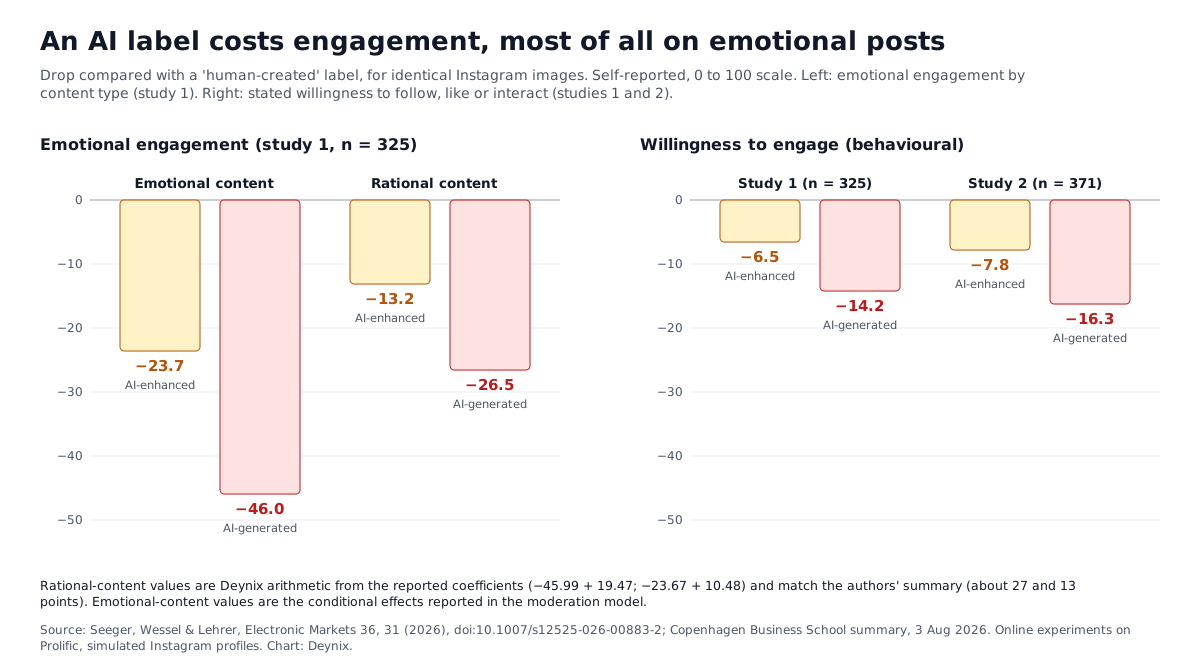
Figure 3. How much an AI label lowered engagement with identical images, compared with a human-created label. Self-reported, 0 to 100 scale. Source: Seeger, Wessel and Lehrer [4]; rational-content figures are my arithmetic from the reported coefficients and match the authors' summary [5].
The type of post mattered a lot. For emotional content (a sunset, a personal moment), the AI-generated label cut emotional engagement by about 46 points and the AI-enhanced label by about 24. For rational content (a product, a feature, practical information), the cuts were about 27 and 13 [4] [5]. With a human-created label, emotional content beat rational content. With an AI-generated label, the advantage reversed. As Wessel put it, "social media is, at its core, social" [5].
Timing helped only for light-touch AI. When the AI-enhanced label appeared after people had seen the image rather than before, the penalty shrank. For fully AI-generated content, showing the label later made no difference [4].
Read these numbers with care. They are self-reported intentions in a simulated feed, not real likes. In the first study, participants were asked to remember the label they saw, and real users often don't look that closely. Wessel himself points out that platforms often make labels easy to miss [5]. So these are best read as the cost when people notice the label, not the cost on every post.
Two more 2026 studies add detail. In an experiment with 606 people shown a brand's Instagram post with an AI-generated person, a detailed disclosure ("this person does not exist") worked in two opposite directions. It made people less likely to suspect manipulation, which protected trust, and it made the image feel more synthetic, which eroded trust [9]. And in a 43-person study of websites, people tended to prefer the sites with AI images until AI use was disclosed. Then trust shifted towards sites with photos, most of all for government and health sites [10].
Finding 5: most people can't tell, so the look and the label do the work
If audiences penalise AI images, you'd expect them to be good at spotting them. They aren't.
In a preregistered study, Joel Frank and colleagues at Ruhr University Bochum and CISPA asked 3,002 people in the US, Germany and China to judge whether images, audio and text were made by people or machines [6]. For images, average accuracy was 48.6% in the US, 45.9% in Germany and 49.9% in China. That's no better than guessing. People also leaned towards "human": US participants rated 77.7% of the AI images as human-made.
Faces are no easier. Sophie Nightingale (Lancaster University) and Hany Farid (UC Berkeley) showed 315 people a mix of real and AI-generated faces. Average accuracy was 48.2%. After training and feedback, a new group of 219 people reached only 59.0%. A third group rated the AI faces as slightly more trustworthy than the real ones (4.82 against 4.48 on a seven-point scale, 7.7% higher) [11].
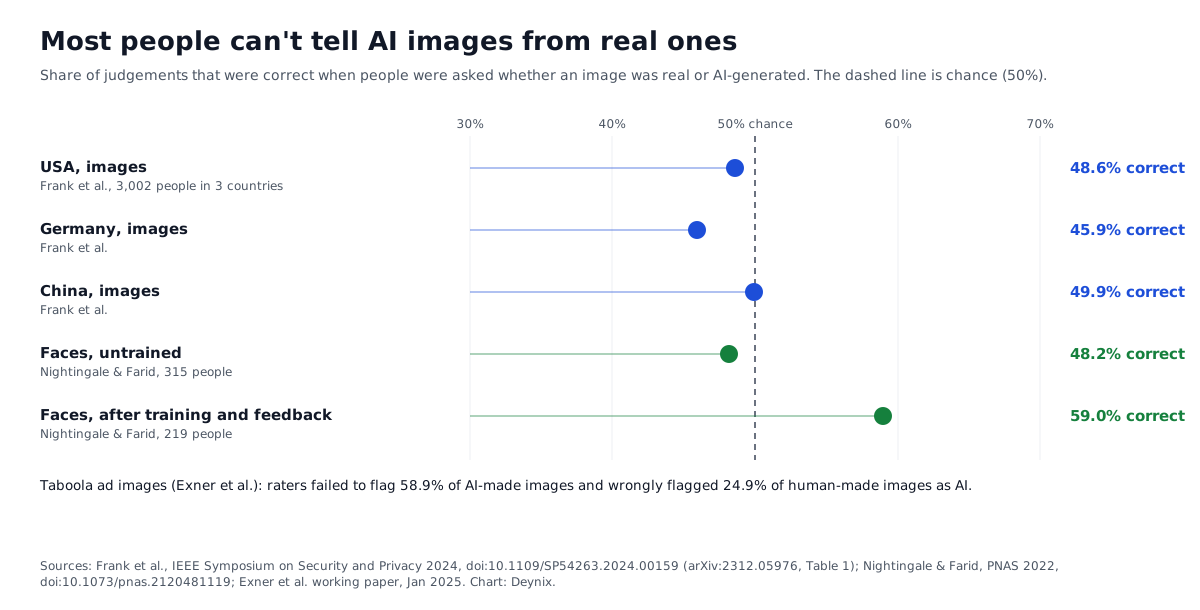
Figure 4. How often people can tell AI images from real ones. Chance is 50%. Sources: Frank et al. [6], Nightingale and Farid [11], Exner et al. [2].
This helps explain the pattern in Findings 1 to 4. Your audience doesn't know how an image was made. They react to cues. One cue is the look: saturated colour, a glossy, too-perfect finish. The other is the label. Both are partly in your control.
Finding 6: on a small account, the evidence is thin but points the same way
All of that comes from ads and experiments. What about a real, small social account? I found one field experiment, and it's small.
Cristina Fleșeriu and Mara Ilinca Fron ran a test on an existing culinary Instagram account with 770 followers, published in Oeconomica Jadertina in December 2025 [12]. They published 24 single-image recipe posts in alternating order: 12 fully made by a person (cooked, plated, photographed and captioned) and 12 with the image, recipe and caption all made by AI.
None of the differences in likes, comments, shares, saves, reach, impressions or engagement rate were statistically significant. Human posts drew more comments on average (5.33 against 2.33), a difference that came close to significance (p = .07). In follower surveys, people preferred the human photos and recipes but liked the AI captions more, and only the caption difference was statistically significant [12].
With 24 posts on one account, this can only tell you that there was no large gap. It can't rule out a modest one. The authors list the same limits. The paper doesn't say whether the AI posts carried a label. I mention it mainly because it's the only published field test I found on an ordinary small account, and because the comments result fits the label experiments: people respond to the human behind a post.
Methodology
Question. Do AI-generated images make social and marketing posts perform worse than human-made images, and what drives any difference?
Search. On 26 October 2026, I searched the web, OpenAlex and Crossref for field and experimental studies comparing AI-generated with human-made marketing or social images, studies of AI content labels on visual social media, and studies of people's ability to detect AI images. I followed citations from the two Hartmann and Exner papers.
What I read. Full text for the January 2025 working paper of the Taboola study [2], the Hartmann, Exner and Domdey paper (the September 2024 version, whose abstract matches the published article) [3], Seeger, Wessel and Lehrer [4], Frank et al. (the arXiv version, whose sample matches the published abstract) [6], Nightingale and Farid [11], and Fleșeriu and Fron [12]. Abstracts only for the published Taboola paper [1], Zimand-Sheiner et al. [9] and Thorshaug et al. [10].
Checks. Every number was re-checked against the source text in a separate pass. Key claims were cross-checked against a second source: the published abstract against the working paper, Taboola's announcement for the raw click-through rates, and Copenhagen Business School's summary for the label effects. Where a number comes from one source, the text says so.
Charts. All four charts were drawn in code from numbers in the cited papers. The rational-content figures in Figure 3 are my arithmetic from the reported coefficients (−45.99 + 19.47 and −23.67 + 10.48), and they match the authors' rounded summary. I haven't re-analysed any raw data.
What I left out. I found a vendor blog post claiming real photos beat AI images by 42% on social. It didn't publish its method or data beyond a short description, so I haven't used it. I also didn't use survey results about what people say they think of AI ads, because the studies above measure behaviour or controlled reactions instead.
Limits. The two field studies are display ads, not organic social posts, and neither tested what a visible AI label does. The label experiments use self-reported intentions. Most studies use 2023 to 2024 image models, and newer models may be harder to spot. No study I found tests AI images on organic LinkedIn or X posts, or tests branded graphics (text, logo and colours) rather than photo-style images.
What this means in practice
1. Stop asking "AI or not?" and start asking "does it look like AI?" That was the dividing line in the biggest field study [1]. Before you post, look at the image as a stranger would. If it looks glossy, oversaturated or too perfect, it's costing you, whoever made it.
2. Turn the saturation down. Intense colour signalled AI in the Taboola data and lowered rated quality and realism in the lab data [1] [3]. It's the cheapest fix in this post.
3. Generate several, pick one, and don't trust the first model you tried. In the Meta test, the gap between the best and worst AI image was bigger than the gap between most AI images and the stock photo [3]. Picking matters more than producing.
4. Use real photos where the post is personal. Labels hit emotional content hardest, and in the one small-account test, human posts drew more comments, though the gap fell just short of significance [4] [12]. A launch-day team photo, a customer visit or a messy desk should be real. Use AI for explainers, concepts and product information, where the penalty was smaller.
5. Don't invent people. AI faces are convincing and can even seem more trustworthy [11], which is exactly why a fake "customer" or "team member" is a bad idea. With AI-generated people, even a clear disclosure cuts both ways [9], and our research on disclosure wording found that being found out is the worst outcome of all. In the US, it can also cross into fake-testimonial territory, which we covered in our post on the FTC rule.
6. Expect labels and plan for them. If your image is generated by an AI tool that embeds standard provenance data, Meta may label it whether you disclose it or not [7]. Where AI only edited your own photo, the label is lighter, and in the experiments so was the penalty [4]. Editing a real photo with AI may be a better trade than generating one from scratch.
7. Test it on your own account, honestly. Alternate AI and real images on comparable posts for a few weeks and compare engagement per impression, not raw likes. Keep a note of which images were AI-made. Expect noise: 24 posts couldn't detect anything but a large difference [12], so treat a small test as a sanity check, not proof.
Where Deynix fits. Deynix can make branded images for your posts: paste a screenshot or type a headline and get an image in your colours, logo and handle, sized for X, LinkedIn, Instagram and link previews. Every post waits in Review until you approve it, so nothing goes out, image included, without your say-so [13]. To be clear, none of the studies above tested branded headline graphics like these. They tested photo-style images. The habits above apply whichever tool you use.
What we don't know yet
- Whether the field results hold for organic posts. Both field studies are display ads. Organic feeds on LinkedIn and X have different audiences and different ranking.
- What real labels cost in the wild. The label experiments asked people to pay attention to labels. How many people notice them on real platforms, and what that does to real engagement, isn't published.
- Whether newer models change the picture. Most studies used 2023 to 2024 models. If newer images are even harder to spot, the "looks like AI" penalty may shrink, or shift to new tells.
- How branded graphics fare. Text-and-logo images are what many founders post, and they're barely studied.
If you know of a study that tests any of these, I'd like to read it.
References
- Exner, Y., Hartmann, J., Ding, Z., Zhang, S. and Netzer, O. (2026). AI in Disguise: Quasi-experimental analysis of a large-scale deployment of AI-generated ads. Marketing Science, published online 19 October 2026. https://doi.org/10.1287/mksc.2025.0547
- Exner, Y., Hartmann, J., Netzer, O. and Zhang, S. (2025). AI in disguise: How AI-generated ads' visual cues shape consumer perception and performance. Working paper, version of 14 January 2025. https://business.columbia.edu/sites/default/files-efs/citation_file_upload/ssrn-5096969.pdf
- Hartmann, J., Exner, Y. and Domdey, S. (2025). The power of generative marketing: Can generative AI create superhuman visual marketing content? International Journal of Research in Marketing, 42(1), 13–31. https://doi.org/10.1016/j.ijresmar.2024.09.002
- Seeger, F., Wessel, M. and Lehrer, C. (2026). AI content labeling and user engagement on social media: The role of AI level, content type, and disclosure timing. Electronic Markets, 36, 31. https://doi.org/10.1007/s12525-026-00883-2
- Copenhagen Business School (2026). AI labels reduce social media engagement. 3 August 2026. https://www.cbs.dk/en/articles/ai-labels-reduce-social-media-engagement
- Frank, J., Herbert, F., Ricker, J., Schönherr, L., Eisenhofer, T., Fischer, A., Dürmuth, M. and Holz, T. (2024). A representative study on human detection of artificially generated media across countries. 2024 IEEE Symposium on Security and Privacy, 55–73. https://doi.org/10.1109/SP54263.2024.00159
- Meta (2024). Our approach to labeling AI-generated content and manipulated media. 5 April 2024, updated 1 July and 12 September 2024. https://about.fb.com/news/2024/04/metas-approach-to-labeling-ai-generated-content-and-manipulated-media/
- Taboola (2026). New study: AI ads match human creative in major report from Columbia University, Harvard University, Technical University of Munich, and Carnegie Mellon University. 28 January 2026. https://investors.taboola.com/news-releases/news-release-details/new-study-ai-ads-match-human-creative-major-report-columbia
- Zimand-Sheiner, D., Kol, O. and Levy, S. (2026). This person does not exist: Detailed AI disclosure and trust in synthetic visual brand posts. Journal of Marketing Communications. https://doi.org/10.1080/13527266.2026.2729146
- Thorshaug, P. S., Schjelderup, H. G. and Papachristos, E. (2026). How AI-generated images affect human preference and trust in websites. CHI 2026 Extended Abstracts. https://doi.org/10.1145/3772363.3798849
- Nightingale, S. J. and Farid, H. (2022). AI-synthesized faces are indistinguishable from real faces and more trustworthy. PNAS, 119(8), e2120481119. https://doi.org/10.1073/pnas.2120481119
- Fleșeriu, C. and Fron, M. I. (2025). AI versus human content creation on Instagram: Engagement outcomes and consumer perceptions. Oeconomica Jadertina, 15(2), 19–47. https://doi.org/10.15291/oec.4845
- Deynix. Homepage, accessed 26 October 2026. https://www.deynix.com
Browse all updates in News.