Can your followers tell an AI wrote your post? What the detection research actually shows
Most readers can't tell AI writing from human writing, and the ones who can are the people you most want to impress. I read the detection studies and ran a small analysis of a public dataset. Swapping out the 'AI words' doesn't fix it, and pasting your post into a chatbot to check won't tell you much.

By Kyle Kirkby
Published | Updated
If you draft posts with Claude or ChatGPT, you've probably wondered whether people can tell. The advice online splits two ways. One camp says nobody can tell any more, so it doesn't matter. The other hands you a checklist of tell-tale words and punctuation and says to strip them out.
Neither camp shows much data. Even careful founder-facing pieces describe who notices only in rough terms. Nobody can measure your own audience, but researchers have measured how well different kinds of readers do. So I read the human-detection studies, the detector benchmarks and the platform statements, and ran a small analysis of a public dataset where the method is shown below.
The short version: most readers are no better than a coin toss. People who write with AI every day are close to perfect. And the clues they use go deeper than the word lists people pass around, so deleting "delve" doesn't get you very far.
This is a research summary, not a product pitch. The Deynix part is short and near the end.
Executive summary
- Most readers are guessing. Across six experiments with 4,600 participants, people told AI-written profiles from human ones only 50 to 52% of the time, even when they were paid for accuracy or told whether each answer was right [2]. In a study of social media threads, 1,095 participants got it right 42% of the time [3].
- People who write with AI every day are a different story. Five annotators who use AI for writing tasks, voting together, got 299 of 300 articles right. Four annotators who didn't use AI for writing were close to chance, and they were confident anyway [1].
- Deleting the "AI words" isn't enough. When the model was told to avoid the clues the experts look for, including their list of AI words, the experts still caught all 30 of its articles [1]. In my analysis of the same public dataset, that "humanized" text used 7.3 of the listed AI words per 1,000 words, against 6.6 in the human articles. The experts were spotting something besides vocabulary.
- Spotting a single "AI word" proves nothing. In that dataset, 26% of 50-word snippets written by professional journalists contained at least one word from the experts' AI-vocabulary list. The journalists also used more em dashes than GPT-4o or Claude did.
- Asking a chatbot is a poor test. Asked directly, GPT-4o flagged 2 of 30 rewritten AI articles and o1 flagged 6. The best commercial detector caught 29 of 30 [1].
- Being suspected can cost you, whether or not you used AI. In an experiment from 2019, readers who believed they were seeing a mix of AI-written and human-written profiles trusted the ones they suspected were AI-written less [6]. Two vendor studies of LinkedIn found that the same person's AI-sounding posts got about a fifth to a quarter less engagement [12] [13].
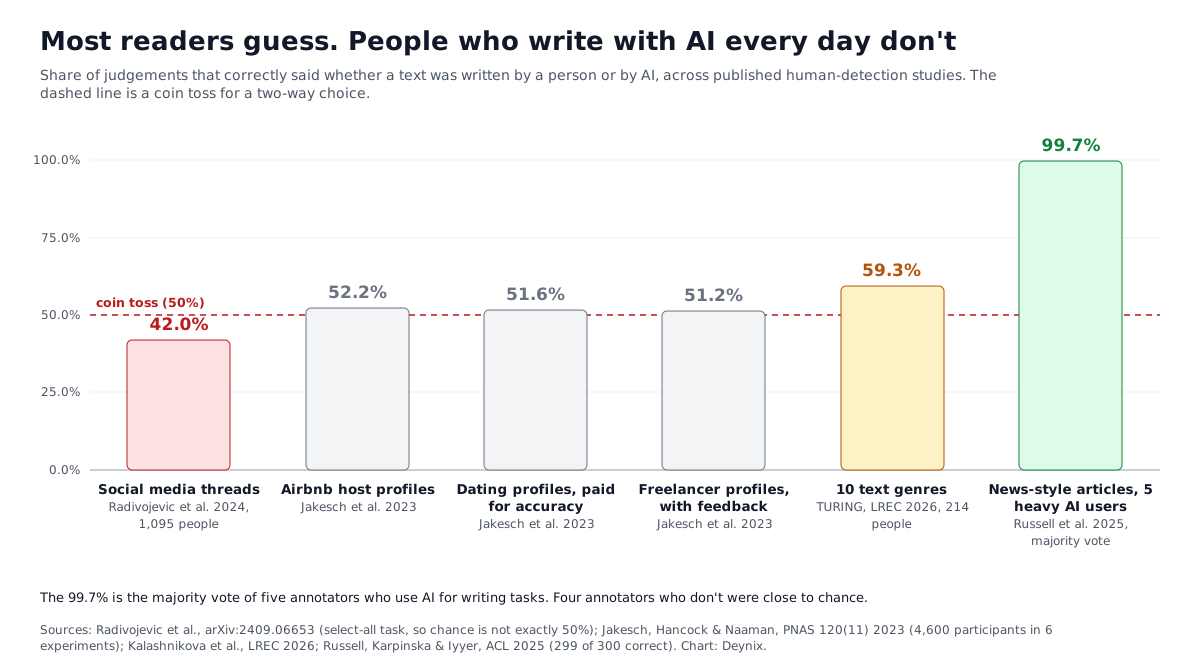
Figure 1. How often readers correctly said whether a text was written by a person or by AI. Sources: [3], [2], [4], [1]. The social media study used a select-all task, so chance there isn't exactly 50%.
Why this question matters for founders now
Many founders now draft at least some posts with an AI assistant, and the platforms have noticed. LinkedIn added a "Seems like AI slop" option to posts in 2026. It says more than a million members used it within the first two weeks, and that it has cut views of content its classifiers class as AI slop by 40% [10] [11]. We covered what LinkedIn counts as slop earlier this month. LinkedIn's line is that using AI is fine and generic, empty posts are the problem.
So there are two separate questions. Can a reader tell that AI wrote your post? And does it cost you if they think it did? The research answers the first one more clearly than the second, and the answer depends a lot on who's reading.
Finding 1: most readers can't tell, and more effort doesn't help
The largest study is by Maurice Jakesch, Jeffrey Hancock and Mor Naaman, published in PNAS in 2023 [2]. It's about the kind of text founders write: short self-presentations. The researchers collected real profiles from Airbnb (hosts), OkCupid (dating) and Guru.com (freelancers), fine-tuned language models on them, and asked 4,600 participants across six experiments to say which profiles were AI-generated.
Across the three main experiments, participants got it right 50 to 52% of the time. On Airbnb profiles it was 52.2%. Paying people for accurate answers didn't help (51.6%). Neither did telling them after each answer whether they'd been right (51.2%) [2].
A caveat: those experiments used GPT-2 and GPT-3, which are much older than what you're using now. Newer studies with newer models point the same way, though, for ordinary readers at least:
- In a 2024 study from the University of Notre Dame, 1,095 participants read social media discussion threads where some replies came from GPT-4, Claude 2 or Llama 2 bots built on personas. They correctly identified the posts 42% of the time, and often took bots for humans: their false-negative rate was 49% [3]. This one is a preprint, not yet peer-reviewed.
- In the TURING study, published at LREC 2026, 214 people judged 500 texts across ten genres. They were right 59.3% of the time, better than chance but far from reliable. They also leaned towards calling texts human [4].
- A 2026 systematic review of 30 studies concluded that, on average, people "do not distinguish AI-generated content from human-generated content reliably better than chance" [5]. It's a single-author preprint, so treat it as a map of the literature rather than the final word.
The older evidence agrees too. In a 2021 study, untrained readers told GPT-3 text from human text at chance, and training only nudged them up to 55% [15].
What this means: for a typical follower scrolling past a post, "can they tell?" mostly comes down to luck.
Finding 2: readers who use AI themselves can tell, almost every time
The finding that changes the picture comes from Jenna Russell, Marzena Karpinska and Mohit Iyyer (University of Maryland, Microsoft and UMass Amherst), published at ACL 2025 [1].
They hired annotators through Upwork to read 300 non-fiction articles. Half came from publications such as the Associated Press, National Geographic and the Wall Street Journal. The other half were written by GPT-4o, Claude 3.5 Sonnet or o1-Pro from the same title and subtitle, at a similar length. Annotators said which was which, how confident they were, and why.
Experience made the difference. Four annotators who didn't use AI for writing caught 56.7% of the AI articles but also flagged about half of the human ones as AI, which is about what you'd get by guessing. They were confident anyway, averaging 4.03 out of 5. Five annotators who use AI for writing tasks, such as editing and copywriting, were far better. Individually, in the first experiment they caught 92.7% of the AI articles on average and wrongly flagged about 4% of the human ones. Voting together, they got 299 of the 300 articles right across all five experiments [1].
They didn't get any training or feedback. Nobody told them which answers were wrong.
The authors are careful about the limits. Their articles were under 1,000 words (the human ones averaged about 750), and they say they can't make claims about other kinds of text, naming social media posts specifically [1]. A 60-word post gives a reader much less to go on. The individual results also varied: one expert who was strong on GPT-4o and Claude was fooled by almost every o1-Pro article.
What this means: your audience isn't one kind of reader. If you sell to founders, marketers or anyone else who writes with AI every day, a good share of the people reading your posts may be the kind who can tell. That's my inference, not something these studies measured, but it's the readers founders most want to impress.
Finding 3: deleting the "AI words" doesn't remove the tell
When the experts explained their calls, vocabulary came up most: 53.1% of explanations mentioned it. They named words such as "crucial", "testament" and "vibrant". But other clues came up a lot too. Sentence structure appeared in 35.9% of explanations, such as "not only... but also", "it's not just this, it's this" and lists of exactly three things. Grammar and punctuation appeared in 24.8%, because AI text tends to be grammatically perfect while people make small slips. Originality appeared in 23.7%, quotes in 22.3% and clarity in 19.5% [1].
The researchers then tested whether the tells could be removed. They paid the experts to list the clues they look for, compiled those into a guide, and told o1-Pro to write articles that would get past a detector following that guide. The experts, voting together, still caught all 30 of those articles and wrongly flagged none of the human ones. Their confidence dropped, but their accuracy held [1].
The researchers published their dataset, so I measured how much of the vocabulary the rewrite actually removed. I counted every word from the experts' AI-vocabulary list (105 words and short terms from the paper's Table 12) in all 300 articles. The method is under "Methodology" below.
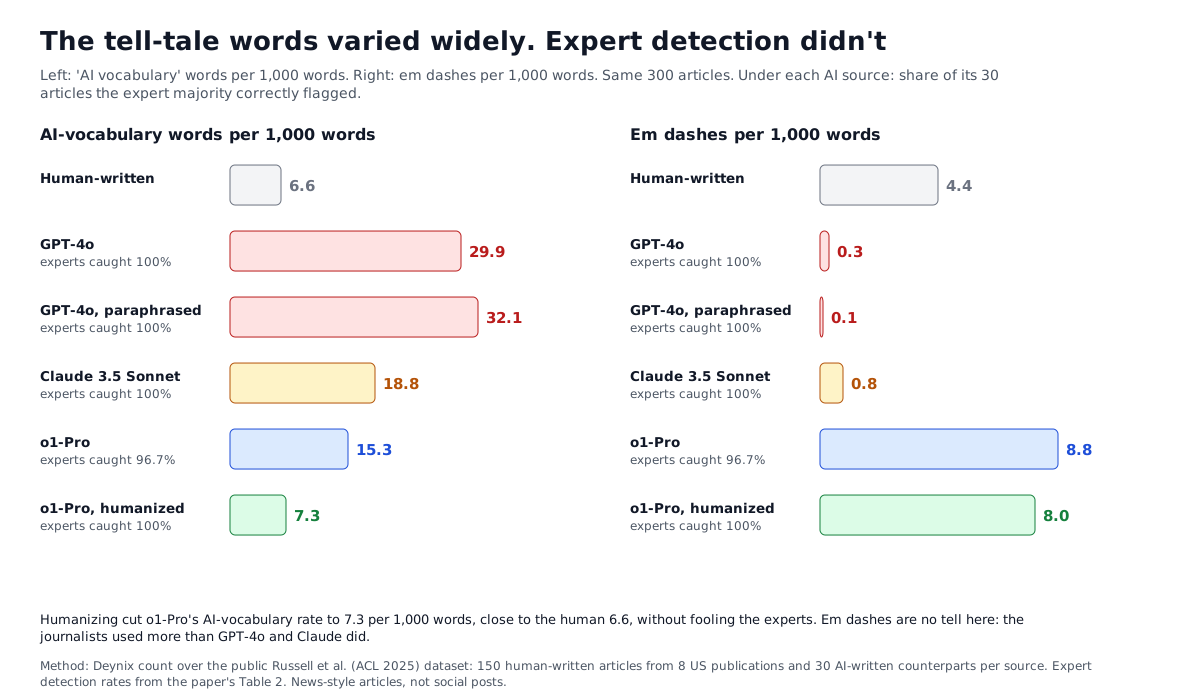
Figure 2. AI-vocabulary words and em dashes per 1,000 words, by source, with the share of each source's 30 AI articles that the expert majority caught. Deynix analysis of the public dataset from [1] ([14]).
GPT-4o used about 30 words from the list per 1,000 words, roughly four and a half times the rate in the human articles (6.6). The humanized o1-Pro articles got down to 7.3, close to the human level. The experts still caught every one.
A real-world dataset shows the same shift. LigoSocial, a vendor, scored 134,522 LinkedIn posts from 1,499 people, all of whom had used an AI writing assistant at some point. Posts using words like "delve", "game-changer" and "ever-evolving landscape" fell from 4.2% in 2023 to 0.5% in 2026. Over the same years, "It's not X, it's Y" contrasts rose from 1.2% to 5.9% of posts, and "Here's why" set-ups from 1.3% to 9.6% [13]. People learned to delete the famous words. They kept the structures, and the structures are on the experts' list too.
The em dash is the other popular tell. In this dataset, it doesn't hold up. The journalists used 4.4 em dashes per 1,000 words. GPT-4o used 0.3 and Claude 0.8, while o1-Pro used 8.8. Depending on the model, em dashes were either rarer than in human writing or more common. LigoSocial also reports that posts with em dashes didn't lose engagement on their own [13].
What this means: a find-and-replace pass on the word list won't make your post read as yours. The experts were reacting to safe, generic, over-explained writing, and you can't fix that with a word swap.
Finding 4: one "AI word" proves nothing, especially in a short post
That cuts the other way too. If you, or someone in your replies, decide a post is AI-written because of one word, you'll often be wrong.
Social posts are short, so I cut every article in the dataset into consecutive snippets of 50, 100 and 200 words. Then I counted how many snippets contained at least one word from the experts' list.
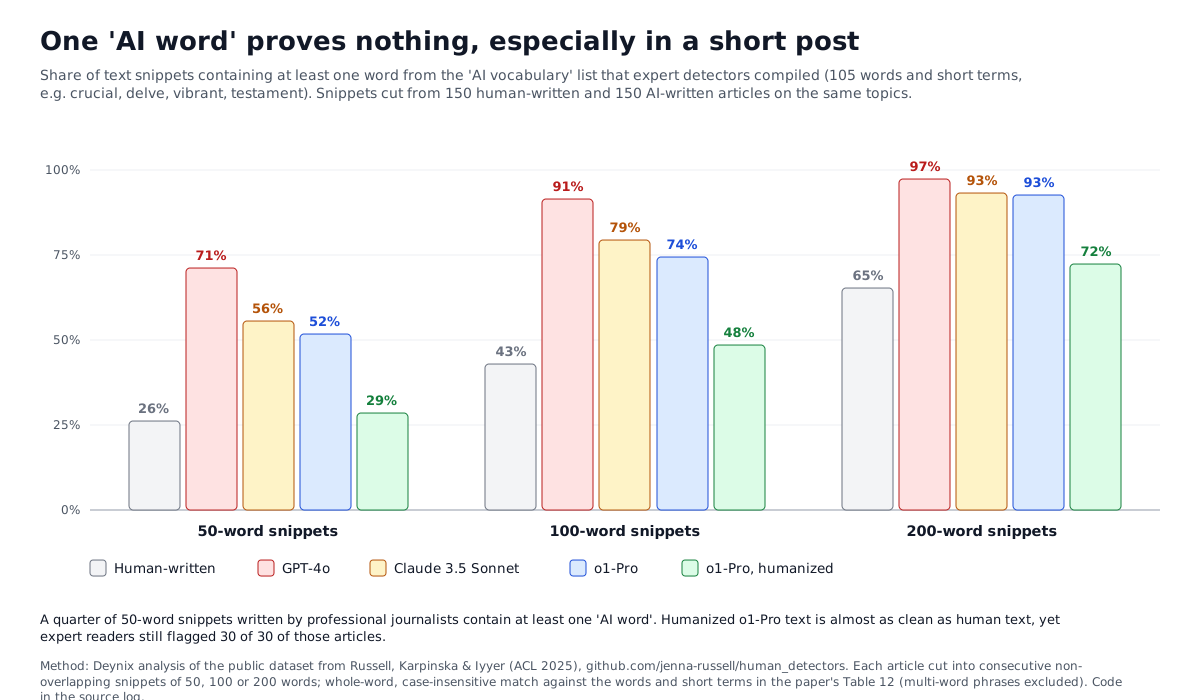
Figure 3. Share of 50-, 100- and 200-word snippets containing at least one AI-vocabulary word. Deynix analysis of the public dataset from [1] ([14]).
Of the 2,140 50-word snippets from human-written articles, 26.1% contained at least one word from the list. At 200 words, it was 65.4%. Many of the words are ordinary ones, such as "key", "support" and "significant", and professional journalists use them all the time. In GPT-4o's text, 71.1% of 50-word snippets had one. So a listed word makes AI a bit more likely, but it's far from proof. In a post-length snippet, the humanized o1-Pro text (28.7%) was hardly different from the human text.
Some words were much more lopsided than others. Across all 150 AI articles, "highlights" appeared 50 times against 3 times in the 150 human articles. "Significance" appeared 34 times against 2, "importance" 34 against 3, and "crucial" 85 against 9. "Enhance" appeared 28 times in the AI articles and never in the human ones. Long-run data shows similar patterns. A study of more than 15 million PubMed abstracts found sudden jumps in words like "delves", "underscores" and "showcasing" after ChatGPT arrived, and estimated that at least 13.5% of 2024 abstracts were processed with LLMs [9].
What this means: cut the lopsided words from your drafts, because they're cheap to fix. But don't treat their absence as proof of a human voice, or their presence as proof of a machine.
Finding 5: chatbots are poor judges, and detectors vary a lot
A common shortcut is to paste a draft into ChatGPT and ask whether it sounds AI-written. The Russell study tested exactly that [1].
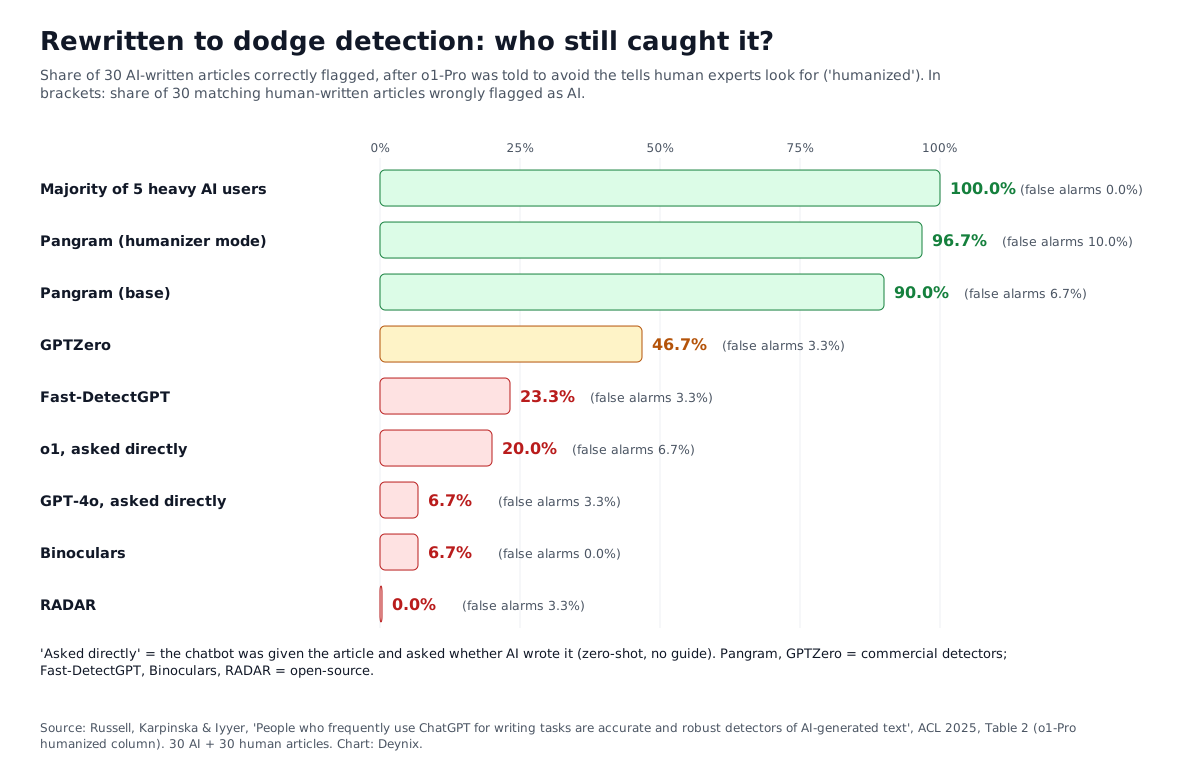
Figure 4. Detection of AI articles rewritten to avoid the experts' tells. Source: Russell, Karpinska and Iyyer, ACL 2025, Table 2 [1].
On the rewritten o1-Pro articles, GPT-4o asked directly caught 6.7% (2 of 30) and o1 caught 20%. Giving the chatbots the experts' own guide didn't help on these articles: GPT-4o with the guide caught 3.3%. The commercial detector Pangram caught 96.7% in its anti-humanizer mode, while GPTZero caught 46.7%. The open-source detectors did worst [1]. Flypost, a vendor, reports something similar from its own LinkedIn work. Before using a dedicated detector, it tried having an AI model rate posts, and the model caught only about one in three of the AI-written posts the detector later found [12].
Short text is where detectors struggle most, and social posts are short. Brian Jabarian and Alex Imas (University of Chicago Booth) tested four detectors on 1,992 human passages and matched AI versions from four models, including passages under 50 words [7]. Pangram made very few errors on these short passages, with a false-positive rate of at most 2.5%, though it missed more AI text in a couple of model-and-genre combinations. The open-source RoBERTa detector wrongly flagged between 29% and 49% of genuine human text that short. One commercial tool, Originality.ai, rejected some very short passages as too short to score [7]. The paper is an NBER working paper, not yet peer-reviewed, and it tests text that is wholly human or wholly AI. That leaves out the most common founder case: an AI draft you've edited.
Weak detectors also misfire on some human writers. In a 2023 study, seven popular detectors flagged an average of 61.22% of essays by non-native English speakers as AI-generated, while scoring essays by US eighth-graders almost perfectly [8]. Those detectors are older now, but the lesson stands. A detector's verdict on one short post is a guess unless you know its error rates on text like yours.
What this means: don't use a chatbot to check your drafts, and don't accuse anyone else on the strength of a free detector. If you need to know, a dedicated detector with published error rates is the better tool. A colleague who writes with AI every day may be just as good.
Finding 6: being suspected can cost you, whether or not you used AI
Does any of this matter if most readers can't tell? The evidence says it can, for two reasons.
First, suspicion alone can cost trust. In the 2019 CHI study by Jakesch, French, Ma, Hancock and Naaman, participants rated Airbnb host profiles for trustworthiness. When they believed every profile was AI-written, they trusted them about as much as human-written ones. But when they believed they were seeing a mix, they trusted the hosts whose profiles were labelled as AI-written, or that they only suspected were, less. The authors called this the "Replicant Effect" [6]. A social feed in 2026 is exactly that kind of mix. The cost lands on posts that seem AI-written, including the ones you wrote yourself.
Second, readers' guesses aren't random. The 2023 PNAS study found that people use the same flawed rules of thumb. They treat first-person pronouns, contractions and talk of family as signs of a human writer [2]. Those rules were consistent enough that the researchers could select AI-written profiles people rated as human 65.7% of the time, against 51.6% for unselected AI profiles. In the Notre Dame study, participants also said they felt less comfortable reading posts they believed came from bots [3].
For engagement on LinkedIn, the only data I found comes from two vendors, and neither is peer-reviewed. Both compare a person's own posts with each other, which rules out simple differences between accounts:
- Flypost ran 2,016 posts from 336 B2B creators through Pangram. The same person's mostly-AI posts got about 24% fewer reactions than their human-written ones, and completely AI-written posts about 32% fewer [12].
- LigoSocial scored 134,522 posts with an AI judge. Posts that read as AI got 21% less engagement than the same author's other posts that year. The judge also flagged 20% of posts written before ChatGPT existed, and LigoSocial publishes that error rate [13].
Both vendors sell AI writing tools, and both say they can't prove AI causes the gap. People may use AI for posts that would have done worse anyway. And neither can tell readers scrolling past from LinkedIn's own classifiers showing these posts to fewer people. Still, two different methods point the same way. That fits the experimental evidence that reading as AI, rather than being AI, is what costs you. We found the same pattern for images in our post on AI visuals.
Methodology
Question. Can social media readers tell when a post was written with AI, which readers can, what clues they use, and does it matter?
Sources. I looked for primary studies that measured human detection accuracy with a known ground truth, then for detector benchmarks with published error rates, then for platform statements and field data on engagement. I read the full text of [1], [2], [3], [4], [5], [7], [8] and [15]. For [6] I read an author copy of the full paper. For [9] I read the arXiv full text and checked it against the published abstract. For [10] to [13], I read the web pages. Every key number was checked against a second source where one exists: the publisher's abstract or metadata through OpenAlex, a second write-up, or a related study. The source log lists each claim and how it was checked.
My analysis. Russell, Karpinska and Iyyer published their dataset under the MIT licence [14]. It contains 150 human-written articles and 150 AI-written counterparts, 30 from each of five set-ups: GPT-4o, GPT-4o paraphrased, Claude 3.5 Sonnet, o1-Pro, and o1-Pro humanized. Each AI article was generated from a human article's title and subtitle, so topics match. I took the 105 single words and two-word terms from the paper's AI-vocabulary list (Table 12) and left out its multi-word phrases. I counted whole-word, case-insensitive matches. For Figure 2, I divided total matches and em dashes by total words in each group. For Figure 3, I cut each article into consecutive, non-overlapping snippets of 50, 100 or 200 words, discarded the leftover words at the end, and recorded whether each snippet contained at least one listed word. Expert detection rates come from the paper's Table 2. The code is in the source log, so you can rerun it.
Limits. The dataset is news-style articles of a few hundred words, not social posts, and the human writers are professional journalists, who write more polished prose than most founders. Snippets are slices of articles, not stand-alone posts. The word list is the experts' list, and it includes common words, which is part of the point. Counting words isn't the same as how a reader judges a post. The human-detection studies use different tasks and models, so Figure 1 compares them loosely, not as one experiment. None of this measures your own followers.
Practical takeaways
- Write for the reader who can tell. Assume some of your audience uses AI every day and will notice. That's especially likely if you sell to founders, marketers or developers.
- Fix the structure, not just the words. Look for "it's not X, it's Y", "Here's why", lists of exactly three, a neat summary at the end, and quotes that all sound the same. Those survived when the vocabulary didn't.
- Still cut the lopsided words. "Crucial", "highlights", "significance", "importance", "enhance" and "testament" are cheap to remove. Just don't stop there.
- Add something a model couldn't know. A number from your business, a thing a customer said, a mistake you made last week. Originality was one of the experts' main clues, and the two LinkedIn vendor studies both found that specific, first-hand posts did better.
- Don't use a chatbot as your detector. It missed most of the rewritten AI articles in the Russell test. If you want a second opinion, ask a colleague who writes with AI all the time, or use a dedicated detector with published error rates.
- Don't accuse other people from a hunch. One "AI word" or an em dash is weak evidence. A quarter of 50-word snippets by professional journalists contained a listed word.
- Decide your own disclosure policy. Whether readers can tell is a separate question from whether you should say you used AI. Our posts on EU AI Act labels and disclosure wording cover that.
Where Deynix fits
This research is why Deynix is approval-first. Deynix drafts posts, replies and quotes, and it writes from your site, your saved thoughts, the brand voice you confirm and, once X is connected, your own recent posts. Every post waits in Review until you approve it, whether you drafted it in the app or your assistant did through Claude or ChatGPT. Nothing goes out until you say so [16].
Review is where the takeaways above get done. Read the draft as if you were one of the experts, cut the structure that gives it away, and add the detail only you have. If a draft doesn't sound like you, edit it or reject it.
References
- Russell, J., Karpinska, M. and Iyyer, M. (2025). "People who frequently use ChatGPT for writing tasks are accurate and robust detectors of AI-generated text." Proceedings of ACL 2025, pp. 5342–5373. https://aclanthology.org/2025.acl-long.267/
- Jakesch, M., Hancock, J. T. and Naaman, M. (2023). "Human heuristics for AI-generated language are flawed." PNAS 120(11), e2208839120. https://doi.org/10.1073/pnas.2208839120
- Radivojevic, K., Chou, M., Badillo-Urquiola, K. and Brenner, P. (2024). "Human Perception of LLM-generated Text Content in Social Media Environments." arXiv:2409.06653 (preprint). https://arxiv.org/abs/2409.06653
- Kalashnikova, N., De Bufala, N., Fayad, S. and Cervoni, L. (2026). "TURING: Evaluating Human Abilities to Identify AI-Generated Texts." Proceedings of LREC 2026. https://aclanthology.org/2026.lrec-1.355.pdf
- Ramos, M. L. F. (2026). "Is it Cake or is it AI? A Systematic Review of Human Uncertainty in Distinguishing Generative Artificial Intelligence Content." arXiv:2604.03437 (preprint). https://arxiv.org/abs/2604.03437
- Jakesch, M., French, M., Ma, X., Hancock, J. T. and Naaman, M. (2019). "AI-Mediated Communication: How the Perception that Profile Text was Written by AI Affects Trustworthiness." CHI 2019. https://doi.org/10.1145/3290605.3300469
- Jabarian, B. and Imas, A. (2025). "Artificial Writing and Automated Detection." NBER Working Paper 34223. https://www.nber.org/papers/w34223
- Liang, W., Yuksekgonul, M., Mao, Y., Wu, E. and Zou, J. (2023). "GPT detectors are biased against non-native English writers." Patterns 4(7), 100779. https://doi.org/10.1016/j.patter.2023.100779
- Kobak, D., González-Márquez, R., Horvát, E.-Á. and Lause, J. (2025). "Delving into LLM-assisted writing in biomedical publications through excess vocabulary." Science Advances. https://doi.org/10.1126/sciadv.adt3813
- LinkedIn (15 September 2026). "How LinkedIn is Continuing to Tackle AI Slop." https://news.linkedin.com/2026/how-linkedin-is-tackling-ai-slop
- Hutchinson, A. (20 August 2026). "LinkedIn says 1M people have reported AI slop." Social Media Today. https://www.socialmediatoday.com/news/linkedin-says-1m-people-have-reported-ai-slop/828465/
- Cassman, S. (last verified 21 October 2026). "Does LinkedIn Penalise AI-Generated Posts? A 2026 Study of 2,016 Posts." Flypost (vendor study). https://www.flypost.io/learn/ai-generated-linkedin-posts-study
- LigoSocial Research (25 September 2026). "What 134k posts show about AI-written LinkedIn posts." LigoSocial (vendor study). https://ligosocial.com/research/ai-linkedin-posts
- Russell, J., Karpinska, M. and Iyyer, M. "Human Detectors" dataset and code (MIT licence). https://github.com/jenna-russell/human_detectors
- Clark, E., August, T., Serrano, S., Haduong, N., Gururangan, S. and Smith, N. A. (2021). "All That's 'Human' Is Not Gold: Evaluating Human Evaluation of Generated Text." Proceedings of ACL 2021. https://aclanthology.org/2021.acl-long.565/
- Deynix, homepage, accessed 27 October 2026. https://www.deynix.com
Browse all updates in News.